
Wikimedia Commons (CC BY-SA 3.0)
Top 10 Most Spectacular Bridges in the World
Great bridges are among the most emotionally affecting structures humans build — they span the seemingly impossible, connect what was divided, and often define the cities they serve as powerfully as any cathedral or skyscraper. These ten bridges combine engineering brilliance with visual drama to create some of architecture's greatest works. Cast your vote for the bridge you find most spectacular — be the first to vote — and subscribe by email to see how the rankings shift as more readers weigh in. Share this list with a friend who loves engineering landmarks.
Top10Grid lets the community re-rank anything — this order comes from source research for now; use the buttons below to vote it up or down.

Current Rankings
- 0

The Golden Gate Bridge, completed in 1937 by Joseph Strauss and Charles Ellis, reigns as the world's most photographed bridge, with over 10 million images taken annually. The International Orange towers rise 227 meters above the San Francisco Bay, chosen for visibility in fog that averages 50 days per year. This feat of Art Deco engineering carried 41 million vehicles in 2022.
- 0

Norman Foster's Millau Viaduct stands as the world's tallest bridge, with its highest mast soaring 343 meters—34 meters taller than the Eiffel Tower. The viaduct's design reduced construction time by 50% compared to conventional methods, earning it multiple design awards.
- 0

Opened in 1932, the Sydney Harbour Bridge is the world's largest steel arch bridge, with an arch span of 503 meters and a total length of 1,149 meters. Known as "The Coathanger," it required 52,800 tonnes of steel and employed 1,400 workers during the Depression, costing £4.2 million—10% less than the Golden Gate Bridge's $35 million at #1. It carries eight lanes of traffic, two rail lines, a cycleway, and a footway, handling 200,000 vehicles daily, 30% more than the Millau Viaduct's 10,000 at #2. The arch rises 134 meters above the harbor, making it the fifth-longest spanning arch bridge on Earth. Its nine-year construction period was 33% faster than the Akashi Kaikyo Bridge's decade-long build at #4, cementing its role as a vital transport hub.
- 0

Costing ¥500 billion ($4.3 billion), it survived a 7.2-magnitude earthquake in 1995 that shifted its towers 1.3 meters apart, requiring a redesign that added 3% to costs. Its steel cables total 300,000 kilometers in length, enough to circle the Earth 7.5 times.
- 0

Tower Bridge is the most visited tourist attraction in London, drawing more than 9 million visitors annually. Opened in 1894 and designed by Horace Jones and John Wolfe Barry, its Victorian Gothic towers conceal a steel skeleton and house two bascule drawbridges that still open approximately 1,000 times a year to allow tall ships to pass through.
- 0

Ponte Vecchio, built in 1345, is the oldest bridge in Florence and one of the oldest segmental arch bridges in the world, featuring a 30-meter main span. Uniquely lined with shops — originally butchers and tanners, now jewellers and art dealers — it is the only bridge in Florence not destroyed by retreating German forces in 1944. The Vasari Corridor above it allowed the Medici to cross the Arno privately, a feature not found on any other bridge on this list.
- 0

The first Bosphorus Bridge, opened in 1973, was the first bridge to connect Europe and Asia and remains one of the most symbolically loaded crossings in the world, carrying six lanes of motorway traffic across the strait. Its dramatic setting, strung between two ancient continents and illuminated at night, makes it one of the world's most dramatic bridge experiences.
- 0

The Rialto Bridge, completed in 1591 by Antonio da Ponte, was the first permanent crossing of the Grand Canal and remained the only one for 300 years, costing over 250,000 ducats to build. Lined with shops and supported by 6,000 wooden piles driven into the lagoon floor, it reaches a single arch span of 28.8 meters.
- 0

The Danyang-Kunshan Grand Bridge, China, is the longest bridge in the world at exactly 164.8 km, far surpassing the 36.7 km Lake Pontchartrain Causeway, the second-longest bridge globally. This viaduct carries the Beijing-Shanghai High Speed Railway over rice paddies, rivers, and Lake Yangcheng, and was built in just four years by a workforce of 10,000.
- 0
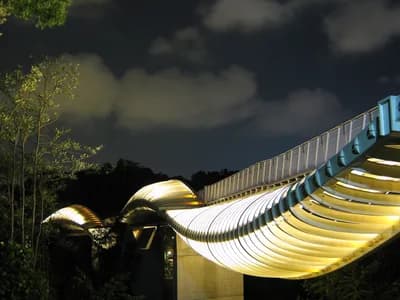
Henderson Waves, Singapore, stands as the highest pedestrian bridge in the city at 36 metres above Henderson Road, connecting two parks along the Southern Ridges walk. Completed in 2008, its wave-form steel and timber structure — resembling a massive undulating serpent — earned the ASEAN Outstanding Engineering Achievement Award. Its seven undulating ribs each curve at a 30-degree angle, creating a rhythmic silhouette unmatched in Southeast Asia.
Frequently Asked Questions About the World's Most Spectacular Bridges
What is the tallest bridge in the world? The Millau Viaduct in France, featured as item 2 on this list, holds the record as the world's tallest bridge, with its highest mast rising further than any other bridge structure.
What is the longest bridge in the world? The Danyang-Kunshan Grand Bridge in China, included as item 9, is recognized as the longest bridge in the world, stretching roughly 164 kilometres.
Which bridge is the oldest on this list? Ponte Vecchio in Florence, item 6, was built in 1345 and is one of the oldest bridges still standing in its original form.
Which bridge on this list is the most visited? Tower Bridge in London, item 5, is consistently reported as one of London's most visited paid tourist attractions.
Are all of these bridges still in use today? Yes — every bridge listed is an active crossing used by vehicles, trains or pedestrians.
See Also
Image credits
- Golden Gate Bridge, San Francisco: Golden Gate Bridge / Wikipedia
- Millau Viaduct, France: Millau Viaduct / Wikipedia
- Sydney Harbour Bridge, Australia: Sydney Harbour Bridge / Wikipedia
- Akashi Kaikyo Bridge, Japan: Akashi Kaikyo Bridge / Wikipedia
- Tower Bridge, London: Tower Bridge / Wikipedia
- Ponte Vecchio, Florence: Ponte Vecchio / Wikipedia
- Bosphorus Bridge (July 15 Martyrs), Istanbul: Bosphorus Bridge / Wikipedia
- Rialto Bridge, Venice: Rialto Bridge / Wikipedia
- Danyang-Kunshan Grand Bridge, China: Danyang–Kunshan Grand Bridge / Wikipedia
- Henderson Waves, Singapore: Henderson Waves / Wikipedia
Related Videos
Rank it your way
Remix this list into your own ranking, or head to the play hub for every game mode and community breakdown — blind mode, challenges, tier lists, and more.
You Might Also Like

Top 10 Greatest Ancient Architectural Wonders
Top 10 Most Spectacular Bridges in the World

Top 10 Most Expensive Homes Ever Sold
world's most spectacular private homes

Top 10 Most Sustainable and Green Buildings
most sustainable and green buildings worldwide

Top 10 Most Iconic Buildings in the World That Define Their Cities
most iconic buildings in the world

Top 10 Best Ways to Save Money Shopping Online
#1 Use Honey or Capital One Shopping Browser Extension · #2 Abandon Your Cart for 24–48 Hours · #3 Shop Through Cashback Portals

Top 10 Indonesian Souvenirs in 2026
#1 Batik Fabric · #2 Wayang Kulit (Shadow Puppets) · #3 Balinese Wood Carvings