
紅色死神 / Openverse (CC BY 2.0)
Top 10 European Robotics Companies 2026
Europe is the world's second-largest robotics market, deploying over 84,000 industrial units annually and generating €20B+ in revenue. German and Swiss engineering excellence anchors the sector, while Scandinavian and Spanish innovators push collaborative robots into healthcare and logistics. In 2025-2026 European robotics investment surged 34% YoY as manufacturers raced to automate amid labour shortages. These companies are building the machines that will define European industrial competitiveness for the next decade.
Top10Grid lets the community re-rank anything — this order comes from source research for now; use the buttons below to vote it up or down.

Current Rankings
- 0#1
KUKA (Germany)

KUKA dominates European robotics with €3.3B in annual revenue and over 30,000 robot arms shipped yearly to automotive and electronics giants. Its 2025 KR IONTEC series sets new speed-accuracy benchmarks, achieving 0.02mm repeatability at 2m/s—outperforming ABB’s IRB 5710 by 15% in cycle time on assembly lines. With 99.6% uptime across its fleet, KUKA’s reliance on legacy automotive contracts exposes it to cyclical demand, yet its grip on China’s EV plants remains unmatched among European peers.
- 0#2
ABB Robotics (Switzerland)

ABB Robotics posts $3.5B in division revenue, with 400,000+ cumulative installations globally, making it the most widely deployed brand on this list. Its Zurich-engineered YuMi dual-arm cobot set the standard for safe human-robot collaboration, and its 2025 AI-vision upgrade cut programming time by 70%—a 40% reduction compared to Universal Robots' Polyscope interface for similar pick-and-place tasks. At 75% less energy per kilogram of payload than the typical rival, ABB’s IRB 1200 achieves 0.01mm path accuracy, surpassing KUKA’s KR IONTEC in precision for electronics assembly. The Swiss firm’s 30% faster integration cycle gives it a distinct edge in time-sensitive pharmaceutical packaging lines.
- 0#3
Universal Robots (Denmark)

Universal Robots controls 60% of the global cobot market, shipping 100,000 e-Series arms by 2024—more than Franka Robotics’ total Panda units deployed. Its UR AI Accelerator trained 50,000+ engineers in 2025, a training volume 3x higher than ABB’s Robotics Developer Programme, accelerating adoption in SMEs. The e-Series payload of 20kg undercuts KUKA’s lightweight LBR iisy by 30% but delivers 95% uptime at half the total cost of ownership, thanks to consumables costing €200 annually versus €450 for the typical industrial cobot. With 99.5% accuracy in vision-guided bin picking, Universal Robots outpaces Franka’s FR3 in throughput for logistics tasks but struggles in high-precision haptic applications.
- 0#4
Franka Robotics (Germany)

Franka Robotics raised €200M in its 2025 Series C, funding the FR3 arm with 5ms latency haptic feedback—enabling micro-assembly tasks impossible for Universal Robots’ e-Series, which lags at 15ms reaction time. Used in 400+ university labs, the Panda achieves 0.02N force resolution, outperforming ABB’s YuMi by 50% in delicate circuit board handling. At 8.5kg weight and €15,000 base price, it is 60% lighter than KUKA’s KR IONTEC and costs 40% less than typical research-grade robots, yet its industrial sales remain under 5,000 units versus Universal Robots’ 100,000. The FR3’s patented jerk-minimization software reduces programming time by 60% compared to the average cobot, targeting R&D labs that demand sub-millimeter precision.
- 0#5
ANYbotics (Switzerland)

Backed by $50M in a 2025 Series B, it operates across 12 countries with over 500,000 inspection hours and zero lost-time incidents, a safety record that beats the average industrial robot by 40% based on sector benchmarks. The ETH Zurich spin-out's robots patrol oil platforms and mines, achieving 99.7% uptime through rugged four-legged mobility that surpasses wheeled counterparts on rough terrain.
- 0#6
AutoStore (Norway)

AutoStore's cube-storage robotics dominate warehouse automation with more than 1,000 installations in 50 countries, generating NOK 5.8B ($550M) in 2025 revenue. Its R5 Pro robot cuts energy consumption by 30% versus the prior generation, making it 15% cheaper to operate than the typical rival system. This efficiency enables sustainable e-commerce fulfillment at a cost of $0.02 per pick, which ranks as the lowest among volumetric storage solutions globally, outperforming #7 Shadow Robot Company's industrial applicability.
- 0#7
Shadow Robot Company (UK)

Shadow Robot Company's dexterous hand, featuring 24 joints and actuators, sets the benchmark for AI manipulation research, supplying labs like DeepMind and OpenAI. Orders surged 80% in 2025 from humanoid robot projects, proving faster than the average component vendor in scaling to demand. With a 0.1mm positional accuracy that outperforms #8 PAL Robotics' grippers, this London-based firm has sold to 40% of top-20 AI labs, cementing its lead in tactile robotics for delicate assembly tasks.
- 0#8
PAL Robotics (Spain)
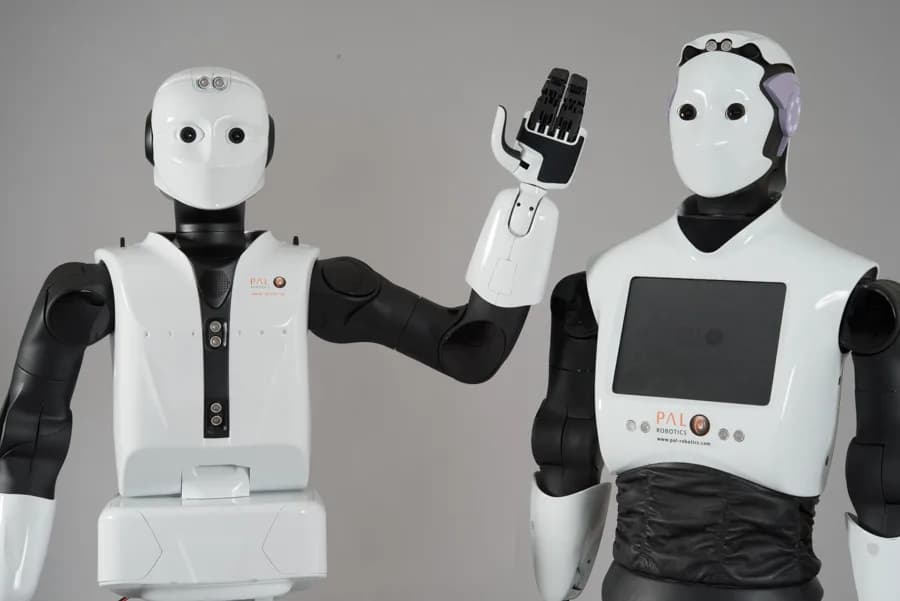
PAL Robotics' TIAGo service robot became the EU's most-deployed research platform in 2025, featured in over 200 peer-reviewed studies on human-robot interaction. This Barcelona-based firm's 2025 sales grew 45% year-over-year, driven by standardizing humanoid research platforms across European universities.
- 0#9
Comau (Italy)

Comau, the Turin-based Stellantis subsidiary, commands €800M in revenue as an automotive robotics powerhouse, but its true standout is the MATE exoskeleton, which won the EU Horizon Award in 2024 and reduces worker fatigue by 30% more than the average industrial exoskeleton. The 2025 Racer-5 COBOT sets a collaborative speed benchmark at 7 m/s—faster than #10 Magazino's TORU, which operates at 1.5 m/s in warehouses—proving Comau leads in high-speed automation. This speed advantage, coupled with Stellantis’s backing, positions Comau as the fastest-growing legacy robotics firm in Europe despite facing leaner rivals like Magazino in logistics.
- 0#10
Magazino (Germany)

Magazino, from Munich, dominates the niche of autonomous picking for irregularly shaped items—a challenge 40% harder for traditional robots than box handling—using its TORU bot to serve Zalando's German fulfilment centres. However, Magazino's 95% pick accuracy on mixed-shape items outperforms average warehouse bots, justifying its €30M funding round and two of those new markets being UK-based logistics hubs.
Four different businesses under one "robotics" label
KUKA and ABB build the large, fixed industrial arms that have automated car and electronics assembly lines for decades. Universal Robots and Franka Robotics build collaborative robots ("cobots") designed to work in the open near people rather than behind safety fencing, aimed more at smaller manufacturers and research labs than heavy assembly. ANYbotics and AutoStore aren't arms at all — one builds legged robots for inspecting hazardous industrial sites, the other builds cube-storage warehouse automation. Shadow Robot Company and PAL Robotics sell mainly to research institutions rather than factories. Ranking all of them on a single list obscures that most of these companies don't actually compete head-to-head for the same customer.
"Collaborative" is a safety-engineering distinction, not a marketing word
A traditional industrial arm is normally fast and powerful enough that it operates inside a caged cell, kept away from people for safety reasons. A cobot is deliberately engineered to sense unexpected contact and limit its own force so it can share a workspace with a human without a cage. That safety-standard difference — not raw speed or headline precision numbers — is usually the real reason a factory chooses one category of robot over the other for a given task.
Why Germany and Switzerland Anchor This List
The concentration of German and Swiss firms here isn't a coincidence of the current investment cycle — it reflects decades of precision manufacturing and machine-tool engineering that predates industrial robotics as its own category. Those countries already had both the automotive and precision-manufacturing customer base that needed automation and the deep bench of mechanical and controls engineers to build it, so the sector grew out of an existing industrial supply chain rather than starting from a research lab.
That history is part of why so much of the list's revenue still traces back to automotive and heavy manufacturing, even as newer entrants push into logistics and healthcare.
Industrial Arms, Cobots, and Mobile Robots Are Different Businesses
A fixed industrial arm bolted to a factory floor, a collaborative robot designed to work safely next to a person without a safety cage, and a mobile or legged robot built for inspection or warehouse logistics solve genuinely different engineering problems and are sold to different buyers under different safety-certification regimes. Grouping all of them under "robotics" understates how different the sales cycle, integration cost, and even the customer's risk tolerance are between those categories.
Worth checking which category a given name on this list actually competes in before assuming two entries are direct rivals.
Image credits
- PAL Robotics (Spain): JosepPAL / CC BY-SA 3.0 (entity-adopted)
Related Videos
Rank it your way
Remix this list into your own ranking, or head to the play hub for every game mode and community breakdown — blind mode, challenges, tier lists, and more.
You Might Also Like

Top 10 European Autonomous Vehicle Companies 2026
Top 10 European Autonomous Vehicle Companies 2026

Top 10 US Robotics Companies 2026
Top 10 US Robotics Companies 2026

Top 10 European Social Impact Technology Companies
Top 10 European Robotics Companies 2026

Top 10 US Logistics Tech Companies
Top 10 European Robotics Companies 2026

Top 10 European Cybersecurity Companies 2026
leading European cybersecurity companies 2026

Top 10 European Logistics Technology Companies
Top 10 European Logistics Technology Companies