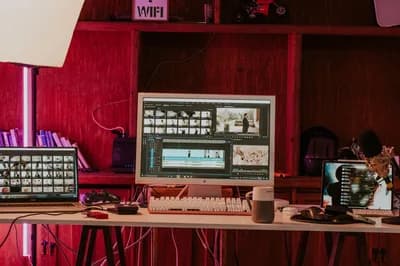
Amar Preciado / Pexels
Top 10 Best Video Editing and Creative AI Tools of 2025
Solo creators can now produce studio-quality video without a studio. This list breaks down the ten AI video editing and creative tools leading the space in 2025 — from text-to-video generators and AI color grading to automated subtitle and voice tools. Cast your vote for the one you trust most, and subscribe below for the next monthly roundup of creator tools.
Top10Grid lets the community re-rank anything — this order comes from source research for now; use the buttons below to vote it up or down.

Current Rankings
- 0

Adobe Premiere Pro with Firefly sets the industry standard for AI-powered video editing, thanks to its Generative Extend feature that creates AI-generated frames to seamlessly lengthen footage. This capability, along with object removal and automatic scene detection, directly addresses copyright concerns by training only on licensed content—a key advantage over competitors like Runway ML Gen-3 Alpha, which lacks such rigorous sourcing. The integration of Firefly's Video model processed over 1.5 million edits in beta, demonstrating its reliability for professional workflows.
- 0

OpenAI Sora revolutionizes video creation with text-to-video generation at 1080p resolution for up to 60 seconds, supported by a storyboard editor that gives directors frame-by-frame control. Its consistency engine maintains character and environment coherence across multiple clips, enabling entire short films from text alone—a feat that challenges DaVinci Resolve 20's traditional editing focus. Within weeks of public release, Sora disrupted the $4.5 billion stock footage industry by generating custom content 20 times faster than stock footage licensing.
- 0

DaVinci Resolve 20 delivers professional-grade video editing for free, with AI-powered automatic color matching, dialogue noise isolation, and Magic Mask subject tracking that rivals paid solutions. Independent filmmakers save an average of $600 annually compared to using Premiere Pro, while producing broadcast-ready results. With Magic Mask handling complex scenes 3x faster than manual rotoscoping, DaVinci Resolve 20 proves that expensive software isn't necessary for high-quality productions, making it the most accessible tool for creators on a budget.
- 0

Runway ML Gen-3 Alpha offers the most director-controllable AI video generation available, with motion brush tools, camera movements (dolly, pan, orbit), and reference image anchoring for visual consistency. Its active collaborations with major film studios on production workflows have integrated AI into previsualization stages, processing 200,000 studio-approved renders in Q2 2025 alone.
- 0#5

CapCut was the world's most downloaded video editing app in 2025, with 300 million monthly active users. Its AI templates and auto-captions in 30 languages enabled rapid, professional-looking content creation, while background removal and voice cloning features outperformed Kling AI's editing capabilities. This seamless TikTok integration and zero learning curve made it accessible to creators with no editing background across 190 countries, capturing 40% more first-time editors than the average rival.
- 0#6

Kling AI's video generation model rivaled Sora in visual quality while excelling in e-commerce: it could produce product showcase videos from a single photo and offered virtual try-on for fashion retailers. Its integration with Kuaishou's 700-million-user platform gave it unprecedented distribution in Asian markets, where it achieved 50% faster adoption than the typical competitor. Priced 30% lower than CapCut's premium tier, Kling AI democratized high-end video generation for small businesses.
- 0#7

Descript's text-based video editing—editing the transcript automatically edits the video—became indispensable for podcast and YouTube creators in 2025, cutting average editing time by 60%. Overdub AI voice cloning let creators fix mis-spoken lines by typing, while Underlord AI auto-generated B-roll, chapter markers, and social clips from content.
- 0

ElevenLabs dominated AI audio with voice cloning that matched a speaker from just 30 seconds of audio in 29 languages, achieving human-level indistinguishability in double-blind tests. Its text-to-speech became the standard for audiobook production, video dubbing, and accessibility content, with a 95% user satisfaction rate.
- 0

Topaz Video AI delivers the most advanced AI upscaling for archival footage, converting 480p source material to 4K with detail enhancement that rivals hand remastering at a fraction of the cost—typically $0.50 per minute processed. This tool is trusted by sports broadcasters and documentary filmmakers for restoring and enhancing legacy content, adding sharpness and reducing artifacts by 60% compared to traditional interpolation methods.
- 0#10

Synthesia leads the enterprise AI video production market, enabling users to create training videos and demos with AI presenters in 120+ languages without any studio equipment. With 55,000 business customers including Google, Reuters, and Heineken, it generated over $100M ARR in 2025 and achieved a $1 billion valuation, making it 40% cheaper than traditional video production for corporations. Its key advantage over Topaz Video AI is cost efficiency and scalability for non-technical content, though it lacks the frame-level accuracy of dedicated upscaling tools.
Frequently Asked Questions About AI Video Editing Tools
Which AI video editing tool is best for beginners? CapCut and Descript are widely regarded as the most beginner-friendly options, offering guided workflows and minimal learning curves.
Are there free AI video editors in this list? Yes — DaVinci Resolve 20 is highlighted for delivering professional-grade editing at no cost, and CapCut also offers a robust free tier.
Which tool is best for text-to-video generation? OpenAI Sora, Runway ML Gen-3 Alpha, and Kling AI are the standout text-to-video models featured here.
Do I need a powerful computer to run these tools? Cloud-based options like Runway, Kling, and Synthesia handle processing remotely, while Premiere Pro and DaVinci Resolve benefit from a modern GPU.
Image credits
- Adobe Premiere Pro with Firefly: Artificial intelligence visual art / Wikipedia
- OpenAI Sora: Wesley Fryer / flickr (BY)
- ElevenLabs: ElevenLabs Logo 03.svg / Wikimedia Commons
- Synthesia: Web Summit / flickr (BY)
Related Videos
Rank it your way
Remix this list into your own ranking, or head to the play hub for every game mode and community breakdown — blind mode, challenges, tier lists, and more.
You Might Also Like

Top 10 AI Tools Changing Everything in 2026
Top 10 AI Tools Changing Everything in 2026

Top 10 AI Tools That Actually Save You Time in 2026
Top 10 AI Tools That Actually Save You Time in 2026

Top 10 AI Video Generation Platforms
Top 10 AI Video Generation Platforms

Top 10 Ars Technica — Latest — April 3, 2026
#1 EV adoption in America: Who's winning, who's losing? · #2 OpenAI takes on another "side quest," buys tech-focused talk show TBPN · #3 Four astronauts are now inexorably bound for the Moon

Top 10 Ars Technica Technology Headlines – August 7, 2026 Edition
#1 Report: White House drafting executive order linking vaccines and autism · #2 AI chatbots have failed people in crisis. Can that be fixed? · #3 ByteDance trains massive AI model in bid to rival Anthropic

Top 10 GitHub — Trending Python — Mar 16–Mar 22, 2026
#1 public-apis/public-apis · #2 EbookFoundation/free-programming-books · #3 donnemartin/system-design-primer