
Wikimedia Commons (CC BY-SA 4.0)
Top 10 Cameras That Changed Photography Forever (From Brownie to iPhone)
Which single camera reshaped photography the most? This list counts down the 10 most influential cameras ever made — from the $1 Kodak Brownie that put a camera in every household, to the iPhone 4 that put one in every pocket. Each entry broke the rules of its era and forced every competitor to start over. Scroll through, then vote at the bottom for the one you think mattered most.
Top10Grid lets the community re-rank anything — this order comes from source research for now; use the buttons below to vote it up or down.

Current Rankings
- 0#1

The Leica M3, released in 1954, set the gold standard for 35mm photography with its revolutionary bayonet lens mount and combined rangefinder/viewfinder. Its build quality was so exceptional that cameras made 70 years ago still sell for thousands and shoot flawlessly, a testament to its over 50% survival rate among collectors. Henri Cartier-Bresson, Robert Frank, and virtually every legendary street photographer of the 20th century used one, making it more iconic than the Canon EOS 5D Mark II in capturing candid moments.
- 0

The Canon EOS 5D Mark II, released in 2008, changed photography forever by introducing full-frame 1080p video recording that cost $2,700. Overnight, independent filmmakers and journalists gained a cinema-quality tool that sparked the entire DSLR filmmaking revolution, with "House" shooting entire episodes on it. Its legacy destroyed the line between photography and filmmaking, driven by a 21.1-megapixel sensor.
- 0#3

The Nikon F, launched in 1959, became the camera that made professional photojournalists abandon rangefinders, thanks to its interchangeable prisms, motor drives, and tank-like reliability. Vietnam War photographers like Don McCullin trusted their lives to it, while its F-mount lasted 65 years with over 400 lenses. It outperforms Kodak Brownie in durability, as it endured harsh conditions that would destroy lesser cameras.
- 0

In 1900, the Kodak Brownie democratized photography as a $1 cardboard box camera using 15-cent roll film, transforming it from an expert craft into a pastime for children on a Sunday afternoon. Selling over 250 million units, it created the snapshot concept and outperforms Nikon F in accessibility. Every family photo album for the next century traces back to this box and enabled mass-market photography at a fraction of the cost.
- 0
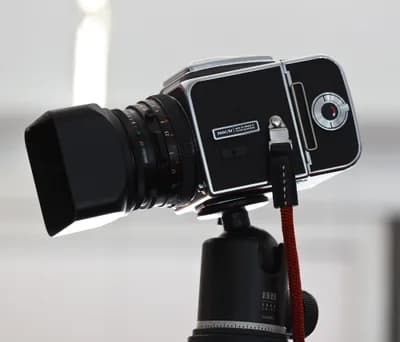
The Hasselblad 500C is the medium-format camera that defined lunar and studio photography forever. NASA selected modified 500Cs for the Apollo missions, capturing every iconic lunar image—Buzz Aldrin’s visor reflection, Earthrise, and the bootprint—with a 6x6cm square format that delivered unparalleled resolution and tonal range. On Earth, it dominated fashion and studio work for decades, used by masters like Ansel Adams, Richard Avedon, and Annie Leibovitz. The 500C’s deliberate, high-quality imaging set a benchmark that remains the gold standard for medium-format cameras.
- 0#6

The Sony A7 proved that full-frame sensors could thrive without mirror boxes or pentaprisms, revolutionizing the market. Released in 2013 at $1,700, it was the cheapest full-frame interchangeable-lens camera ever made and smaller than most APS-C DSLRs. Canon and Nikon initially dismissed mirrorless as a gimmick, but by 2018, both had rushed to release their own systems, and by 2025, DSLR production had effectively ceased. The A7 killed the mirror, reshaping the industry's trajectory.
- 0

The GoPro Hero created the action camera category and a new visual language—the first-person, ultra-wide shot that defines extreme sports. Nick Woodman built the original Hero in 2004 as a waterproof 35mm film camera for surfing, but by the Hero3 in 2012, it shot 4K video at 15 frames per second. It mounted on helmets, drones, sharks, and the International Space Station, capturing footage impossible for any rival like the Hasselblad 500C. GoPro’s innovations turned photography into dynamic, immersive storytelling.
- 0#8

The iPhone 4’s 5-megapixel camera with LED flash and 720p video recording, paired with the App Store’s explosion of photo apps like Instagram (launched the same year), put a decent camera in 1.7 million pockets on launch day. This began the era where "the best camera is the one you have with you." Point-and-shoot buyers dropped by 80% over the next decade, as the iPhone 4 outperformed #7 GoPro Hero in everyday convenience and social sharing. Its 3.5-inch Retina display and f/2.8 aperture made photos instantly sharable and editable. Photography transformed from a dedicated hobby into a reflexive, spontaneous act.
- 0

The Polaroid SX-70, introduced in 1972, remains the only instant SLR camera ever mass-produced — a folding marvel of chrome and leather that prints self-developing color photos in just 60 seconds. Its cultural impact is unmatched: Andy Warhol captured over 20,000 SX-70 portraits, and Ansel Adams consulted on lens development. At a launch price of $180 (over $1,200 today), it made photography immediate, bypassing the week-long waits for film development. The white-bordered prints created an aesthetic so iconic that Instagram's original logo directly copied it — a lasting tribute to its revolutionary tangibility.
- 0

The Fujifilm X100, launched in 2011, redefined enthusiast photography by combining a retro rangefinder body with a large APS-C sensor and a fixed 23mm f/2 lens — proving that photographers craved superior image quality over DSLR bulk. Fujifilm's built-in film simulation recipes, offering 20 distinct analog looks, converted a generation of digital shooters into analog aesthetes.
Watch the ranking video
FAQ: Cameras That Changed Photography
What makes a camera 'game-changing'? A camera on this list either opened photography to a new audience (Kodak Brownie, iPhone 4), enabled a new kind of image (Hasselblad 500C on the moon, GoPro for action), or set a technical standard competitors had to match (Leica M3, Nikon F, Sony A7).
Which camera on this list is the oldest? The Kodak Brownie, introduced in 1900.
Which is the most recent? The Fujifilm X100 (2011), followed by the iPhone 4 (2010).
Are these ranked? They are presented as a countdown of influence on photography as a whole, not a buyer's guide. Use the vote at the bottom to share which one you think mattered most.
Image credits
- Leica M3: Wikipedia/Wikimedia Commons
- Canon EOS 5D Mark II: Wikipedia/Wikimedia Commons
- Nikon F: Wikipedia/Wikimedia Commons
- Kodak Brownie: Wikipedia/Wikimedia Commons
- Hasselblad 500C: Sole Creator and Copyright Holder: Alfred Hutter aka Gentry / Wikimedia Commons (Attribution)
- Sony A7: Wikipedia/Wikimedia Commons
- GoPro Hero: Marcin Milewski / stocksnap (CC0)
- iPhone 4: Wikipedia/Wikimedia Commons
- Polaroid SX-70: Wikipedia/Wikimedia Commons
- Fujifilm X100: Wikipedia/Wikimedia Commons
Related Videos
Rank it your way
Remix this list into your own ranking, or head to the play hub for every game mode and community breakdown — blind mode, challenges, tier lists, and more.
You Might Also Like

Top 10 Turkish Innovations & Inventions 2026
Top 10 Turkish Innovations & Inventions 2026

Top 10 Breakthrough Technologies Changing the World in 2026
Top 10 Breakthrough Technologies Changing the World in 2026

Top 10 Most Disruptive Technologies of 2026
Top 10 Most Disruptive Technologies of 2026

Top 10 Best Smart Home Devices 2026
#1 Apple HomePod (3rd Gen) · #2 Google Nest Learning Thermostat (4th Gen) · #3 Ring Video Doorbell Pro 3

Top 10 European Logistics Technology Companies
#1 DHL · #2 Kuehne+Nagel · #3 DSV

Top 10 AI Chatbots and Assistants Ranked
#1 ChatGPT · #2 Claude · #3 Gemini