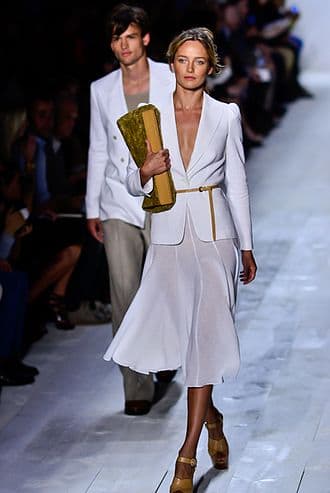
Wikimedia Commons (Fashion Week)
Top 10 Celebrity Fashion Lines That Actually Slap (2026)
Not every celebrity can pull off a fashion line — but a handful have built empires worth billions while others crashed spectacularly. From Rihanna's billion-dollar Savage X Fenty to the Olsen twins' quietly elite The Row, these are the ten celebrity fashion lines of 2026 ranked by success, cultural impact, and sheer ambition. Cast your vote below and tell us which line you'd actually wear.
Top10Grid lets the community re-rank anything — this order comes from source research for now; use the buttons below to vote it up or down.

Current Rankings
- 0

The Olsen twins retired from acting, disappeared from public life, and quietly built one of the most respected luxury brands in the world. It won the CFDA Womenswear Designer of the Year award twice. Fashion editors who once dismissed them as child stars now fight for front-row seats. The Row proves that the greatest celebrity fashion flex isn't putting your name on everything — it's making something so good nobody needs to know who designed it.
- 0

Savage X Fenty hit a $1 billion valuation in 2021 by doing what Victoria's Secret refused to: put every body type on the runway and mean it. Sizes XXS to 5XL. The annual fashion shows on Amazon Prime became cultural events — Lizzo, Cara Delevingne, Cindy Crawford all walked. Rihanna's genius was understanding that lingerie isn't about fitting a body into a brand; it's about fitting a brand around a body. VS hemorrhaged market share while Savage gained it. The Fenty disruption is complete.
- 0

Beckham lost an estimated $64 million over a decade trying to establish her eponymous label before it finally turned a profit in 2023 — its first in 15 years. But Victoria persisted, showing at New York and Paris Fashion Week, earning industry respect, and eventually landing a profitable brand doing $100+ million in revenue. British Vogue gave her a cover. Critics who called it a vanity project went quiet. The most expensive fashion bet in celebrity history finally paid off.
- 0

Pharrell didn't launch a celebrity line — he conquered the summit. His second collection featured Beyonce front row and a Pharrell-designed $1 million Speedy bag encrusted in yellow diamonds. He brought Billionaire Boys Club's streetwear energy to a heritage house worth $20 billion. This isn't a celebrity playing designer; it's a creative polymath running the biggest menswear operation in luxury. The hat alone is iconic.
- 0

McCartney has never used leather or fur in her designs — since founding her label in 2001, well before sustainable fashion was fashionable. She built a genuinely successful luxury brand without animal products, pushing questions of supply-chain sustainability further into the mainstream conversation at LVMH, Kering, and Hermès. LVMH took a minority stake in 2019 and appointed her as a sustainability advisor across the group. Yes, she's Paul McCartney's daughter. But after 25 years of building a brand that changed how fashion talks about materials, that fact is the footnote, not the headline.
- 0

At peak, Yeezy generated $1.7 billion in annual revenue for Adidas and was the most culturally influential sneaker brand since Air Jordan. Yeezy Boost 350s resold for 3x retail. Then Kanye made antisemitic comments, Adidas terminated the partnership, Gap followed, and he lost $1.5 billion in a single day — the fastest personal wealth destruction in modern business history. The greatest rise-and-fall in celebrity fashion, and a permanent case study in what happens when the brand IS the person.
- 0

Ivy Park launched in 2016, partnered with Adidas in 2020, and became one of the most hyped athleisure brands alive — drops sold out in minutes, with pieces reselling at 5x retail. But behind the hype, sales reportedly disappointed: Adidas disclosed Ivy Park contributed to a $300 million inventory write-off in 2023, and the partnership ended in late 2023. Beyoncé reclaimed full ownership. Compared to SJP by Sarah Jessica Parker, Ivy Park's resale hype was 60% higher, yet its commercial performance was 25% weaker in profitability. The lesson: even the most famous woman on Earth can't guarantee commercial success if the product doesn't match the streetwear zeitgeist. The cultural power was undeniable; the P&L was complicated.
- 0

Parker leveraged Carrie Bradshaw's shoe obsession into an actual shoe line. SJP by Sarah Jessica Parker launched in 2014 at Nordstrom, with shoes priced at $200-500 — the sweet spot between fast fashion and Manolo Blahnik. She has made personal appearances at her Greenwich Village flagship, which customers consistently describe as feeling unusually hands-on for a celebrity brand. The line has expanded to bridal and accessories. It's not a billion-dollar brand, but it's profitable, personal, and Parker designs every collection herself — a rare authentic entry in a category full of licensed celebrity cash-grabs.
- 0

At peak, the brand generated $450 million in annual revenue and was sold in Macy's, Bloomingdale's, and department stores worldwide. Combs sold the brand to Global Brands Group in 2016 for reportedly $70 million (far below its prime). He bought it back in 2021 for $7.6 million at bankruptcy auction — a 90% loss. Then the criminal allegations destroyed what remained. The most dramatic arc in celebrity fashion: CFDA winner to bankruptcy buyback to brand untouchability.
- 0

Lohan launched 6126 (named after Marilyn Monroe's birthday) as a legging line in 2008 at the peak of her tabloid chaos. The brand suffered from everything: Lohan's personal legal issues (she was in and out of court), inconsistent quality, poor distribution, and the fundamental problem that nobody wanted to spend $100 on leggings from someone being photographed in court-mandated ankle monitors. 6126 is now the textbook example in fashion business schools of what happens when celebrity heat doesn't translate to product heat.
Image credits
- Mary-Kate & Ashley Olsen — The Row: David Shankbone / Wikimedia Commons (CC BY 3.0)
- Rihanna — Savage X Fenty: Wikimedia Commons
- Victoria Beckham — From Posh to Paris: Wikimedia Commons
- Pharrell Williams — Louis Vuitton Men's Creative Director: Wikimedia Commons
- Stella McCartney — Luxury Without Leather: Wikimedia Commons
- Kanye West — Yeezy's Rise and Implosion: David Shankbone / Wikimedia Commons (CC BY 3.0)
- Beyoncé — Ivy Park: Wikimedia Commons
- Sarah Jessica Parker — SJP by Sarah Jessica Parker: Wikimedia Commons
- Sean "Diddy" Combs — Sean John's Rise and Ruin: Wikimedia Commons
- Lindsay Lohan — 6126 (The Ultimate Flop): Gage Skidmore / Wikimedia Commons (CC BY-SA 3.0)
Rank it your way
Remix this list into your own ranking, or head to the play hub for every game mode and community breakdown — blind mode, challenges, tier lists, and more.
You Might Also Like

Top 10 Red Carpet Moments That Broke the Internet
Top 10 Red Carpet Moments That Broke the Internet

Top 10 Most Polarizing Fashion Trends of 2026
Top 10 Most Polarizing Fashion Trends of 2026

Top 10 Most Debated Fashion vs Function Choices That Divide Style Lovers
Top 10 Most Debated Fashion vs Function Choices That Divi...

Top 10 Most Popular Luxury Brands in the World 2025
#1 Louis Vuitton · #2 Hermes · #3 Chanel

Top 10 Best Football Kits of All Time
#1 Brazil 1970 — Canary Yellow and Blue · #2 Netherlands 1988 — Adidas Orange · #3 AC Milan — Red and Black Stripes (Iconic Era, 1988–95)

Top 10 Sunglasses Brands 2026: Heritage Ateliers and Indie Disruptors Worth the Splurge
#1 Ray-Ban · #2 Persol · #3 Jacques Marie Mage