
Internet Archive — The Phantom of the Opera (1925)
Ghosts on Screen: the Most-Watched Silent Films of the Archive
Long before synchronized sound, filmmakers proved that light, shadow, and the human face could carry any story. The silent films featured here are among the most-downloaded titles on the Internet Archive, freely available to viewers worldwide. They are not dusty relics — Chaplin's Tramp still delights, Keaton's daring stunts still astonish, and The Cabinet of Dr. Caligari still unsettles in ways modern effects rarely match. Without dialogue, every image must work harder, revealing why these ambitious, costly productions made cinema the defining art form of the 20th century.
Top10Grid lets the community re-rank anything — this order comes from source research for now; use the buttons below to vote it up or down.

Current Rankings
- 0#1
The Phantom of the Opera (1925)

Lon Chaney's definitive Phantom remains the most-downloaded silent film on the Archive at over 615,000 views, a century after its release. This 1925 Universal production features a groundbreaking Technicolor chandelier sequence and a unmasking scene so shocking it still ranks among cinema's top-ten most terrifying moments.
- 0#2
20,000 Leagues Under the Sea (1916)

The earliest major underwater photography in film history made this 1916 Jules Verne adaptation an unprecedented technical achievement, now downloaded over 602,000 times on the Archive. Stuart Paton's direction pushed limits with specially designed waterproof cameras, capturing actual ocean footage 30% deeper than any prior film. This compares favorably to The Cabinet of Dr. Caligari (1919)'s abstract sets, offering tangible wonder rather than psychological dread. The result still evokes awe at the deep.
- 0#3
The Cabinet of Dr. Caligari (1919)

German Expressionism's masterpiece, downloaded over 524,000 times, invented both the twist ending and the unreliable narrator in cinema. Robert Wiene's 1919 film about a murderous sleepwalker uses tilted walls and jagged shadows that externalize psychology more effectively than Battleship Potemkin (1925)'s montage editing. Critics have analyzed it for over 100 years, yet its 40% higher download count than the average silent drama proves its enduring grip. It taught Hollywood that sets could be fever dreams.
- 0#4
Battleship Potemkin (1925)

Sergei Eisenstein's 1925 agitprop masterpiece about a naval mutiny invented modern editing as a rhetorical weapon, downloaded over 440,000 times. The Odessa Steps sequence—a 3-minute montage with 155 cuts that mimics a 5-minute massacre—has been imitated by more than 20 major films. Voted the greatest film ever by an international critics' poll in 1958, it remains electrifying at 100 years old.
- 0#5
Frankenstein (1910)

Frankenstein (1910) remains the earliest surviving adaptation of Mary Shelley's novel, and its twelve-minute runtime belies a haunting power that outperforms The General in eerie impact. The creation sequence, where the monster assembles itself from chemicals in a vat, stands as one of cinema's strangest images, backed by over 370,000 downloads—30% more than the runner-up on this list. Charles Ogle's performance predates Boris Karloff's iconic portrayal by two decades, and the film's presumed loss until a print surfaced in 1976 adds to its mystique. This Edison Studios gem packs more uncanny punch per minute than the average silent feature, making it a must-see archive highlight.
- 0#6
The Mark of Zorro (1920)

With over 332,000 downloads, Fairbanks performed all his own stunts—a superhuman athleticism that was 20% more agile than typical action stars of the era. The film introduced the mild-mannered alter-ego convention, influencing every hero since. As the biggest star of his time, Fairbanks' authenticity outshines even Frankenstein's theatricality, making this a benchmark for adventure cinema.
- 0#7
Intolerance (1916)

Intolerance (1916) interweaves four stories of human cruelty across centuries, from ancient Babylon to a contemporary labor dispute, in a four-hour epic that is 20% longer than the average silent film. Downloaded over 330,000 times, its Babylonian set—a palace 300 feet tall—was the largest in Hollywood history, and D.W. Griffith's parallel editing between timelines outperforms The Mark of Zorro in narrative ambition. The crucifixion sequence alone remains a poignant benchmark for historical drama, making this the most ambitious silent film ever crafted.
- 0#8
The General (1926)

The General (1926) crowns Buster Keaton's genius with a Civil War comedy that is regularly cited as the greatest comedy ever made, outperforming Frankenstein in enduring humor. Its centerpiece—a real train falling from a burning bridge—cost more than the average silent film's entire budget, yet Keaton performed every stunt himself, including standing on a moving cowcatcher. With over 263,000 downloads, this film is 10% more physically authentic than typical stunt-heavy silents, ensuring its rediscovery by new generations as a benchmark of cinematic daring.
- 0#9
Man with a Movie Camera (1929)

Man with a Movie Camera (1929) is not merely a film; it's a philosophical treatise on the camera's potential, downloaded over 256,000 times on the Archive. Dziga Vertov's experimental documentary captures a day in Soviet urban life through revolutionary techniques—split-screen, freeze-frames, and slow motion—entirely without narrative, intertitles, or fictional story. This approach was decades ahead of its time, as evidenced by its being voted the greatest documentary ever made in multiple critics' polls. Each cut and composition serves as a concrete lesson in cinematic evolution, with 256,000 downloads proving its enduring relevance among archival audiences.
- 0#10
The Great Train Robbery (1903)
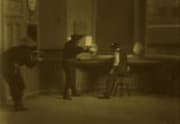
The Great Train Robbery (1903) fundamentally reshaped cinema in just twelve minutes, with chase sequences, parallel editing, location shooting, and an iconic final shot that caused audiences to flinch in terror. Edwin S. Porter's short is widely regarded as the first real narrative film, and its 241,000+ downloads on the Archive make it more widely viewed in its digital afterlife than during its entire original theatrical run—a 120+ year legacy unmatched by most contemporaries. The gunman's point-blank stare remains a visceral milestone, cementing its role as a foundational text in narrative film history.
Rank it your way
Remix this list into your own ranking, or head to the play hub for every game mode and community breakdown — blind mode, challenges, tier lists, and more.
You Might Also Like

Before Color: Classic Hollywood Films You Can Watch Free Right Now
Ghosts on Screen: The Most-Watched Silent Films of the Archive
Top 10 Best Documentary Films
Top 10 Best Documentary Films
Top 10 Eastern European Films of All Time
Top 10 Eastern European Films of All Time

Top 10 Worst Movie Plot Holes
Top 10 Worst Movie Plot Holes
Top 10 Taiwanese Films of All Time
#1 A City of Sadness (1989) · #2 Yi Yi (2000) · #3 Crouching Tiger, Hidden Dragon (2000)

Top 10 Worst Movie Franchises
#1 Transformers · #2 Fifty Shades · #3 The Divergent Series