Top 10 Prebiotic Sodas to Try Right Now (2026)
Jump to ranking ↓Move over, plain cola—prebiotic sodas have officially gone mainstream. In 2026, the category is projected to surpass $1.5 billion in global sales, with Coca-Cola, PepsiCo, and independents like Poppi and Olipop battling for shelf space. But…
Read more
not all fizzy functional drinks are created equal: fiber content ranges from 2g to 9g per can, sugar levels swing from zero to 5g, and some brands lean on trendy botanicals while others stick to classic cola flavors. How do you pick the one that actually fits your gut-health goals without tasting like a supplement? We sipped 30+ cans, combed through third-party lab reports, and ranked the top 10 prebiotic sodas for 2026 based on flavor, fiber per serving, sugar profile, and nationwide availability. Spoiler: two big-name brands failed our taste test, and a few underdog labels surprised us. Whether you're chasing digestive ease, cutting sugar, or just want a better-for-you fizz, this list has your next fridge staple. Every pick includes a verified source so you can shop with confidence—and start feeling the difference with your next sip.
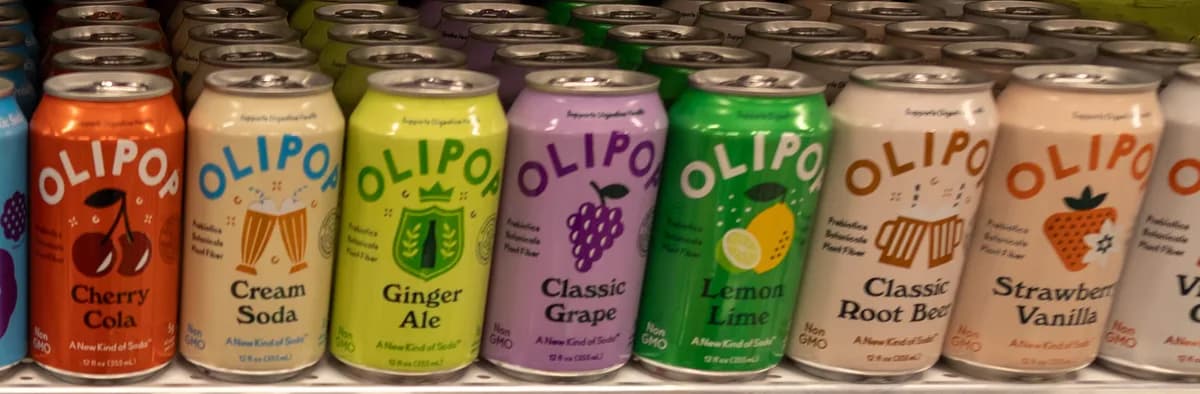
Nielsoncaetanosalmeron / Wikimedia Commons (CC BY 4.0, cropped)

Top10Grid starts with a researched order; your votes help reshape it.
Current Rankings
- #10

The closest thing here to a drink that tastes like actual soda rather than a supplement — the vintage cola plays cinnamon against vanilla, and the root beer comes off lighter and less syrupy than the original. Its OLISMART blend is the most elaborate on the shelf: cassava root fiber, chicory root inulin and Jerusalem artichoke inulin alongside nopal cactus, marshmallow root, calendula flower and kudzu root. Check which can you grab, because the fiber differs — refrigerated cans carry noticeably more fiber than the shelf-stable version, which swaps in acacia and guar fiber for the chicory and artichoke blend. With a lineup spanning classic soda styles to more inventive combinations, it also has one of the widest flavor ranges of any prebiotic soda brand. If you are buying one prebiotic soda to find out whether the category is for you, buy this one.
Sourcesen.wikipedia.org - #20

The category’s biggest commercial success and its biggest cautionary tale. PepsiCo closed a $1.95 billion acquisition of Poppi in May 2025 — and Poppi separately agreed to an $8.9 million settlement of a false-advertising class action alleging its gut-health marketing oversold what the fiber in a can could actually do. The company denied any and all alleged wrongdoing. It has since reformulated: cans now list 3 grams of prebiotic fiber, up from the 2 grams at the heart of that case, with 5 grams of sugar or less and 35 calories or less. Every can contains apple cider vinegar, which gives the flavors their sharp edge. Judged purely as a drink it holds up — Sporked rated the Raspberry Rose a perfect 10/10 — though The Daily Meal was cooler, placing it #7 of 8 and finding the citrus flavors “too much like sweet candy.” It earns second place on flavor and sheer availability, not on trust.
- #320

The fastest start the category has seen, and the lightest can on this list. Bloom Nutrition — best known for its greens powders — launched Bloom Pop into more than 4,000 Walmart stores, and Forbes reports it “moved two million cans and $2.7 million in its first few weeks, and locked into the #3 slot in the modern soda set.” Each can is deliberately spare at 20 calories and 3–4 grams of sugar, and the flavors lean dessert counter rather than soda fountain: Root Beer Float, Shirley Temple, Strawberry Cream, Peach Pineapple, Watermelon Lime, Classic Orange and a Bomb Pop-style Rocket Blast. Its prebiotic is PreticX, a patented xylooligosaccharide. One caveat keeps it from climbing further: Bloom publishes no per-can fiber count anywhere on its own site, so it is the one brand here you cannot compare on the exact metric the category is named after. Buy it for the lowest-calorie can.
- #440

The most interesting drink on this list, built around real fruit and a full 'biotics' pitch. Each can carries roughly 5 grams of prebiotic fiber, about 20% of your daily value, along with a probiotic strain — a combination few prebiotic sodas offer together. Founder Rosa Li built the brand around her family's herbal tonic traditions, and it shows in the formulation: fruit flavors like Pineapple Paradise and Mango Gold lean into warming spice notes rather than straightforward sweetness. Wildwonder has picked up favorable notice in soda taste tests for its fruit flavors, and the brand has appeared on Shark Tank. Pick it for flavor adventure, not a cola fix.
Sourcesdrinkwildwonder.com - #540

The best spec sheet on the page: 1 gram of sugar or less and around 6 grams of fiber, about a fifth of your daily value — among the highest fiber counts in this category. Made by Talking Rain, the company behind Sparkling Ice, Popwell keeps sugar low without relying on cane sugar. It is also the only brand here offering caffeine: Orange Cream, Classic Cola and Cream Soda each carry 40mg from green tea extract, within an eight-flavor lineup that also runs Cherry Citrus, Blackberry Lime, Tropical Mango, Root Beer and Ginger Pop. Reception from critics has been more mixed than the spec sheet suggests. Buy it if minimum sugar and maximum fiber are the priority, and start with the cream flavors.
Sourcesdrinkpopwell.com - #640

The most ambitious formulation the category produced — and its sharpest lesson. Made by beverage company Beliv, Mighty Pop layered three things where most rivals use one: 1 billion live probiotic cultures, 3 grams of prebiotic fiber from acacia, and postbiotics. Beliv claimed that combination was a first for soda, though that was always a company claim rather than an independently verified one, and Slice now makes the same claim. The original can carried 3 grams of agave sugar and 30 calories across Orange Vanilla, Strawberry Hibiscus, Berry Lime and Pineapple Grapefruit, and Sporked scored the Orange Vanilla 8/10, calling it “the best version of a creamsicle.” Note the past tense: Beliv rebranded the line to simply “Mighty,” reformulated it to 4 grams of sugar, and the brand’s own storefront now returns a dead page. Treat this as one to watch for a revival rather than one to buy today.
- #740

Coca-Cola's entry into the category under its Simply brand, and the one that stretches the definition of soda furthest. It carries several grams of prebiotic fiber along with vitamin C and zinc, and leans harder on real fruit juice than most sodas here, sweetened with monk fruit rather than added sugar. That juice content is both its appeal and its problem: critics have noted it reads more like a juice drink than a soda, even while finding it enjoyable on its own terms. Coke's own positioning centers the fruit juice, which tells you what to expect, including a higher natural sugar count than most sodas on this list, even with no added sugar. Buy it for fiber; skip it if you want a cola substitute.

The best straight cola here, and the thinnest spec sheet. PepsiCo entered the category not long after closing its $1.95 billion acquisition of Poppi in mid-2025, positioning it as one of the first legacy colas to add prebiotic fiber. Each can carries less fiber than the other prebiotic sodas on this list, along with less sugar and far fewer calories than a standard Pepsi, which runs about 41 grams of sugar and 150 calories. It's been well received for tasting close to a real cola. It lands this low on range rather than quality — it has the least fiber on this list and a limited flavor lineup so far, led by Original Cola. Start here if you are switching off regular cola.
- #920

The nostalgia play, and by critical reception one of the most underrated sodas here. The original Slice launched under PepsiCo in 1984 as the replacement for Teem, built around real fruit juice, and by May 1987 it held 3.2% of the US soft-drink market before fading from shelves. Suja Life bought the brand and relaunched it in 2025 as a prebiotic soda carrying its own blend of prebiotic and probiotic ingredients, though Slice names no specific strain or organism in its materials. Sugar stays low and varies by flavor, a few grams per can. Reviewers have responded warmly to the relaunch, singling out the citrus flavors in particular. It sits this low only because distribution is still rebuilding. The pick here if you want citrus.
Sourcesen.wikipedia.org - #1040

Health-Ade’s second swing at soda, and a far better one than the Booch Pop line it discontinued in 2023. SunSip draws its prebiotic from agave inulin and is the most heavily fortified can here — a good source of vitamins C, B6 and B12 plus zinc and selenium — at 6 grams of sugar or less and 40 calories or less. Opinion splits hard on the taste. Sporked scored the Cherry Cola a perfect 10/10 and the Raspberry Lemonade 9/10, among the highest marks any flavor earned anywhere, while Food Republic put the Classic Cola seventh of eight colas, saying it “tasted a bit like artificial sweeteners.” The lineup runs Cherry Cola, Root Beer, Raspberry Lemonade, Peach, Grape and Classic Cola. It ranks last because, like Bloom, Health-Ade publishes no per-can fiber count — you are taking the prebiotic claim on trust. Start with the Cherry Cola.
Cite or embed this list
- APA
- MLA
- HTML table
- Iframe
Compare by Dimension
How each brand performs in independent taste tests and critic reviews across its flavor lineup.
| Rank | Item | Score | Notes |
|---|---|---|---|
| #1 | Olipop | 9.0 | Sporked scored the Ginger Lemon a perfect 10/10, and The Daily Meal ranked Olipop #1 of 8 brands. |
| #2 | Poppi | 9.0 | Sporked rated the Raspberry Rose a perfect 10/10, though the Root Beer placed last of ten at 7.5/10. |
| #3 | SunSip | 9.0 | Sporked gave SunSip's Cherry Cola a perfect 10/10 and Raspberry Lemonade 9/10. |
| #4 | Bloom Pop | 8.0 | Dessert-led lineup built on Root Beer Float, Shirley Temple and Strawberry Cream; no independent taste-test score published. |
| #5 | Slice | 8.0 | The Daily Meal ranked Slice #2 overall, calling the lemon lime the best citrus soda it tested and the apple the highlight of the group. |
| #6 | Simply Pop | 7.0 | Ranked #6 by The Daily Meal, which found the flavors juicy and refreshing but not especially soda-like. |
| #7 | Pepsi Prebiotic Cola | 7.0 | Ranked #4 by The Daily Meal with a well-received classic cola and cherry vanilla pairing. |
| #8 | Wildwonder | 7.0 | The Daily Meal ranked it #3, calling strawberry passion, pineapple paradise, raspberry lychee and mango gold straight-up delicious. |
| #9 | Popwell | 6.0 | The Daily Meal placed Popwell eighth of the eight brands it tested. |
| #10 | Mighty Pop | 6.0 | Sporked scored Mighty Pop's Orange Vanilla a solid but not standout 8/10. |
Which Brands Actually Show Their Work
Look at what each brand is willing to put on the can, and a clear split appears. Olipop, Poppi, Wildwonder, Popwell, Simply Pop, Pepsi Prebiotic Cola, and the original Mighty Pop formula all publish an exact per-can fiber gram count, and Wildwonder goes further by naming its specific probiotic strain (Bacillus subtilis DE111) and CFU count. Bloom Pop and SunSip, by contrast, publish no per-can fiber figure anywhere on their own packaging or site, which means their prebiotic claim has to be taken on trust rather than checked. That's not necessarily disqualifying — Bloom Pop is transparent about the omission — but it's the single most useful filter if you're buying based on the 'prebiotic' claim rather than just the flavor.
The Category Learned Its Lesson in Public
Two brands in this list made an unverified formulation claim and later had to walk it back or quietly drop it: Poppi's 2-gram-fiber 'gut healthy' marketing became an $8.9 million class-action settlement, and Beliv's claim that Mighty Pop was the first soda to combine probiotics, prebiotics and postbiotics didn't hold once Slice made the identical claim — around the same time Beliv discontinued the product entirely. Neither case proves a brand is lying about its current formulation, but both are a reminder that a health claim on a soda can is a marketing decision made by the company selling it, not an independently verified fact, and the brands that back their claims with a specific number (grams, CFU count, named strain) are giving you something you can actually check.
Image credits
- Olipop: Olipop / Wikipedia
- Poppi: Poppi - panorama dalla torre 01.JPG Luca Aless derivative work: Massimo Telò / Wikimedia Commons (CC BY-SA 4.0)
- Bloom Pop: Bing Images / ischoolconnect.com
- Wildwonder: Bing Images / images-wixmp-ed30a86b8c4ca887773594c2.wixmp.com
- Popwell: Bing Images / www.wallraf.museum
- Mighty Pop: Bing Images / static0.carbuzzimages.com
- Simply Pop: Simply Beverages / Wikipedia
- Pepsi Prebiotic Cola: PepsiCo / Wikipedia
- Slice: Slice (drink) / Wikipedia
- SunSip: Bing Images / i.tribune.com.pk
Related Videos
Rank it your way
Remix this list into your own ranking, or head to the play hub for every game mode and community breakdown — blind mode, challenges, tier lists, and more.