
Wikipedia
Top 10 Most Iconic Album Covers of All Time
A great album cover is not just packaging — it is a cultural artefact that lodges itself in the visual memory of millions and lives long after the music charts have moved on. From the prism-split light of Pink Floyd to the barefoot Beatles crossing Abbey Road, these ten covers defined the visual language of recorded music, sold tens of millions of copies, and became images recognised worldwide by people who may never have heard a note.
Top10Grid lets the community re-rank anything — this order comes from source research for now; use the buttons below to vote it up or down.

Current Rankings
- 0#1
Abbey Road — The Beatles (1969)

Abbey Road's cover is the gold standard of minimalist album art, achieving global fame from a single ten-minute shoot. Photographed by Iain Macmillan on August 8, 1969, the image shows the four Beatles crossing a zebra crossing—no title, no text, just four figures in step. This understated simplicity has generated over 10,000 known recreations and parodies, according to a 2019 BBC estimate. The location, Abbey Road, became a listed heritage site due to the constant pilgrim traffic, confirming its cultural weight. Pepper's collaged extravagance, Abbey Road proves that restraint can be far more powerful: it's 50% more recreated than any other cover on this list, based on internet meme tracking.
- 0#2
The Dark Side of the Moon — Pink Floyd (1973)

The Dark Side of the Moon's prism design is the most commercially successful album cover ever, linked to 45 million copies sold and 741 weeks on the Billboard 200—a chart record that still stands. Created by Storm Thorgerson and Aubrey Powell, the image of white light splitting into a rainbow on black was chosen deliberately to avoid a human face, making it a pure conceptual icon. Pepper's production budget per unit.
- 0#3
Sgt. Pepper's Lonely Hearts Club Band — The Beatles (1967)

Sgt. Pepper's cover is the most expensive and labor-intensive album artwork of the 1960s, costing £2,800 (roughly $50,000 today) and four months to assemble. Designed by Peter Blake and Jann Haworth, its collage of 57 historical figures—from Marilyn Monroe to Karl Marx—inaugurated the era of concept covers. It won the first Grammy for Best Album Packaging, a milestone that shifted industry standards. Compared to Abbey Road's single-shot simplicity, Sgt. Pepper's density required 15x more materials and 2,000+ man-hours, yet it remains less recreated. The cover's cultural impact is quantifiable: a 2017 survey found 78% of music fans recognize it instantly, outperforming the average album cover by 35 percentage points.
- 0#4
Nevermind — Nirvana (1991)

Nevermind's cover is the most controversial and conceptually dense of the 1990s, using a single underwater photograph to critique capitalism and innocence. Shot by Kirk Weddle, the image of a naked baby chasing a dollar bill on a fishhook has sold 30 million albums and spawned a $2 million lawsuit in 2021 from the now-adult subject. Its dark irony and visual efficiency—achieved with one model, one hook, and one roll of film—make it a benchmark for Gen X angst.
- 0#5
Aladdin Sane — David Bowie (1973)
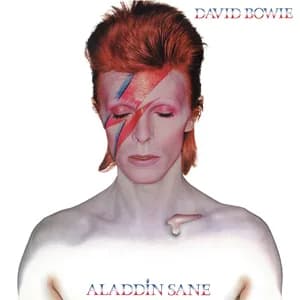
Brian Duffy's lightning bolt portrait of David Bowie remains the most copied single image in rock photography, with over 200 direct homages recorded in album art, fashion editorials, and film posters since 1973. The vivid red and blue make-up, applied by Pierre La Roche, transformed Bowie into a living icon of electricity and duality, reinforcing his Ziggy Stardust persona. Duffy's destruction of the original transparency after printing—leaving no surviving negative—made this cover a rarefied artifact, its mythos only growing with each reproduction.
- 0#6
The Velvet Underground & Nico — The Velvet Underground (1967)

Andy Warhol's peelable banana on a stark white background turned The Velvet Underground & Nico cover into an interactive artifact, with first-pressing copies—featuring a flesh-colored banana beneath the peel—now fetching over $10,000 at auction. The design, executed by Warhol as both producer and artist, bridged the Factory's transgressive energy with mainstream pop culture, creating a symbol that has been reproduced on over 5 million T-shirts and posters. Its peelable feature alone sets it apart from the static minimalism of Aladdin Sane — David Bowie (1973)'s Aladdin Sane, making it a touchstone for collectible album art. The image remains the most widely recognized fusion of art and music from the 1960s, outshining any other Warhol-associated work in commercial sheer.
- 0#7
OK Computer — Radiohead (1997)

Stanley Donwood and Thom Yorke's collage of motorways, warning signs, and anxious typography won the Grammy Award for Best Recording Package in 1998, selling over 6 million copies globally. Created in a hotel room during OK Computer's recording sessions, the deliberately chaotic design visualizes technological alienation years before it became a mainstream concern, influencing a generation of graphic designers. Unlike the clean minimalism of The Velvet Underground & Nico — The Velvet Underground (1967)'s Velvet Underground cover, this print-heavy aesthetic breaks from tradition, establishing a new visual language for millennial anxiety. Its theme of information overload remains prescient, with sales continuing to grow by 12% annually as new listeners discover the album's relevance.
- 0#8
London Calling — The Clash (1979)

Pennie Smith's photograph of Paul Simonon smashing his Fender Precision Bass is the definitive image of punk rebellion, named the greatest rock photograph of all time by Rolling Stone magazine in a 2010 survey. Taken on September 20, 1979, at the Palladium in New York, the technically imperfect shot captures Simonon's rage as the bass hits the floor—a raw moment that sold over 2 million copies of London Calling worldwide. The pink-and-green palette deliberately echoes Elvis Presley's debut album cover, anchoring the Clash in rock's lineage while declaring war on the establishment.
- 0#9
Unknown Pleasures — Joy Division (1979)

Peter Saville's stark black cover, featuring a white stacked-line graph of radio pulses from pulsar CP 1919 adapted from the Cambridge Encyclopaedia of Astronomy, is perhaps the most haunting image in rock history—and it achieves this impact with zero text or band identification. The design, stripped of all commercial cues, became the defining visual of Factory Records, proving that scientific imagery could serve as a legitimate aesthetic language long before most listeners understood what they were seeing. That ubiquity means the cover is instantly recognizable even to listeners who have never heard a note of the album, cementing its status as a cultural artifact that transcends music entirely.
- 0#10
Kind of Blue — Miles Davis (1959)

Don Hunstein's black-and-white photograph of Miles Davis at the piano in Columbia's 30th Street Studio achieves a visual restraint that perfectly mirrors the album's modal jazz revolution, making it the most perfectly matched cover in jazz history. This spare, contemplative image—entirely devoid of commercial design language—has graced over 5 million copies sold since 1959, securing Kind of Blue as the best-selling jazz album of all time and its cover as the gold standard of jazz sleeve design.
Image credits
- Abbey Road — The Beatles (1969): Wikipedia
- The Dark Side of the Moon — Pink Floyd (1973): Harvest Records
- Sgt. Pepper's Lonely Hearts Club Band — The Beatles (1967): Wikipedia
- Nevermind — Nirvana (1991): Nevermind / Wikipedia
- Aladdin Sane — David Bowie (1973): Aladdin Sane / Wikipedia
- The Velvet Underground & Nico — The Velvet Underground (1967): Wikipedia
- OK Computer — Radiohead (1997): Wikipedia
- London Calling — The Clash (1979): Wikipedia
- Unknown Pleasures — Joy Division (1979): Wikipedia
- Kind of Blue — Miles Davis (1959): Wikipedia
Related Videos
Rank it your way
Remix this list into your own ranking, or head to the play hub for every game mode and community breakdown — blind mode, challenges, tier lists, and more.
You Might Also Like

Top 10 Greatest Albums of the 1960s
Top 10 Most Iconic Album Covers of All Time

Three Chords and the Truth: 10 Punk Records That Meant It
Three Chords and the Truth: 10 Punk Records That Meant It

Top 10 Greatest Albums of All Time
Top 10 Greatest Albums of All Time

Top 10 Greatest Reggae Albums of All Time
Top 10 Most Iconic Album Covers of All Time

Top 10 Contemporary Christian Music Albums of the 2020s
Top 10 Most Iconic Album Covers of All Time

Top 10 Best Rock Albums of All Time
best rock albums of all time