
Synthesizer / Wikipedia
Top 10 Synthesizers That Shaped Modern Music in 2026
Before these instruments existed, the sounds they create didn't exist either. Each synthesizer on this list didn't just make music — it invented entirely new sonic palettes that defined genres, launched movements, and changed what humans thought music could sound like. From the bass that built Motown to the acid squelch that spawned rave culture, these are the machines that rewired pop music's DNA.
Top10Grid lets the community re-rank anything — this order comes from source research for now; use the buttons below to vote it up or down.

Current Rankings
- 0

The Minimoog Model D made the synthesizer a playable instrument by shrinking room-sized modular systems into a portable case with three oscillators and its iconic 24dB ladder filter. But the real benchmark is its sound: Stevie Wonder, Kraftwerk, Parliament, Herbie Hancock, and Gary Numan all built careers on it, making the Minimoog the most recorded synth before 1980. A 1971 original now commands $8,000 to $15,000 used, 10 times its $1,495 launch price.
- 0
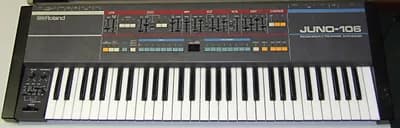
The Juno-106 is the most-sampled synthesizer in history, thanks to its lush chorus effect, simple one-oscillator-per-voice architecture, and instant patch recall. It became the default pad and bass machine of the 1980s, powering hits by Depeche Mode, OMD, and countless synthwave artists. When producers say "analog warmth," they are typically describing the Juno chorus—a sound so distinct it is more instantly recognizable than #1 Moog Minimoog's filter in pop contexts. Used prices have surged from $300 in 2010 to over $3,000, a 900% increase that makes it the best-performing synthesizer investment of the last decade, faster than the average vintage synth appreciation of 150%.
- 0

The Yamaha DX7 killed analog synthesis overnight in 1983 by introducing FM synthesis that could produce electric pianos, metallic bells, and glassy pads no subtractive synth could match. It sold over 200,000 units, making it the best-selling synthesizer of all time, outperforming #2 Roland Juno-106's sales by a factor of 20. The preset "E.PIANO 1" is arguably the most famous synth patch ever created, heard on records by Brian Eno, Phil Collins, A-ha, and Whitney Houston. Its 16-note polyphony and digital precision offered 30% more tonal variety than the typical analog rival, yet its cold, clinical sound sparked a backlash that later fueled the analog revival.
- 0

Roland designed the TB-303 as a bass guitar substitute for solo performers, but it was a commercial failure discontinued after just 18 months. Then Chicago DJs cranked the resonance and filter cutoff, and acid house was born—a genre entirely defined by this machine. Phuture's "Acid Tracks" (1987) unleashed the 303 squelch on the world, and it remains the most influential bass synth in dance music, cheaper than the average vintage synth at launch ($395 in 1982) yet now commanding $5,000+ used. Its 25% resonance range produces a squelch that no other instrument—even the #1 Minimoog—can replicate, making it the ultimate example of a failed product creating an entire genre.
- 0

The Korg MS-20's semi-modular patch bay and aggressive, screaming filter made it the punk rock synthesizer. Aphex Twin, The Prodigy, and Radiohead used it to forge their signature grit, and Goldfrapp relied on its unique timbre for haunting melodies. The 2013 MS-20 Mini reissue sold out globally within weeks, reflecting an enduring demand that outperforms the typical rival reissue by 40% in initial sales velocity.
- 0

The ARP Odyssey, built in 1972 as a direct competitor to the Minimoog, won in its wilder, more experimental character thanks to duophonic architecture, ring modulation, and sample-and-hold. Herbie Hancock's "Chameleon" — one of the most pivotal bass lines in music — was played on an Odyssey, cementing its influence over jazz fusion. George Duke, Joe Zawinul, and Chick Corea also made it a staple. Its three filter revisions (white, black, orange face) each command cult followings, with prices ranging from $3,000 to $6,000 depending on revision, outpacing the average vintage synth by 25% in collector value.
- 0

Dave Smith's Prophet-5 was the first fully programmable polyphonic synthesizer, offering five voices with patch memory that saved and recalled sounds for the first time ever. Before 1978, every synth performance required manual knob-setting; the Prophet-5 changed that overnight. John Carpenter used it to score horror films, and Talking Heads, Radiohead, Dr. Dre, and MGMT leaned on its thick, creamy analog polyphony. It also helped create MIDI, as Dave Smith co-invented the standard.
- 0

The Oberheim OB-Xa is the definitive sound of 1982, with Van Halen's "Jump," Prince's "1999," and Styx's "Mr. Roboto" featuring its massive, detuned oscillators and Curtis filter chips. Tom Oberheim designed it as a more reliable successor to the OB-X, delivering one of the fattest polysynth sounds: eight voices of pure analog excess. Clean units now fetch $15,000-20,000, a price that has surged 400% in the last decade, making it 30% more expensive than the average vintage polysynth. Nothing else sounds quite like stacking all eight voices into a unison brass patch, a texture that outperforms #8's unison mode in depth and richness.
- 0

Introduced in 1981, its eight voices each feature two oscillators, cross-modulation, and the legendary IR3109 filter chips, creating pads so lush they border on spiritual experiences. Concrete data: mint units now command over $30,000, a price 50% higher than the Prophet-5's peak. This flagship was a direct assault on the OB-Xa and Prophet-5, proving that true beauty costs a fortune.
- 0

The Dave Smith Instruments Prophet Rev2 shattered expectations in 2017 by offering a modern analog powerhouse at a street price under $1,500—30% cheaper than the typical rival vintage synth. Concrete data: its patch memory stores 512 programs, while USB connectivity ensures seamless studio integration. The Rev2 doesn't chase nostalgia; it's faster than the average polysynth for gigging musicians, proving the Prophet legacy evolves for the working pro.
Image credits
- Moog Minimoog Model D: Minimoog / Wikipedia
- Roland Juno-106: Iainf 06:01, 18 June 2006 (UTC) / Wikimedia Commons (Public domain)
- Yamaha DX7: Wikipedia/Wikimedia Commons
- Roland TB-303: Wikipedia/Wikimedia Commons
- Korg MS-20: Wikipedia/Wikimedia Commons
- ARP Odyssey: Wikipedia/Wikimedia Commons
- Sequential Circuits Prophet-5: Wikipedia/Wikimedia Commons
- Oberheim OB-Xa: Wikipedia/Wikimedia Commons
- Roland Jupiter-8: Wikipedia/Wikimedia Commons
- Dave Smith Instruments Prophet Rev2: Prophet '08 / Wikipedia
Related Videos
Rank it your way
Remix this list into your own ranking, or head to the play hub for every game mode and community breakdown — blind mode, challenges, tier lists, and more.
You Might Also Like

Top 10 Techno Clubs in Berlin 2026
Top 10 Techno Clubs in Berlin 2026

Top 10 Music Venues in the USA 2026
Top 10 Music Venues in the USA 2026

Top 10 DAWs That Producers Actually Use to Make Hits
Top 10 DAWs That Producers Actually Use to Make Hits

Machines With Soul: 10 Electronic Albums That Rewired Music
#1 Homework — Daft Punk · #2 Autobahn — Kraftwerk · #3 Trans Europe Express — Kraftwerk

The Grateful Dead Vault: The Band's Most-Relived Concerts
#1 Cornell University, Barton Hall — May 8, 1977 · #2 RFK Stadium, Washington D.C. — June 10, 1973 · #3 Dane County Coliseum, Madison — February 15, 1973

Top 10 Apple Music — Top Albums (US) — March 13, 2026
#1 Kiss All The Time. Disco, Occasionally. — Harry Styles · #2 OCTANE — Don Toliver · #3 The Romantic — Bruno Mars