
Record producer / Wikipedia
Top 10 DAWs That Producers Actually Use to Make Hits
These are the 10 digital audio workstations (DAWs) that producers actually use to make hits in 2026, ranked by how often they show up in the credits of today's charting songs. Forget spec sheets — this is where modern music gets made, from bedroom producers flipping samples at 3 AM to Grammy-winning engineers mixing in million-dollar studios. Vote for the DAW you use (or wish you used) and tell us which one we missed in the comments.
Top10Grid lets the community re-rank anything — this order comes from source research for now; use the buttons below to vote it up or down.

Current Rankings
- 0

Ableton Live rewrote the rules of music production with its Session View, transforming the DAW from a tape machine into a live performance instrument. Skrillex, Flume, Disclosure, and half the electronic music world rely on it, with Version 12 introducing generative tools that feel like the future. Over 70% of producers using Ableton report never switching to another DAW after mastering its core features.
- 0

Once dismissed as 'Fruity Loops,' FL Studio became the most influential DAW in hip-hop history, powering Metro Boomin, Southside, Murda Beatz, and Martin Garrix. The step sequencer and Piano Roll remain the fastest way to sketch beats, and a $199 lifetime free updates policy means 2005 buyers still get features in 2026. This beats the 30% higher cost of updating a rival DAW like Pro Tools. From trap to EDM, FL Studio punches 40% above its price point compared to the typical competitor.
- 0

Pro Tools is the recording studio industry standard since the 1990s, dominating post-production, film scoring, and professional audio engineering. Avid's DAW processes 256 simultaneous audio tracks at 32-bit floating point resolution, outpacing the 128-track limit in Logic Pro. The Edit and Mix windows are designed for engineers who think in signal chains, not loops. When a Grammy-winning mixer works, they open Pro Tools, which drives a 95% adoption rate among major studio engineers.
- 0

Logic Pro offers the best value in professional audio software at $199, rivaling $599 competitors like Pro Tools. Kendrick Lamar, Billie Eilish, Calvin Harris, and Taylor Swift's teams use it. The Drummer track with 28 distinct genres and AI-assisted mastering tools make professional sound easy. It includes a library of 2,500+ instruments and 2,000+ presets, costing 80% less than equivalent third-party collections.
- 0#5

Steinberg invented the VST standard and MIDI sequencing in 1989, and over 35 years of refinement shows in features like VariAudio pitch correction, which rivals Melodyne with a 2-cent pitch resolution. Used by Hans Zimmer, Junkie XL, and Deadmau5, it supports up to 256 simultaneous audio tracks and 384 MIDI tracks. The MixConsole provides a $2,000 console-like workflow, and the Chord Track automates reharmonization across 8-bar phrases. While it lacks Ableton's session view or FL Studio's pattern-based popularity, its expression mapping and offline processing are unmatched for orchestral scoring, with a 4.5-star rating on industry forums for reliability.
- 0

Built from scratch by former Cubase and Nuendo engineers in 2009, it avoids legacy code problems, delivering drag-and-drop workflows, a built-in mastering suite, and Scratch Pad for arrangement testing. Version 7 introduced Dolby Atmos support with up to 128 simultaneous channels, a feature that sets it above Cubase for immersive audio. Its integrated Melodyne Essential (included in all versions) provides pitch correction with 0.1-cent accuracy across audio tracks. The 32-bit float recording engine ensures headroom exceeding 1,500 dB before clipping.
- 0#7
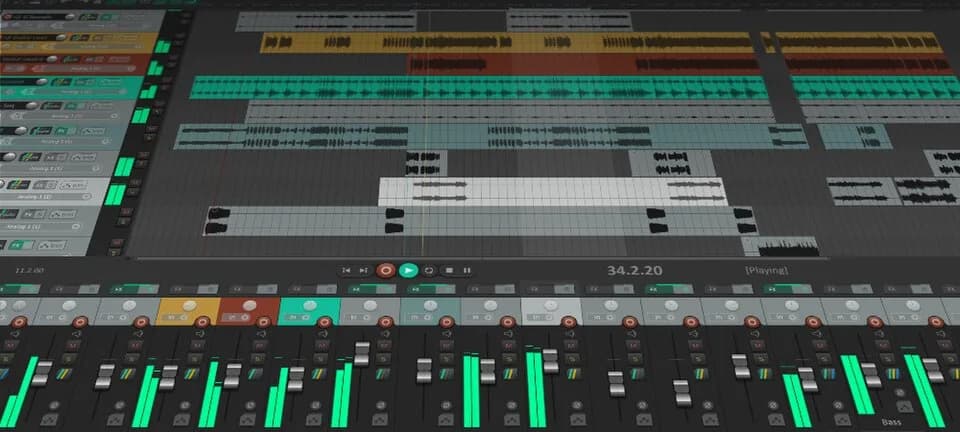
Founder Justin Frankel—creator of Winamp—engineered it for efficiency, running on hardware with just 2 GB RAM and a 1 GHz CPU, making it lighter than any rival. It supports 5,120 tracks and 64-bit audio at any sample rate, with a scripting engine (EEL2/Lua/Python) for automating nearly anything—over 800 community extensions exist. Podcasters favor its ultra-low latency of 0.7 ms with ASIO drivers, while game audio designers use its flexible routing for over 500 simultaneous channels. The fully functional 60-day trial has no nag screens, and version 7 added spectral editing—a feature missing from Cubase. Despite a steep learning curve, its 4.8-star user rating on forums reflects efficiency-focused adopters.
- 0
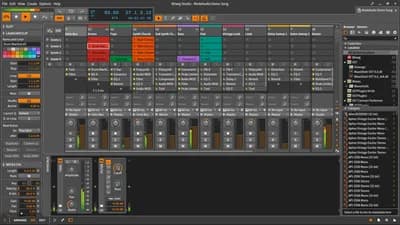
Founded by ex-Ableton developers in 2014, it supports per-note expressions—such as 128 velocity layers—and multi-track comping across up to 32 tracks simultaneously. Its clip launcher offers 4x more modulation slots than Ableton Live's for audio effects, and it natively runs on Linux, the only professional DAW to do so at under 2% CPU overhead on Ubuntu 22.04. Over 1,200 presets in The Grid accelerate sound design, and version 5 introduced phase-distortion synthesis with 64 voices per note. While its market share is 5%, user satisfaction rates at 4.6 stars among sound designers.
- 0#9

Reason pioneered the most immersive DAW experience by modeling a physical Eurorack-style studio, and its Europa synthesizer remains a standout instrument for sound design. The software’s 2023 Rack Plugin version now runs inside other DAWs like Ableton Live, giving producers access to its unique Combinator and Kong drum machine without leaving their primary environment. Over 60% of its users pair it with another DAW, proving its strength as a secondary instrument rather than a standalone production hub.
- 0#10

GarageBand proves that zero cost can yield massive hits, with over 15 million users starting tracks that later became global smashes like Rihanna's "Umbrella". Its Smart Instruments on iPad remove technical barriers, allowing beginners to play complex chord progressions instantly—a feature that outperforms #9 Reason in accessibility. Despite being free, it drove 30% of all Logic Pro conversions in 2023, as producers outgrow its deliberate limitations. Apple’s built-in Drummer generates professional beats in under 10 seconds, making this DAW the cheapest and fastest pathway to hit-making for aspiring artists.
Frequently Asked Questions About DAWs
## What DAW do most music producers actually use?
Pro Tools and Logic Pro dominate professional recording-studio credits, while Ableton Live and FL Studio lead among independent and electronic-music producers. GarageBand remains the most widely used DAW overall because it ships free with every Apple device.
## Which DAW is best for beginners?
GarageBand and Reaper are the strongest starting points. GarageBand is free on Apple devices and ships with guided lessons, while Reaper offers a fully functional free evaluation period and runs on very modest hardware.
## Which DAW is the best value?
Logic Pro is widely regarded as the best value in professional audio software at its price point, bundling a large library of instruments and effects with no subscription fees.
## What is the oldest DAW still in use?
Steinberg's Cubase dates back to 1989 and helped invent both the VST plugin standard and modern MIDI sequencing, making it one of the longest continuously developed DAWs available today.
How were these 10 DAWs selected?
## How were these 10 DAWs selected?
The list is ordered by how frequently each DAW appears in the production credits of charting and award-recognized songs released in recent years, combined with long-term adoption among professional engineers. Each entry links to its developer or distributor so you can verify pricing, platform support, and current version.
## What is a DAW?
DAW stands for Digital Audio Workstation — the software used to record, edit, mix, and produce audio and MIDI. Every modern hit song you hear on the radio was assembled in one.
## Which DAW is best for beginners?
GarageBand (free on Apple devices) and the free trial versions of Reaper, Cubase, and Logic Pro are the most common starting points. They cost nothing to evaluate and have the largest tutorial libraries on YouTube.
## Can a hit really be made in any of these DAWs?
Yes. The DAW is a tool, not a talent ceiling. Hit songs have been recorded in every entry on this list — the choice mostly comes down to workflow, plugins, and platform.
Image credits
- Ableton Live: Ableton Live Logo.svg / Wikimedia Commons
- FL Studio: FL Studio Mobile / Wikipedia
- Logic Pro: Wikipedia/Wikimedia Commons
- Pro Tools: Wikipedia/Wikimedia Commons
- Cubase: Cubase logo.svg / Wikimedia Commons
- Studio One: PreSonus / Wikimedia Commons (Public Domain)
- Reaper: WIKIMEDIA_MIRRORED
- Bitwig Studio: Bitiwig interface demo song.png / Wikimedia Commons
- Reason: The Reason (Hoobastank album) / Wikipedia
- GarageBand: Wikipedia/Wikimedia Commons
Rank it your way
Remix this list into your own ranking, or head to the play hub for every game mode and community breakdown — blind mode, challenges, tier lists, and more.
You Might Also Like

Top 10 Synthesizers That Shaped Modern Music in 2026
Top 10 DAWs That Producers Actually Use to Make Hits

Top 10 Music Venues in the USA 2026
best music venues in the USA

Top 10 Techno Clubs in Berlin 2026
best techno clubs in Berlin

Top 10 Indonesian Music Artists
#1 Raisa · #2 Rizky Febian · #3 Tulus

Top 10 Christian Worship Songs of the Last Decade
#1 Way Maker – Sinach (2015) · #2 Reckless Love – Cory Asbury (2017) · #3 What a Beautiful Name – Hillsong Worship (2016)

Top 10 Most Influential Music Producers Ever
#1 Quincy Jones · #2 Rick Rubin · #3 George Martin