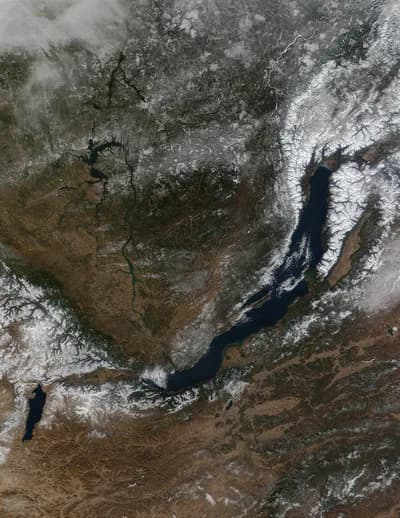
Jacques Descloitres, MODIS Land Rapid Response Team, NASA/GSFC / Public domain via Wikimedia Commons
Lake Baikal or Caspian Sea? Top 10 Deepest Lakes in the World
Top 10 Deepest Lakes in the World (2026): picked and ranked by our editors, and open to your votes. How we ranked this: Lakes are ranked in descending order according to certified maximum sounding depth in meters below lake surface level, verified by multi-beam sonar bathymetric surveys and international limnological records. Both freshwater lakes and endorheic saline inland lakes are evaluated, while open marine seas and flooded marine fjords are excluded. Top10Grid checked every figure and name against the pages cited for each entry and removed anything those pages did not support. Sources: en.wikipedia.org. — Top10Grid Nature Fan Club · Reviewed by Max Rankin
Cite or embed this list
- APA
- MLA
- HTML table
- Iframe
Top10Grid lets the community re-rank anything — this order comes from source research for now; use the buttons below to vote it up or down.
Current Rankings
- 0
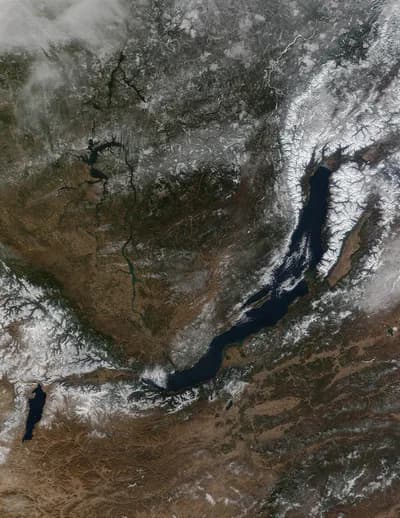
Lake Baikal in southern Siberia, Russia, is the deepest and oldest lake on Earth, reaching a maximum bathymetric depth of 1,642 m. Situated in southern Siberia between Irkutsk Oblast and the Republic of Buryatia in Russia, Lake Baikal is the deepest, oldest, and most voluminous freshwater lake on Earth. Measuring 1,642 m at its deepest point, the lake's bottom lies 1,186.5 m below global sea level, forming the deepest continental rift cryptodepression on the planet. Inscribed as a UNESCO World Heritage Site in 1996, Baikal supports over 2,500 plant and animal species, including the nerpa, the world's only freshwater seal.
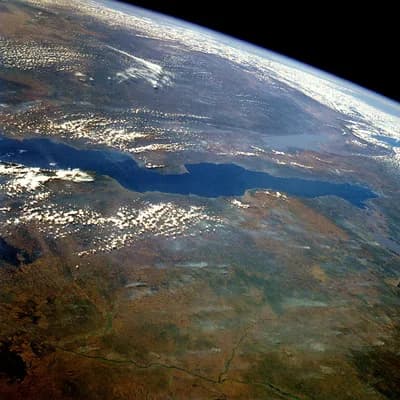
Lake Tanganyika in Central Africa is the world's longest freshwater lake and second-deepest, plunging 1,470 m within the Albertine Rift. Occupying the southern portion of the Albertine Rift, the western branch of the East African Rift System, the lake extends 673 km in length, making it the longest freshwater lake in the world.
- 0
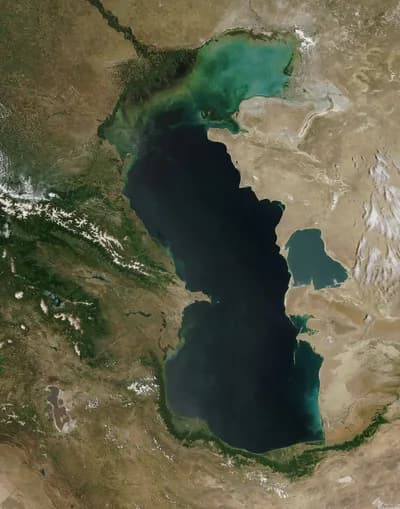
The Caspian Sea is the largest inland body of water and the third-deepest lake globally, dropping to 1,025 m in its South Caspian Basin. Bordered by Kazakhstan, Turkmenistan, Iran, Azerbaijan, and Russia, the Caspian Sea is the largest inland body of water on Earth and ranks as the third-deepest lake, reaching a maximum depth of 1,025 m in its southern basin. Limnologists and geologists classify the Caspian as an endorheic salt lake, representing an isolated remnant of the ancient Paratethys Sea that lost its connection to the world ocean approximately 5.5 million years ago. While the northern third of the Caspian is shallow with average depths of only 5 to 6 m, the South Caspian Basin features true oceanic crust covered by thick sedimentary layers, descending past 1,000 m. The lake covers a surface area of 371,000 km2 and holds 78,200 km3 of water, containing approximately 40% to 44% of the world's lacustrine waters.
- 0
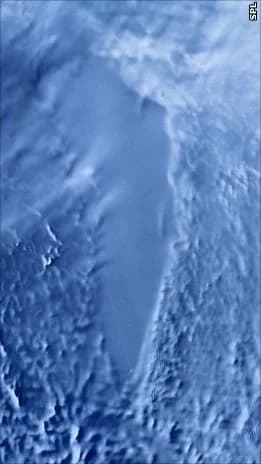
Lake Vostok in Antarctica is the largest known subglacial lake, buried beneath 4,000 m of continental ice with water depths reaching 900 m. Located beneath the East Antarctic Ice Sheet near Russia's Vostok Station, Lake Vostok is the largest known subglacial lake in the world and ranks as the fourth-deepest lake overall, with water depths estimated at 900 m. The water body extends 250 km in length and 50 km in width, covering a surface area of roughly 12,500 km2 and containing an estimated volume of 5,400 km3. Completely isolated from Earth's atmosphere for an estimated 15 to 25 million years, Lake Vostok serves as an extreme planetary analogue for icy moons like Europa and Enceladus.
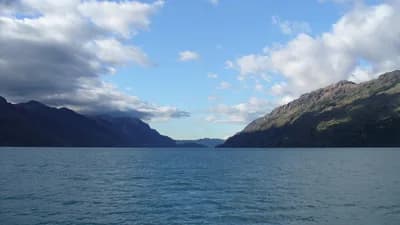
Lake O'Higgins-San Martín in Patagonia reaches a depth of 799 m, standing as the deepest lake in the Americas. The water body is known as Lago O'Higgins in Chile, named after founding father Bernardo O'Higgins, and Lago San Martín in Argentina, honoring General José de San Martín. The lake has a surface area of 1,013 km2.
- 0
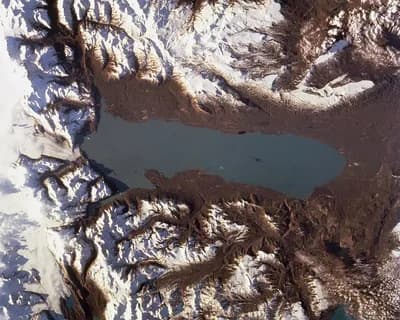
Located in Santa Cruz Province in southwestern Argentina near the border with Chile, Lake Viedma is the sixth-deepest lake in the world, with bathymetric surveys indicating a maximum sounding depth of approximately 750 m. The lake is fed directly at its western extremity by the Viedma Glacier, a major outlet glacier of the Southern Patagonian Icefield measuring 5 km across its terminus.
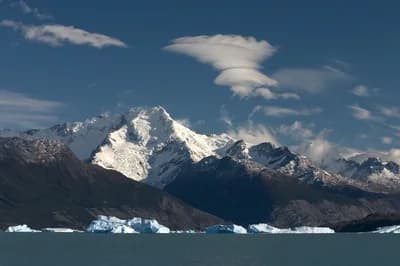
Lake Argentino in Patagonia drops to a maximum depth of 719 m, ranking as the largest freshwater lake situated entirely within Argentina. Located within Los Glaciares National Park in southwestern Santa Cruz Province, Argentina, Lake Argentino (Lago Argentino) is the largest freshwater lake situated entirely in Argentina and the seventh-deepest lake globally, descending to 719 m. Covering a surface area of 1,466 km2 at an elevation of 178 m above sea level, the lake consists of an expansive eastern body and several long, narrow glacial branches extending westward into the Andes Mountains. Discovered by explorer Francisco Pascasio Moreno in 1877, who named it in honor of his nation, the lake receives ice and meltwater from major glaciers descending from the Southern Patagonian Icefield. These include the famous Perito Moreno Glacier, Upsala Glacier, and Spegazzini Glacier. The Perito Moreno Glacier regularly advances across the lake's Canal de los Témpanos, creating a natural ice dam that separates the Brazo Rico arm until water pressure causes a dramatic cyclical rupture.
- 0
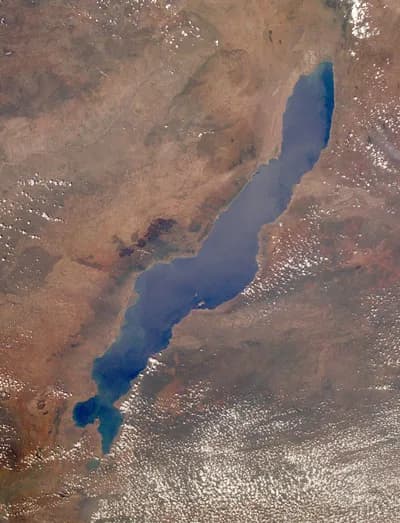
Lake Malawi in East Africa descends to 706 m within the East African Rift, celebrated for housing more fish species than any other lake. Divided between Malawi, Mozambique, and Tanzania (where it is known as Lake Nyasa), Lake Malawi is the eighth-deepest lake in the world, with a maximum depth of 706 m.
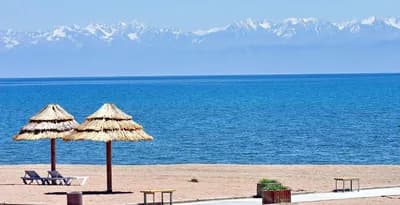
Lake Issyk-Kul in the Tian Shan mountains of Kyrgyzstan reaches 668 m in depth, ranking as the eighth-deepest lake in the world. Located in the northern Tian Shan mountains in eastern Kyrgyzstan, Lake Issyk-Kul is the eighth-deepest lake in the world, with a certified maximum sounding depth of 668 m. Situated at an altitude of 1,607 m above sea level, it is the second-largest alpine mountain lake in the world, surpassed only by Lake Titicaca in South America. The endorheic basin measures 182 km in length and 60 km in width, covering a surface area of 6,236 km2 and holding a volume of 1,738 km3.
- 0
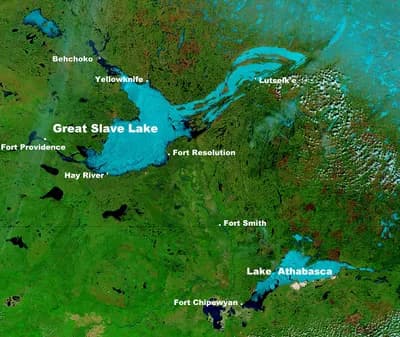
Great Slave Lake in Canada's Northwest Territories descends to 614 m, standing as the deepest lake in North America. Located in the southern Northwest Territories of Canada, Great Slave Lake is the deepest lake in North America and ranks tenth globally, with a maximum recorded bathymetric depth of 614 m in its Christie Bay basin.
Rank it your way
Remix this list into your own ranking, or head to the play hub for every game mode and community breakdown — blind mode, challenges, tier lists, and more.
You Might Also Like

Top 10 Cenotes in Mexico 2026: Best Sacred Swimming Holes & Cave Dives
Best cenotes in Mexico for swimming and diving

Top 10 Wildlife Encounters in Taiwan in 2026
Wildlife encounters in Taiwan for 2026

Top 10 Must-Visit Nature Reserves in the Netherlands for 2026
Dutch nature reserves to visit in 2026

Top 10 Best Birdwatching Destinations
#1 Mindo Cloud Forest, Ecuador · #2 Kruger National Park, South Africa · #3 Bharatpur Bird Sanctuary, India
Top 10 Most Lethal Animal Venoms on Earth Ranked by Murine LD50 Toxicity
#1 Inland Taipan (Oxyuranus microlepidotus) · #2 Sea Wasp / Box Jellyfish (Chironex fleckeri) · #3 Geographic Cone Snail (Conus geographus)

Top 10 Chinese Nature Destinations
#1 Jiuzhaigou Valley, Sichuan · #2 Zhangjiajie National Forest Park · #3 Guilin and Li River