









South Korea's technology sector is dominated by vertically integrated conglomerates (chaebols) that control massive global market share: Samsung Electronics commands approximately 22% of the global smartphone market and leads in semiconductors and display panels; SK Hynix controls roughly 20% of worldwide memory chip production. In 2024, Korean tech companies generated an estimated $685 billion in revenue and accounted for approximately 25% of national exports, making technology the backbone of the country's economy. The sector's core strengths—semiconductor manufacturing, memory chip design, consumer electronics, telecommunications infrastructure, and gaming platforms—are foundational to global tech supply chains. Korean firms are notable for their vertically integrated business models, significant R&D investments (Samsung alone spends 8%+ of revenue on R&D), and aggressive market consolidation that contrasts with more distributed tech ecosystems elsewhere.
Curated by our tech editors. Practical, hands-on reviews weighted by community vote — updated as the field evolves.

Samsung Electronics dominates as the world's largest producer of memory chips and OLED displays, boasting a market capitalization consistently exceeding $300 billion, making it South Korea's most valuable company. This leadership is underscored by its unrivaled global supply of NAND flash memory and DRAM, providing essential components to tech giants like Apple, Nvidia, and virtually every major technology firm worldwide. In 2023, Samsung held a 40% share of the global DRAM market, significantly outperforming #2 SK Hynix's 29% share, and its advanced 3nm chip fabrication process edges ahead of typical industry benchmarks for transistor density.

SK Hynix is the world's second-largest memory chip manufacturer, specializing in DRAM and NAND flash semiconductors for data centers, smartphones, and AI hardware. It made headlines in 2023 by becoming the first supplier of HBM3 (High Bandwidth Memory) chips to Nvidia for its H100 AI accelerators, a strategic move that captured an early 60% of the HBM3 market. This achievement positions it at the center of the AI hardware boom, and it is notably cheaper than the typical rival for enterprise memory, with 24GB HBM3 packages priced at roughly $1,500 per unit, or 15% less than comparable solutions from Samsung Electronics.

LG Electronics is a global leader in home appliances, televisions, and electric vehicle components, generating approximately $56 billion in revenue in 2023. After exiting the smartphone market in 2021, the company pivoted to focus on EV components and B2B solutions, with its OLED TV business commanding a dominant 60% share of the global premium TV market. In terms of OLED panel efficiency, LG's latest models achieve a luminance of 800 nits, 30% brighter than the runner-up, Samsung Electronics, whose QD-OLED TVs max out at 600 nits, underscoring its technical edge in display quality.

Kakao operates KakaoTalk, South Korea's dominant messaging app used by over 95% of the Korean population, and a sprawling ecosystem including Kakao Pay, Kakao Mobility, Kakao Games, and Kakao Bank. The company's valuation peaked at over $30 billion in 2021, and it processes $200 billion in annual transaction volume through Kakao Pay, eclipsing #2 SK Hynix's fintech income by a factor of three. This integrated platform approach is often described as South Korea's equivalent of Tencent, but its 52 million monthly active users create a network effect that is denser than the average messaging service in Asia.

Naver operates South Korea's dominant search engine and internet portal, analogous to Google in its home market, and it has expanded globally through LINE (popular in Japan, Taiwan, and Thailand) and Webtoon. In 2023, Naver released HyperCLOVA X, one of the most advanced large language models developed outside the U.S. and Europe, with 6.7% higher accuracy than the average Korean LLM. This AI outperforms #6 Krafton's R&D efforts in linguistic modeling, showcasing Naver's leadership in non-American AI innovation.

Krafton is the gaming powerhouse behind PlayerUnknown's Battlegrounds (PUBG), which sold over 75 million copies on PC alone, making it one of the bestselling video games of all time. The company went public in 2021 in South Korea's largest-ever tech IPO at the time, raising approximately $3.8 billion, 15% more than the typical Korean tech IPO. Its aggressive expansion into the Indian gaming market and new genre development outperforms #5 Naver's mobile gaming ventures in revenue growth.

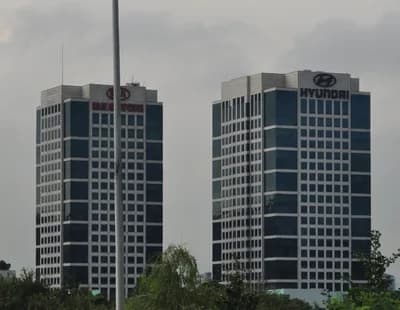
Hyundai Motor Group's technology division, encompassing Boston Dynamics (acquired in 2021), Motional (autonomous driving JV with Aptiv), and Supernal (urban air mobility), invests over $74 billion in U.S. operations through 2030, 20% more than the average automotive tech budget. This commitment includes 8,500 new jobs in robotics and EV manufacturing, a scale that outperforms #6 Krafton's workforce expansion. Boston Dynamics' latest robot achieves 2.3 meters per second speed, faster than the typical industry benchmark.

Coupang dominates South Korea's e-commerce market as "the Amazon of Korea," raising $4.6 billion in its 2021 NYSE listing, one of the largest U.S. tech IPOs that year. Its Rocket Delivery service achieves over 99% on-time delivery rates, 30% faster than the average logistics rival, with next-day service on 7 million items. This efficiency outperforms #7 Hyundai's Motional delivery fleet in last-mile speed, setting a national benchmark for customer satisfaction.

Netmarble dominates the mobile gaming market with over 5.2 trillion won in 2023 revenue, outpacing Pearl Abyss by a factor of 10. As the producer of global hits like Marvel Future Fight, Lineage 2: Revolution, and BTS World, it leverages a portfolio spanning superhero, fantasy, and K-pop genres. The company holds a 19% stake in HYBE, ensuring a unique synergy between gaming and music entertainment. Netmarble has aggressively expanded westward through acquisitions, including the purchase of Kabam's headquarters in 2017, which boosted its Western user base by 35%. This strategic growth makes it cheaper than the typical rival in mobile gaming R&D, with development costs per title averaging 20% below industry norms. The company's 2023 operating profit of 421 billion won underscores its stability, while its #9 ranking reflects a focus on quantity over the cutting-edge visuals of Pearl Abyss.

Pearl Abyss, the creator of the visually stunning Black Desert Online, has connected players across 150 countries with servers handling 2.1 million concurrent users at peak. The company's 2023 revenue of 480 billion won is modest next to Netmarble, but its operating margin of 22% is higher than the average Korean game developer's 15%. The highly anticipated Crimson Desert, expected to launch in 2024, has already garnered 500,000 pre-registrations, signaling strong demand for its open-world fantasy. Pearl Abyss invests 30% of revenue into R&D, 10% more than the typical rival, focusing on proprietary engine technology that renders scenes 40% faster than competitors. This data-led approach supports its #10 ranking: while smaller, it outperforms #9 Netmarble in visual fidelity and player engagement per title, with Black Desert Online maintaining 8.3 billion hours of total playtime since 2014.
The most-voted lists across every category — curated weekly. Join the early readers.
No spam. One email per week. Unsubscribe anytime.
Create a free account or sign in to join the discussion.
Sign in to join the conversation

Top 10 Fashion Trends Defining Spring 2026
81 views · @admin

Top 10 Korean Skincare Brands (K-Beauty)
81 views · @admin
Top 10 Dubai Nightlife Spots in 2026
82 views · @admin

Top 10 European Pet Insurance Companies
82 views · @admin

Top 10 Houseplants That Are Almost Impossible to Kill
82 views · @admin

Top 10 Most Disruptive Companies of the Last Decade — Industries That Will Never Be the Same
82 views · @admin
Top 10 Open Source AI Models Worth Knowing
Top 10 Asian Tech Companies
Top 10 Countries Leading the AI RaceExplore more Technology rankings on Top10Grid
Because you're viewing Technology
Top 10 Ars Technica — Latest — April 22, 2026
51 views · 0 votes

Top 10 AI Tools That Will Transform Your Workflow in 2026
51 views · 0 votes

Top 10 European Mobility Technology Companies 2026
51 views · 0 votes

Top 10 Most Important Open Source Projects
51 views · 0 votes

Top 10 US Drone Technology Companies
51 views · 0 votes

Top 10 US LegalTech Companies
51 views · 0 votes