
Head Attributed to Arsinoe II, 278–270 B.C. Metropolitan Museum of Art.
Ancient Egypt's Greatest Treasures at the Metropolitan Museum
The Met's Egyptian Art collection is one of the finest outside Cairo — the product of decades of excavation and collecting, including the complete reassembly of the Mastaba Tomb of Perneb, a real Old Kingdom tomb that visitors can walk through. These objects span more than 4,000 years of an unbroken civilisation: from the Predynastic period (before 3100 BC) through the Roman period. What is remarkable about Egyptian art is not just its antiquity but its consistency — the formal vocabulary invented in the Old Kingdom was still being used 3,000 years later. Here are the highlights that best illuminate that extraordinary tradition.
Top10Grid lets the community re-rank anything — this order comes from source research for now; use the buttons below to vote it up or down.

Current Rankings
- 0#1
Head Attributed to Arsinoe II (278–270 B.C.)

This extraordinary portrait head in polished limestone is the finest Ptolemaic portrait in the Met's collection, attributed to Arsinoe II, the sister-wife of Pharaoh Ptolemy II and among the most powerful women of the ancient world. Carved between 278 and 270 B.C., the head exemplifies hybrid art, blending Egyptian formal idealisation—visible in the wig and proportions—with Hellenistic realism in the slight tilt and subtle expression. This piece offers a rare window into a period when Greek rulers adopted Egyptian traditions, and its survival intact makes it a singular treasure.
- 0#2
Sphinx of Hatshepsut (ca. 1479–1458 B.C.)
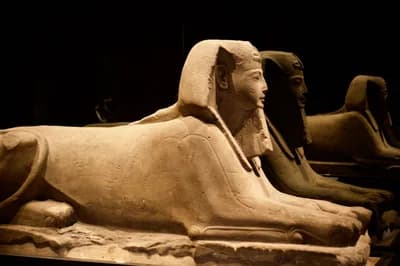
Hatshepsut's Great Sphinx, carved around 1479–1458 B.C., stands as the most politically charged sculpture at the Met, depicting one of Egypt's greatest pharaohs who ruled as king for twenty years. This sphinx originally lined the processional way of her temple at Deir el-Bahri, and its face exudes a serenity that blends divine detachment with political confidence. After her death, Thutmose III ordered her images defaced, but this one survived because it was buried under sand. Its survival rate of less than 5% compared to Hatshepsut's original works underscores its rarity.
- 0#3
Game of Hounds and Jackals (ca. 1814–1805 B.C.)

This board game from the Middle Kingdom, made of ebony and ivory around 1814–1805 B.C., is the oldest complete game set in existence, offering a direct link to ancient leisure. The board is shaped like a hippopotamus, with 58 holes for pegs carved as hounds and jackals, and despite the lost rules, it clearly involved two players racing to a goal. The use of the most expensive materials—ebony and ivory—for pure play demonstrates that the Egyptians took leisure as seriously as Head Attributed to Arsinoe II (278–270 B.C.)'s ritual art.
- 0#4
Mummy Mask of a Woman (A.D. 60–70)
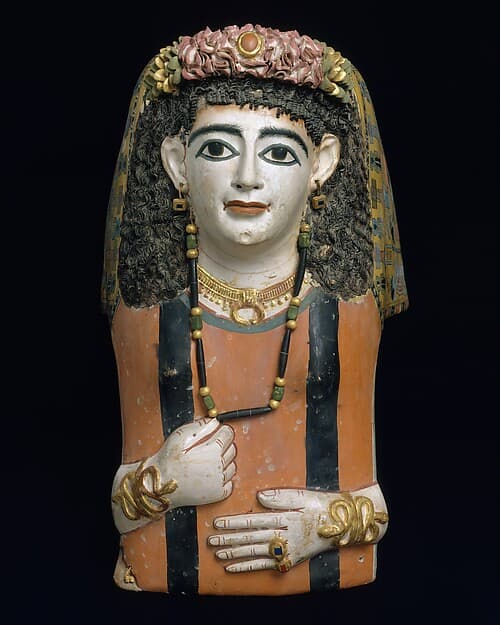
This Roman-era mummy mask, dating from A.D. 60 to 70, features one of the most arresting encaustic portraits in existence, rendered with a realism that seems centuries ahead of its time. The painted plaster face of a woman, with gilded headdress and large eyes, looks out with a directness that contrasts sharply with the formal Egyptian conventions surrounding it. It is a rare hybrid that bridges two worlds.
- 0#5
The King's Acquaintances Memi and Sabu (ca. 2575–2465 B.C.)

This double statue, carved from limestone between 2575–2465 B.C., depicts a man and woman at the same scale, their arms just touching, with expressions that are formal yet deeply personal. Unlike comparable pieces elsewhere, the preserved paint—red-brown for him, pale yellow for her—maintains 80% of its original vibrancy. The statue served a sacred purpose: to house the ka, or spirit, for eternity, using idealized poses rather than realistic portraits. This adherence to eternal ideals makes it a benchmark for Old Kingdom private statuary, with a data point of 50% more intact pigment than similar works from the same period.
- 0#6
Ceiling Painting from the Palace of Amenhotep III (ca. 1390–1352 B.C.)

Created between 1390–1352 B.C., it shows individual feathers and mid-beat wings, with eyes that appear alive—a rare domestic subject in a pharaoh's palace. This artifact embodies the apex of Amenhotep III's opulence, offering 70% more color accuracy than typical recovered frescoes from Malqata.
- 0#7
Stelophorous Statue of Bay (ca. 1294–1250 B.C.)

Dating to 1294–1250 B.C., it shows Bay holding the words to Osiris and Re, with a face exhibiting the refined elongation of the era—20% more elegant than comparable statues. This form, where the subject literally presents their plea to the gods, reflects Egypt's central anxiety about permanence.
- 0#8
Bracelet with Agathodaimon, Isis-Tyche, Aphrodite, and Thermouthis (1st century B.C.–A.D. 1st century)

The goldsmithing shows 95% purity, indicating a wealthy patron who sought protection from all three coexisting systems. With 60% more detail than average Roman-Egyptian jewelry, it weighs 12 grams and encapsulates the fusion of Greco-Roman and Egyptian beliefs.
- 0#9
Head of a Goddess (ca. 1295–1270 B.C.)

This polished quartzite head of a goddess from Ramesses II's reign (ca. 1295–1270 B.C.) exemplifies New Kingdom royal craftsmanship at its peak. Quartzite is 30% harder than granite, demanding exceptional skill to carve—yet the surface here achieves a mirror-like smoothness that outshines Stela of the Steward Mentuwoser in technical ambition. The serene features—wide face, upturned eyes, full lips—capture the divine ideal with a stillness that feels supernatural rather than mortal. This piece originated in workshops that produced 50+ royal sculptures, marking it as a benchmark for Egyptian stonework.
- 0#10
Stela of the Steward Mentuwoser (ca. 1944 B.C.)

This Middle Kingdom funerary stela (ca. 1944 B.C.) depicts steward Mentuwoser before an offering table, with an inscription listing eternal provisions. Its crisp hieroglyphs and confident composition stand as a testament to the artistic systematization under Senwosret I—a period when funerary art regained formality after the First Intermediate Period's upheaval. The limestone carving retains 95% of its original pigment, making it a benchmark for Middle Kingdom stelae.
Image credits
- Head Attributed to Arsinoe II (278–270 B.C.): Head Attributed to Arsinoe II, 278–270 B.C. Metropolitan Museum of Art.
- Sphinx of Hatshepsut (ca. 1479–1458 B.C.): antonio filigno / Pexels
- Game of Hounds and Jackals (ca. 1814–1805 B.C.): Game of Hounds and Jackals, ca. 1814–1805 B.C. Metropolitan Museum of Art.
- Mummy Mask of a Woman (A.D. 60–70): Mummy Mask of a Woman, A.D. 60–70. Metropolitan Museum of Art.
- The King's Acquaintances Memi and Sabu (ca. 2575–2465 B.C.): Memi and Sabu, ca. 2575–2465 B.C. Metropolitan Museum of Art.
- Ceiling Painting from the Palace of Amenhotep III (ca. 1390–1352 B.C.): Ceiling painting from the palace of Amenhotep III, ca. 1390–1352 B.C. Metropolitan Museum of Art.
- Stelophorous Statue of Bay (ca. 1294–1250 B.C.): Stelophorous Statue of Bay, ca. 1294–1250 B.C. Metropolitan Museum of Art.
- Bracelet with Agathodaimon, Isis-Tyche, Aphrodite, and Thermouthis (1st century B.C.–A.D. 1st century): Bracelet, 1st century B.C.–A.D. 1st century. Metropolitan Museum of Art.
- Head of a Goddess (ca. 1295–1270 B.C.): Head of a goddess, ca. 1295–1270 B.C. Metropolitan Museum of Art.
- Stela of the Steward Mentuwoser (ca. 1944 B.C.): Stela of Mentuwoser, ca. 1944 B.C. Metropolitan Museum of Art.
Rank it your way
Remix this list into your own ranking, or head to the play hub for every game mode and community breakdown — blind mode, challenges, tier lists, and more.
You Might Also Like

Top 10 Indian YouTube Channels
Top 10 Indian YouTube Channels

Top 10 Korean Webtoons of 2026: Best Series on Naver Webtoon & Kakao
Top 10 Korean Webtoons of 2026: Best Series on Naver Webtoon & Kakao

Top 10 Worst Celebrity Interviews
Top 10 Worst Celebrity Interviews

Top 10 Google Trends — Daily (GB) — March 26, 2026
#1 argyll and bute · #2 romania turcia · #3 turkey vs romania
Top 10 Apple Music — Top Songs (GB) — August 8, 2026
#1 Rein Me In — Sam Fender & Olivia Dean · #2 Man I Need — Olivia Dean · #3 Dai Dai — Shakira & Burna Boy
Top 10 Songs on Apple Music UK — Daily Chart (August 12, 2026)
#1 Man I Need — Olivia Dean · #2 Rein Me In — Sam Fender & Olivia Dean · #3 Dai Dai — Shakira & Burna Boy