
Engin Akyurt / Pexels
Top 10 Most Impactful US Federal Reserve Decisions in History
From the emergency lending that halted the 1930s banking collapse to Jerome Powell's aggressive 2022-2023 rate hikes, the Federal Reserve's ten most impactful decisions have determined whether the U.S. economy boomed or crashed—shaping your mortgage rate, job security, and wealth. Since 1913, the Fed has controlled interest rates, credit availability, and inflation expectations, yet these watershed moments stand apart: they either prevented financial catastrophe or reshaped the entire economic landscape. This list examines the decisions that transformed America's economy, ranging from Marriner Eccles' Depression-era emergency programs and Paul Volcker's inflation-crushing rate hikes to Alan Greenspan's post-9/11 rate cuts, Ben Bernanke's quantitative easing innovation, and Jerome Powell's inflation-fighting policies. Understanding what triggered each decision, how the Fed responded, and what actually happened reveals the patterns behind market booms and busts—giving you the insights to anticipate Fed moves and protect your financial interests.
Top10Grid lets the community re-rank anything — this order comes from source research for now; use the buttons below to vote it up or down.

Current Rankings
- 0#1
Federal Reserve Act (1913)
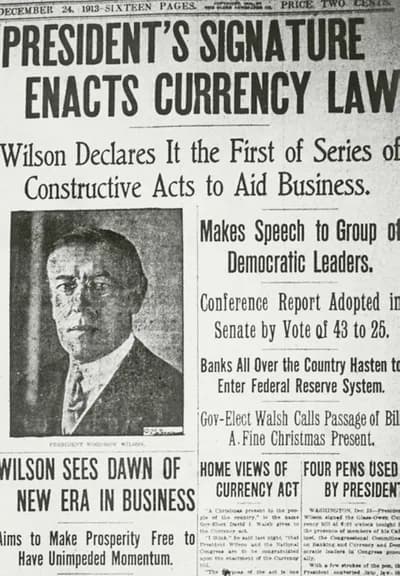
The Federal Reserve Act, signed on December 23, 1913, created the Federal Reserve System as the United States' central bank, establishing 12 regional banks to serve as lender of last resort. This foundational framework ended the chaotic era of private bankers managing liquidity crises and provided the institutional bedrock for all subsequent Fed actions. The Act's design has endured for over 110 years, shaping every major economic response since.
- 0#2
Volcker Shock — Rate Hike to 20% (1979-1981)

Fed Chair Paul Volcker raised the federal funds rate to a peak of 20% in June 1981 to crush double-digit inflation that had plagued the US since the 1970s. The deliberate recession reduced inflation from 13.5% in 1980 to just 3.2% by 1983. The Volcker Shock remains the most decisive anti-inflation action in central banking history, with its effects felt for decades.
- 0#3
2008 Financial Crisis Response — Near-Zero Rates + QE

The Fed slashed rates to 0-0.25% in December 2008 and launched quantitative easing, expanding its balance sheet from $900 billion to $4.5 trillion by 2015. Chairman Ben Bernanke's aggressive response is credited with preventing a second Great Depression, including $1.25 trillion in mortgage-backed securities purchases to stabilize housing. The rapid expansion of the Fed's balance sheet by $3.6 trillion was unprecedented.
- 0#4
2020 COVID-19 Emergency Rate Cuts

In March 2020, the Fed cut rates to 0-0.25% in two emergency moves over two weeks — the fastest rate cut in its history — and launched $120 billion per month in asset purchases. It activated 9 emergency lending facilities backstopping corporate credit, municipal bonds, and money markets, expanding its balance sheet from $4.2 trillion to $9 trillion by 2022.
- 0#5
2022 Inflation Fight — Fastest Hike Cycle in 40 Years

Beginning in March 2022, the Fed raised rates 11 times for a cumulative 525 basis points, reaching 5.25-5.5% by July 2023 — the highest in 22 years and the most aggressive tightening cycle since the Volcker era. The move was triggered by CPI inflation hitting 9.1% in June 2022. Core PCE fell from 5.5% to below 3% by late 2023.
- 0#6
Black Monday Intervention (1987)

When stock markets crashed 22.6% on October 19, 1987 — the largest single-day percentage drop in Dow Jones history — Fed Chair Alan Greenspan issued a one-sentence statement pledging liquidity support. The Fed cut rates and flooded the system with reserves, restoring confidence within weeks. This established the model for central bank 'put' policy during market crises.
- 0#7
Post-9/11 Emergency Rate Cuts (2001)

Following the September 11 terrorist attacks, the Fed cut rates 11 times in 2001, lowering the federal funds rate from 6.5% to 1.75% — the lowest since the 1960s. The Fed also kept markets open and coordinated with foreign central banks to prevent a global liquidity freeze. These cuts helped avert a deeper recession but later contributed to the housing bubble.
- 0#8
2013 Taper Tantrum Warning

Fed Chair Ben Bernanke's May 2013 congressional testimony suggesting the Fed might reduce its $85 billion monthly bond purchases triggered a global market sell-off dubbed the 'Taper Tantrum.' The 10-year Treasury yield surged from 1.6% to 3% in months, and emerging market currencies fell sharply. The episode showed how dependent markets had become on Fed accommodation.
- 0#9
1933 Banking Holiday and Glass-Steagall Response

President Roosevelt declared a national banking holiday in March 1933 at the Fed's urging, halting a wave of bank runs that had seen 9,000 banks fail since 1930. The subsequent Glass-Steagall Act separated commercial and investment banking for 66 years until its 1999 repeal. The Fed's coordination of emergency bank examinations and the FDIC's creation restored public confidence.
- 0#10
2010 Dodd-Frank Financial Reform Response

The Dodd-Frank Wall Street Reform Act of 2010 gave the Federal Reserve sweeping new powers, including oversight of systemically important financial institutions (SIFIs) and the ability to conduct annual bank stress tests. The Fed's first Comprehensive Capital Analysis and Review (CCAR) in 2011 required 19 major banks to demonstrate capital adequacy. Banks now hold 3x more Tier 1 capital than before the 2008 crisis.
Watch the ranking video
Image credits
- Federal Reserve Act (1913): Wikimedia Commons (Public domain)
- Volcker Shock — Rate Hike to 20% (1979-1981): Federal funds rate / Wikipedia
- 2008 Financial Crisis Response — Near-Zero Rates + QE: History of Federal Open Market Committee actions / Wikipedia
- 2022 Inflation Fight — Fastest Hike Cycle in 40 Years: 2021–2023 inflation surge / Wikipedia
- Black Monday Intervention (1987): Black swan theory / Wikipedia
Related Videos
Rank it your way
Remix this list into your own ranking, or head to the play hub for every game mode and community breakdown — blind mode, challenges, tier lists, and more.
You Might Also Like

Top 10 US Insurance Fraud Cases That Changed the Industry
Top 10 Most Impactful US Federal Reserve Decisions in His...

Top 10 US Wealth Management Firms
Top 10 US Wealth Management Firms

Top 10 US IPOs of 2025 by First-Day Performance
biggest stock market debuts of 2025

Top 10 US Credit Unions by Assets (2025): Biggest Members-Owned Banks
largest US credit unions by assets

Top 10 CoinGecko — Top Cryptocurrencies — September 3, 2026
#1 Bitcoin (BTC) · #2 Ethereum (ETH) · #3 Tether (USDT)

Top 10 Cryptocurrencies by Market Cap — March 24, 2026
#1 Bitcoin (BTC) · #2 Ethereum (ETH) · #3 Tether (USDT)