
2008 financial crisis / Wikipedia
Top 10 US Financial Regulators and Their Mandates
The United States operates the world's most complex financial regulatory architecture, with more than a dozen overlapping federal and state agencies collectively overseeing $100+ trillion in financial assets across banking, securities, derivatives, insurance, and consumer finance. This decentralized "alphabet soup" of regulators reflects Congress's deliberate preference for checks and balances over efficiency — each agency has a distinct statutory mandate, independent funding, and politically appointed leadership. In 2025-2026, the regulatory landscape has been upended by the Trump administration's deregulation agenda, with the CFPB scaled back under DOGE reviews and SEC crypto enforcement paused. Understanding who regulates what — and why — is essential for any participant in American financial markets.
Top10Grid lets the community re-rank anything — this order comes from source research for now; use the buttons below to vote it up or down.

Current Rankings
- 0#1
Securities and Exchange Commission (SEC)

The SEC is the primary federal regulator for US capital markets, with a $2.1 billion annual budget and approximately 4,500 staff overseeing $100+ trillion in securities markets, 28,000 registered investment advisers, and 12,000+ public companies. Created after the 1929 crash, its core mandate is investor protection through disclosure — requiring public companies to file audited financials and prohibiting fraud and insider trading. Under Chair Gary Gensler (2021-2025), the SEC pursued aggressive crypto enforcement, filing 100+ actions; under his successor in 2025, the agency shifted toward a pro-innovation stance. The SEC's enforcement reach surpasses the Federal Reserve's supervisory scope by covering over 28,000 investment advisers compared to the Fed's oversight of eight G-SIBs.
- 0#2
Federal Reserve System

The Federal Reserve ("the Fed") is the US central bank, operating through a board of governors and 12 regional reserve banks with an $8.5 trillion balance sheet and responsibility for monetary policy, bank supervision, and financial system stability. Its "dual mandate" from Congress requires pursuing maximum employment AND price stability — a balance that led to the most aggressive rate-hiking cycle since 1980 in 2022-2023. The Fed's supervisory division oversees bank holding companies including the eight US Global Systemically Important Banks (G-SIBs) — JPMorgan, Bank of America, Citigroup, Wells Fargo, Goldman Sachs, Morgan Stanley, BNY Mellon, and State Street. Unlike the SEC's focus on disclosure, the Fed's supervisory mandate directly targets systemic risk at these eight G-SIBs, which together hold over 40% of US banking assets.
- 0#3
Federal Deposit Insurance Corporation (FDIC)
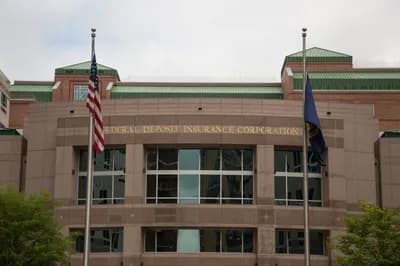
The FDIC insures deposits up to $250,000 per depositor per bank through its Deposit Insurance Fund (DIF), currently holding $116 billion to protect depositors at 4,600+ insured institutions. Created in 1933 after 9,000 bank failures during the Depression, the FDIC has not lost a penny of insured deposits since its founding. The FDIC also serves as the primary federal regulator for state-chartered banks not belonging to the Federal Reserve System — and became the central actor in the 2023 Silicon Valley Bank and Signature Bank failures, executing the largest US bank seizures since 2008.
- 0#4
Office of the Comptroller of the Currency (OCC)

The OCC is an independent bureau of the US Treasury Department that charters, regulates, and supervises over 1,400 national banks and federal savings associations — including JPMorgan Chase, Bank of America, and Wells Fargo — holding over $14 trillion in assets. The OCC conducts continuous on-site examinations of large banks and issues interpretive letters that shape industry-wide banking practices. In 2021, the OCC granted the first federal charter to a cryptocurrency-focused bank (Anchorage Digital), establishing a new regulatory pathway for digital asset institutions. The OCC's supervisory purview over $14 trillion in bank assets rivals the Federal Reserve's balance sheet of $8.5 trillion, yet its staff of roughly 3,500 examiners is significantly smaller than the Fed's total workforce of 23,000.
- 0#5
Consumer Financial Protection Bureau (CFPB)

The CFPB is the most powerful consumer financial watchdog in the US, with a $750 million annual budget that funds enforcement actions returning $19 billion in relief to 195 million consumers since 2010. Its mandate covers mortgages, credit cards, student loans, and payday lending, and its independent funding from the Federal Reserve sparked 2025 political controversy over DOGE-led efficiency reviews and staff reductions. This consumer relief dwarfs the $100 million returned annually by FINRA, making the CFPB the top enforcer for individual financial harm.
- 0#6
Commodity Futures Trading Commission (CFTC)

The CFTC is the primary regulator of the $600 trillion notional derivatives market, operating with a relatively modest $380 million budget. It oversees commodity exchanges like CME Group and ICE, and since 2022 has asserted jurisdiction over spot cryptocurrency markets for commodities like Bitcoin and Ether, becoming central to US crypto regulation under FIT21. The $600 trillion market it polices far exceeds the $7 trillion mortgage-backed securities overseen by the Federal Housing Finance Agency, highlighting its role in systemic risk management.
- 0#7
FINRA (Financial Industry Regulatory Authority)

FINRA is the largest self-regulatory organization for retail investment, overseeing approximately 3,500 broker-dealer firms and 630,000 registered securities representatives. It operates a mandatory arbitration system resolving 15,000+ investor-broker disputes per year and returning $100 million+ annually to harmed investors. Unlike the Consumer Financial Protection Bureau (CFPB), which relies on government funding and enforcement, FINRA is industry-funded and focuses on broker conduct and transparency through its BrokerCheck database.
- 0#8
Federal Housing Finance Agency (FHFA)

The FHFA has controlled Fannie Mae and Freddie Mac since September 2008, guaranteeing over $7 trillion in US mortgage-backed securities that cover more than half of all residential mortgages. Its conservatorship, originally temporary, now ranks as one of the longest and most consequential in history, with 2025 renewal talks about privatization. The $7 trillion mortgage guarantee is dwarfed by the $600 trillion derivatives market regulated by the Commodity Futures Trading Commission (CFTC), yet FHFA's direct impact on housing affordability is unmatched among financial regulators.
- 0#9
National Credit Union Administration (NCUA)
The NCUA is the independent federal regulator and deposit insurer for the US credit union system, overseeing 4,800+ federally insured credit unions with $2.2 trillion in combined assets serving 135 million Americans. The National Credit Union Share Insurance Fund (NCUSIF) provides deposit insurance up to $250,000 per member, equivalent to FDIC coverage. The NCUA examines federally chartered credit unions annually and state-chartered federally insured credit unions in partnership with state regulators.
- 0#10
FinCEN (Financial Crimes Enforcement Network)

FinCEN is a bureau of the US Treasury Department that serves as the Financial Intelligence Unit of the United States, collecting and analyzing financial transaction data from 85,000+ financial institutions to detect money laundering, terrorist financing, and financial crimes. Institutions must file Suspicious Activity Reports (SARs) and Currency Transaction Reports (CTRs), generating over 3 million filings annually. In 2025, FinCEN implemented new beneficial ownership reporting requirements under the Corporate Transparency Act — requiring 32 million US companies to disclose ultimate owners — transforming US AML/BSA compliance.
Image credits
- Securities and Exchange Commission (SEC): bettrichard873 / flickr (PDM)
- Federal Reserve System: Bing Images / s3.tradingview.com
- Federal Deposit Insurance Corporation (FDIC): Tony Webster / Wikimedia Commons (CC BY-SA 4.0)
- Office of the Comptroller of the Currency (OCC): Wikimedia Commons
- Consumer Financial Protection Bureau (CFPB): Wikimedia Commons
- Commodity Futures Trading Commission (CFTC): G. Edward Johnson / Wikimedia Commons (CC BY 4.0)
- FINRA (Financial Industry Regulatory Authority): Stefano Palazzo / Wikimedia Commons (CC BY-SA 3.0)
- Federal Housing Finance Agency (FHFA): Wikimedia Commons
- National Credit Union Administration (NCUA): w:National Credit Union Administration / Wikimedia Commons (Public domain)
- FinCEN (Financial Crimes Enforcement Network): Unknown authorUnknown author / Wikimedia Commons (Public domain)
Rank it your way
Remix this list into your own ranking, or head to the play hub for every game mode and community breakdown — blind mode, challenges, tier lists, and more.
You Might Also Like

Top 10 US Family Offices of Billionaire Dynasties
Top 10 US Family Offices of Billionaire Dynasties

Top 10 US Microfinance Institutions
Top 10 US Microfinance Institutions

Top 10 European Insurance Regulations That Reshaped the Industry (2011–2025)
Top 10 European Insurance Regulations That Reshaped the I...

Top 10 European Commercial Banks by Total Assets
#1 BNP Paribas · #2 Credit Agricole Group · #3 HSBC Holdings

Top 10 German Insurance Conglomerates
#1 Allianz SE · #2 Munich Re · #3 Talanx AG / HDI
Top 10 European Hedge Funds by AUM
#1 Man Group · #2 Marshall Wace · #3 Brevan Howard