
Top 10 Greatest NBA Players of All Time
The GOAT debate never ends, but the evidence never lies. Across eight decades of professional basketball, a handful of players transcended the sport entirely — rewriting record books, redefining positions, and forcing the world to watch. We ranked them by championships, individual dominance, statistical legacy, and lasting cultural impact. Disagree at your own peril.
Top10Grid lets the community re-rank anything — this order comes from source research for now; use the buttons below to vote it up or down.

Current Rankings
- 0#1
Michael Jordan

Michael Jordan won six NBA championships with the Chicago Bulls and was named Finals MVP all six times — a 6-for-6 record no player in history has matched. He averaged 30.1 points per game across his regular-season career, the highest mark in NBA history, and never lost an NBA Finals series. Jordan won five MVP awards, ten scoring titles, and was a 14-time All-Star. His 1995-96 Bulls went 72-10, then a record, and Jordan led the league in scoring that postseason on the way to his fourth championship. Beyond statistics, Jordan globalized basketball and built a cultural empire through Nike's Air Jordan line, which brought in more than $5 billion in a single recent year.
- 0#2
LeBron James

LeBron is the league's all-time leading scorer, having passed Kareem Abdul-Jabbar's record in February 2023 on his way past 40,000 career points, and he ranks in the top five all-time in assists too — a rare combination of volume scoring and playmaking sustained across three different decades. He won four titles with three different franchises, but the signature one is 2016: down 3-1 to a 73-win Warriors team, he and the Cavaliers came all the way back, LeBron averaging 29.7 points, 11.3 rebounds and 8.9 assists across the series. Even in his mid-30s he was still putting up elite scoring numbers, night after night.
Sourcesen.wikipedia.org - 0#3
Kareem Abdul-Jabbar
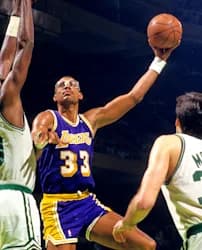
Kareem Abdul-Jabbar held the NBA all-time scoring record for 39 years (1984-2023) with 38,387 points, built on his unstoppable skyhook — often called the most unguardable shot in basketball history. He won six championships (one with Milwaukee, five with the Lakers), six MVP awards (still the record), and played at an elite level from 1969 to 1989, a span of 20 seasons. Kareem was a 19-time All-Star, won Finals MVP in 1985 at age 38, and anchored the Showtime Lakers dynasty alongside Magic Johnson. His combination of longevity, efficiency, and dominance remains unmatched.
Sourcesen.wikipedia.org - 0#4
Magic Johnson

Magic ran the point at 6-foot-9, a size nobody had tried to play the position at before him, and the Showtime Lakers won five championships in nine years built around it. In the 1981-82 season he came within a whisker of a season-long triple-double, averaging 18.6 points, 9.6 rebounds and 9.5 assists, and he won three MVPs over his career. But the performance that defines him came as a 20-year-old rookie: Game 6 of the 1980 Finals, filling in at center for an injured Kareem, 42 points and 15 rebounds. His rivalry with Larry Bird did as much as anything to pull the NBA back from the brink of irrelevance in the early 1980s.
Sourcesen.wikipedia.org - 0#5
Bill Russell
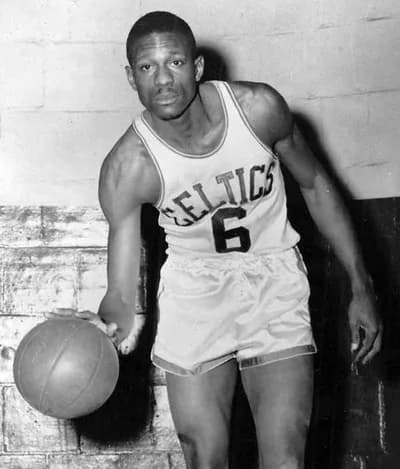
Eleven championships in thirteen seasons is a record that isn't just unbroken, it's unapproachable -- no modern roster construction or schedule would let it happen again. Russell won five MVPs while making defense and shot-blocking a decisive, game-planned weapon at a time the stat wasn't even officially tracked. He spent his final three seasons as player-coach, winning two more titles from the bench as the first Black head coach in major American professional sports. The Celtics' run of eight straight championships from 1959 to 1966 remains the longest title streak in North American pro sports, full stop.
- 0#6
Wilt Chamberlain
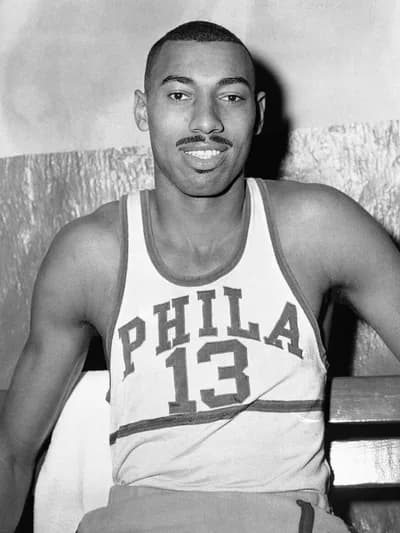
Wilt's numbers don't read like a basketball career so much as a typo that never got corrected. A 100-point game in 1962. A 50.4-points-per-game season. A year in which he averaged more minutes per game than a regulation game actually contains, because he played every overtime too. Two championships and four MVPs undersell him, honestly, next to those single-season numbers -- he also led the league in rebounding eleven separate times, at a career average of 22.9 a game. Nobody before or since has been that singularly, physically overwhelming on a basketball court.
- 0#7
Larry Bird

Larry Bird won three consecutive MVPs (1984-86) and three championships with the Boston Celtics, while shooting 49.6% from the field, 37.6% from three, and 88.6% from the free-throw line across his career — elite efficiency at every distance. Bird was a 12-time All-Star, Finals MVP twice, and revived the Celtics franchise from irrelevance. His rivalry with Magic Johnson is among the most storied in NBA history, lifting the league's ratings and cultural profile dramatically in the 1980s. He underwent heel surgery for bone spurs in the 1988-89 season and battled back problems through his final years, but Bird still averaged over 20 points per game across his last three seasons.
Sourcesen.wikipedia.org - 0#8
Shaquille O'Neal
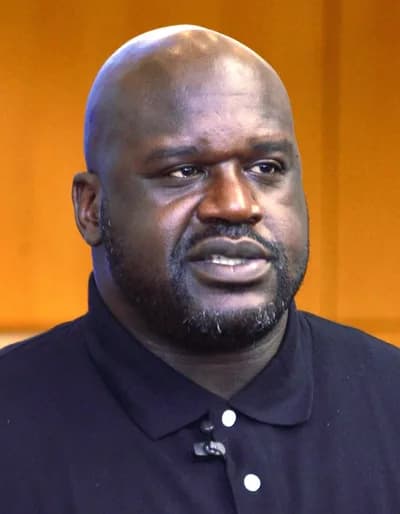
At his physical peak, Shaq simply could not be guarded -- not by one defender, not by a double-team, not by a rule change aimed squarely at him. He won three straight Finals MVPs with the Lakers from 2000 to 2002, plus the regular-season MVP in 2000, and added a fourth championship with Miami in 2006. His career field-goal percentage, 58.2%, is the second-highest of all time -- remarkable for a center taking almost all contested shots in the post rather than easy dunks off cuts. Few players in NBA history combined that kind of force with that kind of efficiency.
- 0#9
Kobe Bryant

Kobe won five championships -- three riding shotgun with Shaq, two more once he was unambiguously the guy -- which settles the question of whether he could do it on his own. He scored 81 points in a single game in January 2006, second only to Wilt's 100, and then closed his career in April 2016 the way he opened it: chasing everything, dropping 60 in his final game. Across 20 seasons he averaged 25.0 points a night, made 18 All-Star teams, won an MVP in 2008, and took Finals MVP in both of his last two titles. He entered the Hall of Fame in 2020.
Sourcesen.wikipedia.org - 0#10
Tim Duncan

Duncan won championships in three different decades -- 1999, 2003, 2005, 2007, and 2014 -- which is a harder thing to sustain than any single dominant peak, however impressive. Two MVPs, three Finals MVPs, and ten first-team All-NBA selections came from a game built on fundamentals rather than flash: 19.0 points and 10.8 rebounds a night for his career, with almost nothing wasted. His quiet demeanor hid a competitive streak that made him the NBA's all-time leader in wins with a single franchise. The last title, in 2014 at age 38, was maybe the most team-oriented championship of his era.
Sourcesen.wikipedia.org
How the GOAT debate actually gets decided
There is no single stat that settles who the greatest NBA player of all time is, which is why the debate never ends. Different frameworks lead to different answers: ranking by championships rewards Bill Russell's 11 titles above almost everyone; ranking by peak individual dominance points to seasons like Wilt Chamberlain's 50.4 points per game or Michael Jordan's undefeated Finals record; ranking by career-long statistical accumulation favors LeBron James, whose all-time scoring record was built over two decades of sustained elite play. None of these approaches is wrong — they're just measuring different things, and most all-time rankings, including this one, end up blending them rather than picking one axis and following it to its logical, and often strange, conclusion.
What separates the top of this list from the rest
The players at the top of this list tend to combine multiple forms of evidence at once — championships, MVP and Finals MVP hardware, and at least one statistical or performance record that stood for decades. Jordan's 6-0 Finals record and LeBron's all-time scoring mark are that kind of anchor stat. Further down the list are players who were just as dominant by one measure but narrower by others: Wilt Chamberlain's single-season and single-game scoring records are unmatched, but he won only two championships to Russell's eleven; Kareem held the career scoring record for nearly four decades but built it over an unusually long 20-season prime rather than a short, explosive peak. The ranking reflects breadth of dominance, not just the size of any one number.
What newcomers to this debate usually get wrong
The most common mistake is comparing raw counting stats across eras without accounting for how the game itself changed — pace was much faster in Wilt Chamberlain's and Bill Russell's era, producing more possessions and inflating counting stats, while the three-point shot barely existed until the late 1980s and didn't become a primary weapon until the 2010s. The second common mistake is treating championship count as a solo achievement rather than a team outcome — a player surrounded by multiple Hall of Famers has a structurally easier path to rings than one carrying a thinner roster. The strongest GOAT arguments account for both era context and roster context rather than reading raw totals at face value.
Image credits
- Kareem Abdul-Jabbar: copyright Steve lipofsky www.Basketballphoto.com / Wikimedia Commons (CC BY 3.0)
- Bill Russell: Bill Russell / Wikipedia
- Wilt Chamberlain: Wilt Chamberlain / Wikipedia
- Larry Bird: Larrybird.jpg / Wikimedia Commons
- Shaquille O'Neal: Shaquille O'Neal October 2017 (cropped).jpg / Wikimedia Commons
- Tim Duncan: Tim Duncan / Wikipedia
Related Videos
Rank it your way
Remix this list into your own ranking, or head to the play hub for every game mode and community breakdown — blind mode, challenges, tier lists, and more.
You Might Also Like
Top 10 Richest Athletes of All Time
Top 10 Richest Athletes of All Time

Top 10 Best Basketball Dunkers of All Time
Top 10 Best Basketball Dunkers of All Time

Top 10 Greatest Basketball Players of All Time
Top 10 Greatest Basketball Players of All Time

Top 10 Greatest WNBA Players of All Time
greatest WNBA players of all time
Top 10 Greatest NBA Dunks in History
#1 Vince Carter's 360 Windmill Over Frederic Weis — 2000 Olympics · #2 Michael Jordan's Free-Throw Line Dunk — 1988 Slam Dunk Contest · #3 Shawn Kemp Over Alton Lister — 1992

Top 10 Most Iconic Sports Moments
#1 Miracle on Ice (1980) · #2 Jesse Owens at the 1936 Berlin Olympics · #3 Michael Jordan's Last Shot (1998)