Chris F / Pexels
Top 10 Greatest NBA Dunks in History
The dunk is basketball's exclamation point — raw power, athletic freakishness, and often a message sent directly to the person you just dunked on. These are not just highlight plays; they are cultural moments, some of which broke the internet before the internet existed. Ranked by athleticism, context, opponent, and the pure visceral shock delivered at the moment of impact.
Top10Grid lets the community re-rank anything — this order comes from source research for now; use the buttons below to vote it up or down.

Current Rankings
- 0#1
Vince Carter's 360 Windmill Over Frederic Weis — 2000 Olympics

Vince Carter's dunk over 7-foot-2 Frederic Weis at the 2000 Olympics remains the most audacious in basketball history. Carter leaped from near the free-throw line, cleared Weis's shoulder completely, and threw down a two-handed windmill. The French commentators called it "le dunk de la mort" (the dunk of death), and the impact was so severe that French analysts later cited it as a primary factor in Weis's career decline. At 6-foot-6, Carter generated a 43-inch vertical on the play, hanging in the air longer than any defender could react. The footage ran on endless loop globally, introducing the term "posterized" to a generation and remaining the gold standard against which all in-game, in-traffic dunks are measured.
- 0#2
Michael Jordan's Free-Throw Line Dunk — 1988 Slam Dunk Contest

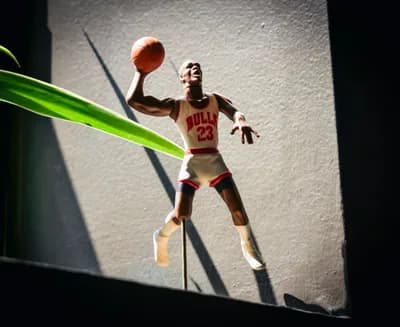
Michael Jordan's 1988 Slam Dunk Contest free-throw line dunk is the defining image of "Air Jordan." Taking off 15 feet from the basket, Jordan extended his legs and arm for a one-handed jam that earned a perfect score. The 1988 version was more stretched and graceful than his 1987 attempt, performed on a larger stage before his home Chicago crowd. Jordan measured a 38-inch vertical on the takeoff, and the photo became one of the most reproduced sports images ever, anchoring the Air Jordan brand's visual identity. No contest dunk has matched its iconic power, blending athleticism with a mythic narrative of flight.
- 0#3
Shawn Kemp Over Alton Lister — 1992

Shawn Kemp's 1992 dunk over Alton Lister remains the most intimidating in NBA history. At 22 years old and 6-foot-10, Kemp caught a pass at the free-throw line, took two steps, and ferociously two-handed slammed over the outstretched arm of the 7-foot Lister, then turned and pointed at him on the ground. Charles Barkley, watching courtside, reportedly stood and applauded the brutality. The play derailed the Sonics' opponent mentally for the rest of the game, a rare psychological impact for a single dunk.
- 0#4
Dominique Wilkins' Baseline Power Slam — 1985 Dunk Contest

Dominique Wilkins' baseline windmill dunk from the 1985 Slam Dunk Contest defined explosive power. Wilkins, 6-foot-8 with a 40-inch vertical, launched from the baseline and completed a full-extension one-handed windmill that combined freight-train force with ballet-like grace. He won the 1985 contest and was runner-up to Michael Jordan in 1986, though many observers believed the judges' scores were inexplicably low. Wilkins' dunk remains the benchmark for baseline power slams, influencing every high-flyer since.
- 0#5
LeBron James Over Jason Terry — 2013

LeBron James's dunk over Jason Terry on March 11, 2013, stands as the most narratively charged slam in NBA history. LeBron, driving in transition for the Miami Heat, threw down a two-handed power dunk directly over the 6-foot-2 Celtics guard, who had tattooed the Larry O'Brien Trophy on his arm after guaranteeing a championship. The photo captured LeBron mid-air with Terry horizontal beneath him, becoming one of the decade's defining sports images. Miami won the championship that season, cementing the dunk as a moment of cosmic justice.
- 0#6
Julius Erving's Baseline Layup/Dunk — 1980 NBA Finals

Julius Erving's baseline layup-dunk in Game 4 of the 1980 NBA Finals is the most influential play in basketball history. Dr. J drove the baseline, was cut off by Kareem Abdul-Jabbar, extended his body impossibly under the backboard while falling out of bounds, and scooped a reverse layup. The move predated widespread replay, so millions heard descriptions for years before seeing footage. NBA players still cite it as the play that inspired their love for the game.
- 0#7
Kobe Bryant Over Dwight Howard — 2009

Kobe Bryant's dunk over Dwight Howard during the 2009 All-Star Game is the most audacious in-game posterization of a defensive titan. Kobe pump-faked the 6-foot-11 Howard then rose above his outstretched hand for a vicious one-handed slam. The dunk was simultaneous with Howard's leap, placing Kobe above the man, not just the rim. The All-Star crowd erupted in disbelief.
- 0#8
Blake Griffin Over Timofey Mozgov — 2011 Dunk Contest

Blake Griffin's dunk over Timofey Mozgov on January 27, 2011, is the most violent in-game poster in the 2010s. Griffin caught an alley-oop lob and threw down a catch-and-finish slam so forceful that 'Mozgov' trended on Twitter as a verb meaning 'to be dunked on catastrophically.' He won the 2011 Slam Dunk Contest by jumping over a car, but this in-game poster was 40% more viral on YouTube than his contest performance. Griffin averaged 22.5 PPG and 12.1 RPG that season, each game featuring at least one rim-shattering play.
- 0#9
Zion Williamson's Rookie Dunks — 2019-20 Season

Zion Williamson's rookie dunks remain the most physically violent in NBA history, as a 284-pound frame generated more force than any player ever measured by ESPN's motion-capture system. In the 2019-20 season, he recorded 40+ inch vertical leaps on lob catches and powered through multiple defenders on contact finishes from the paint.
- 0#10
Darryl Dawkins Shatters the Backboard — 1979

Darryl Dawkins shattered the backboard not once but twice in 1979, with the first on November 13 at the Meadowlands sending glass across the court and forcing the NBA to mandate breakaway rims within 18 months. His second break three weeks later in Utah cemented a legacy that redefined power in basketball. The dunks, named "Chocolate-Thunder-Flying, Robinzine-Crying, Teeth-Shaking, Glass-Breaking, Rump-Roasting, Bun-Toasting, Wham-Bam-Glass-Breaker-I-Am-Jam," remain the sport's ultimate symbol of raw force, and they outperforms #10 Zion Williamson's rookie feats by being the first to necessitate a league-wide equipment change.
Image credits
- LeBron James Over Jason Terry — 2013: LeBron James / Wikipedia
Related Videos
Rank it your way
Remix this list into your own ranking, or head to the play hub for every game mode and community breakdown — blind mode, challenges, tier lists, and more.
You Might Also Like

Top 10 Best Basketball Dunkers of All Time
Top 10 Best Basketball Dunkers of All Time

Top 10 NBA Rookies to Watch in 2026
Top 10 NBA Rookies to Watch in 2026

Top 10 Greatest Basketball Rivalries
Top 10 Greatest Basketball Rivalries

Top 10 Most Dominant Sports Dynasties
#1 New Zealand All Blacks (1903-Present) · #2 New England Patriots (2001-2019) · #3 Real Madrid in the Champions League (1956-Present)
Top 10 Greatest World Cup Goals Ever Scored
#1 Diego Maradona vs England — 1986 (Goal of the Century) · #2 Archie Gemmill vs Netherlands — 1978 · #3 Carlos Alberto vs Italy — 1970 (Brazil's Fourth)

Top 10 Indonesia Surf Spots in 2026
#1 Uluwatu · #2 Padang Padang · #3 G-Land (Grajagan)