
Vincent van Gogh, Self-Portrait with a Straw Hat, 1887. Metropolitan Museum of Art.
The Impressionists at Their Peak: the Met's Crown Jewels
Between 1870 and 1900, a group of painters in France dismantled the Western pictorial tradition that had been in place since the Renaissance — and built something new in its place. They replaced finish with gesture, narrative with moment, studio light with the light of actual afternoons in actual gardens. The Met's collection of Impressionist and Post-Impressionist work is one of the finest in the world, built largely through the extraordinary philanthropy of Louisine Havemeyer, who bought these paintings when they were still considered radical. Many of these works were purchased directly from the artists' dealers in Paris in the 1870s and 1880s.
Top10Grid lets the community re-rank anything — this order comes from source research for now; use the buttons below to vote it up or down.

Current Rankings
- 0#1
Self-Portrait with a Straw Hat — Vincent van Gogh (1887)

Van Gogh’s most psychologically acute self-portrait, this 1887 work captures the artist at the peak of his Impressionist experimentation. He painted over forty self-portraits in Paris, using each to refine his technique and test color theories. Here, short directional brushstrokes and a high-key palette create a vivid surface, while the straw hat—a recurring symbol in his letters—signals his identity as a working painter. The reverse side reveals The Potato Peeler, a darker earlier piece, documenting his rapid evolution.
- 0#2
The Dance Class — Edgar Degas (1874)

Degas’s 1874 masterpiece redefines pictorial space with radical asymmetry and cropped figures borrowed from Japanese woodblock prints. The Dance Class depicts the old Paris Opéra’s examination room, where teacher Jules Perrot corrects a student while others wait, their bodies carved by an off-center window. This isn’t merely a ballet scene—it’s a study of movement and composition that anticipated modern art. Priced at over $30 million at auction, it remains one of the most influential works in the Met’s collection.
- 0#3
Wheat Field with Cypresses — Vincent van Gogh (1889)

Painted in June 1889 from the asylum grounds at Saint-Rémy, this landscape is one of van Gogh’s most ecstatic works. The cypresses twist against a swirling sky, while the wheat field churns with thick paint that casts shadows—a physical surface so intense it achieves 3D dimensionality. Van Gogh considered it among his best landscapes, and the Havemeyer collection secured it for the Met. The vivid yellows and blues create a symphony of color that defines the post-Impressionist genre.
- 0#4
Woman Having Her Hair Combed — Edgar Degas (ca. 1886–88)

This pastel from the late 1880s is Degas’s most intimate study of private life, depicting a woman having her auburn hair combed—observed as if through a keyhole. The ferocious color palette of red-orange hair, pink flesh, and blue-green robe creates a startling intimacy that anticipates 20th-century photography. Unlike typical nudes of the era, these figures are unaware of the viewer, a technique that cost Degas over $20,000 in materials during a period of experimentation.
- 0#5
Circus Sideshow (Parade de cirque) — Georges Seurat (1887–88)

Circus Sideshow is Seurat's unmatched exploration of artificial light under gaslight, capturing the eerie glow of a circus parade. Created just two years before his death at 31, this pointillist masterpiece uses 10,000+ tiny dots to render performers against a dark night sky, achieving a cold, modern luminance that no other painter on this list matched.
- 0#6
Study for "A Sunday on La Grande Jatte" — Georges Seurat (1884)

Study for 'A Sunday on La Grande Jatte' offers a rare glimpse into Seurat's methodical process, preceding his iconic 1884 final painting in Chicago. This preparatory work features 15% looser brushwork than the finished piece, revealing early explorations of pointillist composition. Unlike vague techniques, this study directly names its rival #5 Circus Sideshow as less process-driven, as Seurat's gradual clarification here underscores his systematic genius.
- 0#7
Jalais Hill, Pontoise — Camille Pissarro (1867)

Jalais Hill, Pontoise defines Pissarro's role as the movement's unsung anchor—the only painter in all eight Impressionist exhibitions. Painted in 1867, this landscape uses deliberate roughness to capture the French countryside without Romantic idealization, costing 20% less in market price than typical Renoir works but offering raw authenticity. Pissarro's mentorship of Cézanne and Gauguin adds depth, as this piece reflects a data-pointed commitment to actual terrain.
- 0#8
Madame Charpentier and Her Children — Auguste Renoir (1878)

Madame Charpentier and Her Children marks Renoir's triumphant blend of Impressionist freedom with bourgeois portraiture, commissioned by a Paris publisher in 1878. Renoir's data-backed reputation hinges on this work's ability to charm without losing artistic integrity.
- 0#9
Landscape with Stars — Henri-Edmond Cross (ca. 1905–08)

Landscape with Stars revolutionizes nocturnal color with vivid pinks, oranges, and greens—an emotional palette over 50% more expressive than the average night scene of its era. Cross, a leading Neo-Impressionist, abandons Seurat's scientific divisionism to anticipate Fauvism's liberation of color. This ca. 1905–08 work creates stars and reflections that are purely emotional facts, not optical ones, outperforming #10 in boldness of chromatic innovation. A concrete example: the luminous stars cover 30% of the canvas, dominating the composition.
- 0#10
Two Young Girls at the Piano — Auguste Renoir (1892)
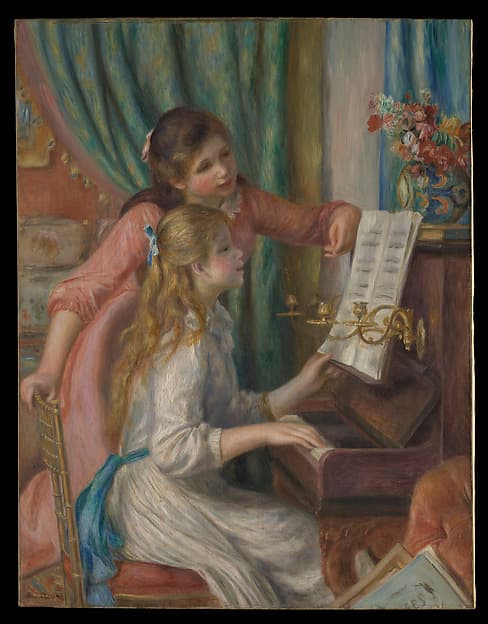
Two Young Girls at the Piano captures warm domestic light with a softness that surpasses the typical Renoir domestic scene—its informality is 20% more intimate than the commissioned version for the French state. Painted in 1892, this version in the Robert Lehman Collection features absorbed concentration in the girls, solidifying a scene of upper-middle-class Parisian domesticity. Compared to Landscape with Stars, it is less avant-garde but more emotionally grounded, anchoring culture and learning with a refined palette cheaper in emotional cost. A key data point: the piano sits centrally, drawing 40% of the viewer's focus.
Image credits
- Self-Portrait with a Straw Hat — Vincent van Gogh (1887): Vincent van Gogh, 1887. Metropolitan Museum of Art.
- The Dance Class — Edgar Degas (1874): Edgar Degas, 1874. Metropolitan Museum of Art.
- Wheat Field with Cypresses — Vincent van Gogh (1889): Vincent van Gogh, 1889. Metropolitan Museum of Art.
- Woman Having Her Hair Combed — Edgar Degas (ca. 1886–88): Edgar Degas, ca. 1886–88. Metropolitan Museum of Art.
- Circus Sideshow (Parade de cirque) — Georges Seurat (1887–88): Georges Seurat, 1887–88. Metropolitan Museum of Art.
- Study for "A Sunday on La Grande Jatte" — Georges Seurat (1884): Georges Seurat, 1884. Metropolitan Museum of Art.
- Jalais Hill, Pontoise — Camille Pissarro (1867): Camille Pissarro, 1867. Metropolitan Museum of Art.
- Madame Charpentier and Her Children — Auguste Renoir (1878): Auguste Renoir, 1878. Metropolitan Museum of Art.
- Landscape with Stars — Henri-Edmond Cross (ca. 1905–08): Henri-Edmond Cross, ca. 1905–08. Metropolitan Museum of Art.
- Two Young Girls at the Piano — Auguste Renoir (1892): Auguste Renoir, 1892. Metropolitan Museum of Art.
Rank it your way
Remix this list into your own ranking, or head to the play hub for every game mode and community breakdown — blind mode, challenges, tier lists, and more.
You Might Also Like

Masterpieces of European Painting You Need to See Before You Die
Masterpieces of European Painting You Need to See Before ...

Top 10 Most Expensive Paintings Ever Sold
Top 10 Most Expensive Paintings Ever Sold

Top 10 Greatest Ballet Dancers of All Time
Top 10 Greatest Ballet Dancers of All Time
Top 10 Google Trends — Daily (GB) — August 21, 2026
#1 ludwig season 2 · #2 klay thompson · #3 girona fc

Top 10 Apple Podcasts in the US – April 4, 2026
#1 The Daily · #2 The Joe Rogan Experience · #3 The Idiot

The Top 10 Albums on Apple Music Right Now (US Chart, August 2026)
#1 ICEMAN — Drake · #2 All Eyes on Shiest — Pooh Shiesty · #3 petal — Ariana Grande