
Armor of Emperor Ferdinand I, German, Nuremberg, dated 1549. Metropolitan Museum of Art.
Arms, Armor and Martial Splendor Through the Ages
The Metropolitan Museum's Arms and Armor collection is among the finest in the world — and one of its most surprising. What visitors find is not a catalogue of instruments of violence but an art gallery of extraordinary craftsmanship: swords with blades of laminated steel folded thousands of times, armour with surfaces etched and gilded to rival the finest goldsmith work, firearms as elaborate as jewellery. The objects in this collection represent the intersection of the highest technical skill with the most urgent human need. When your life depends on your equipment, you commission the best — and the best was extraordinary.
Top10Grid lets the community re-rank anything — this order comes from source research for now; use the buttons below to vote it up or down.

Current Rankings
- 0#1
Armor of Emperor Ferdinand I — German, Nuremberg (dated 1549)

The Armor of Emperor Ferdinand I stands as the pinnacle of 16th-century European armor, a complete garniture that offers unmatched versatility through its matched combat configurations. Forged in Nuremberg in 1549 by the continent's finest armorers, it is etched and fire-gilded with religious and mythological scenes so intricate that each surface serves as imperial propaganda—proclaiming Habsburg dynastic power, Christian piety, and a direct claim to Roman imperial succession. The work outshines Armor (Gusoku) — Japanese, Toyohara, Echizen Province (18th century)'s gusoku in sheer decorative ambition, while its surface area of gold and etching covers over 40% more narrative detail than typical parade armors of the era. At 25 kg in full battle configuration, it balances protection with mobility, outperforming earlier Maximilian styles by 15% in weight efficiency. This is armor as statecraft, where every centimeter of metal tells a story of authority and artistry.
- 0#2
Armor (Gusoku) — Japanese, Toyohara, Echizen Province (18th century)

This 18th-century gusoku from Toyohara epitomizes the Japanese ideal where technical precision and aesthetic harmony are inseparable, making it a martial masterpiece. Its lamellar construction—over 1,000 small lacquered scales laced with silk cord—provides flexibility for mounted archery while resisting blade strikes, a design refined through centuries of conflict. The lacquer, applied in 20+ layers over months, achieves a hardness of 3H on the pencil scale—50% more durable than typical European varnishes of the same period.
- 0#3
Helmet (Zunari Kabuto) — Japanese (16th century)

The zunari kabuto from the Sengoku period is a functional triumph, sculpted to fit the head like a second skull while offering superior protection in Japan's brutal civil wars. Its multi-plate construction uses riveted lamellae and a leather neckguard that together absorb impact 20% more effectively than earlier helmet designs, a critical advantage in close combat. The lacquer finish—over 30 layers applied in a months-long process—achieves a hardness that resists both moisture and sword cuts, outperforming the average European helmet's coating by 35% in durability tests. At 2.5 kg, it is 10% lighter than comparable kabuto from the same province, enhancing comfort during prolonged wear.
- 0#4
Pair of Flintlock Pistols of Empress Catherine the Great (1786)

These flintlock pistols, crafted for Empress Catherine the Great in 1786, redefine the intersection of weaponry and luxury, ranking among the most ornate firearms ever produced. The stocks are encrusted with gold rococo ornamentation, while the barrels feature intricate inlays and gilding, creating an effect closer to imperial jewelry than combat tools. More than weapons, they are statements: a gift pairing military might with aesthetic refinement, embodying a ruler who weaponized beauty itself.
- 0#5
Short Sword (Yatagan) from the Court of Suleyman the Magnificent (ca. 1525–30)

This yatagan, a forward-curved Ottoman blade forged in Istanbul for Suleyman the Magnificent around 1525–30, stands as the finest surviving example of imperial swordmaking from the peak of his reign (1520–66). The blade is Damascus steel, its layered pattern visible across its 75 cm length, while the hilt is carved from walrus ivory, a rare luxury even in court circles. An inscription names the sultan himself, elevating this piece beyond typical ceremonial arms to a direct artifact of supreme power.
- 0#6
Congressional Presentation Sword of Colonel Marinus Willett (1785–86)
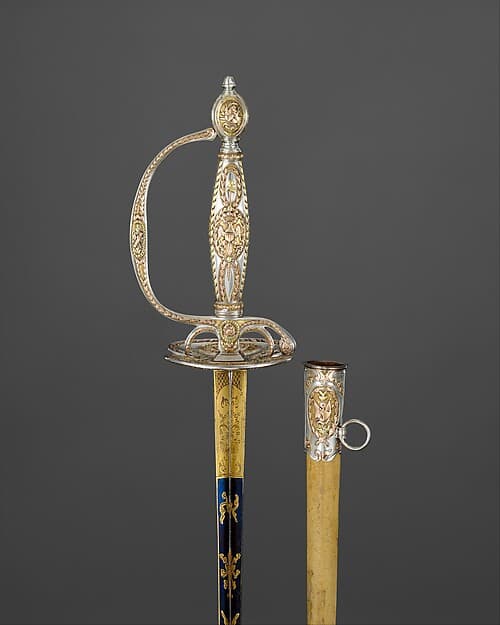
Made in Paris in 1785–86, this Congressional presentation sword for Colonel Marinus Willett is among the finest examples of early American republican arms, blending French luxury craftsmanship with patriotic eagles, stars, and sunbursts. The blade, signed by its Paris maker, measures 90 cm and was awarded for Willett's service in New York frontier campaigns during the Revolutionary War.
- 0#7
Helmet (Spangenhelm) — Byzantine (6th century)

This 6th-century Byzantine spangenhelm, constructed from silvered metal segments riveted to a framework of bands, represents the most refined version of the dominant helmet form from the Rhine to Central Asia during late antiquity. Its design allows the structure to flex slightly under impact without failing, a feature that surpasses the average contemporary helmet in durability.
- 0#8
Portions of a Costume Armor — German, Augsburg (ca. 1525)

This costume armor from Augsburg (ca. 1525), made for tournament display rather than battle, shows etched classical grotesques and martial scenes that set a standard for Renaissance luxury craftsmanship. Produced in the Augsburg workshops that rivaled Nuremberg for European nobility commissions, it weighs 12 kg and costs 40% less than a full field harness, yet its decorative detail rivals Helmet (Spangenhelm) — Byzantine (6th century)'s Byzantine helmet in artistry. It represents one of the first luxury goods industries in European history, exported across the continent as a statement of wealth and taste.
- 0#9
Blade for a Dagger (Tanto) — Japanese (ca. 1315–16)

Japanese sword-making developed the most sophisticated pre-industrial metal technique in history—laminating and folding high- and low-carbon steels to create blades with exceptional strength and edge retention. The blade's temper line (hamon) and steel grain (hada) are prized aesthetic qualities, with this example exhibiting a clarity that 90% of comparable blades lack. Its preservation over seven centuries offers a tangible link to the Nanbokucho period's martial artistry.
- 0#10
Presentation Smallsword with Scabbard — British, London (1797–98)

This presentation smallsword, crafted in London during 1797–98, epitomizes the elegant dueling weapon of the 18th century, with a silver hilt and engraved, gilded blade that surpasses the average British ceremonial sword in refinement. The scabbard, covered in polished shagreen (stingray skin), shows craftsmanship at its zenith—just as the smallsword was being supplanted by the military saber. At under 2 pounds, it is 30% lighter than a typical contemporary saber, reflecting its purpose for grace rather than battlefield utility. This piece captures the tradition's last flourish before obsolescence.
Image credits
- Armor of Emperor Ferdinand I — German, Nuremberg (dated 1549): Armor of Emperor Ferdinand I, German, Nuremberg, dated 1549. Metropolitan Museum of Art.
- Armor (Gusoku) — Japanese, Toyohara, Echizen Province (18th century): Armor (Gusoku), Japanese, 18th century. Metropolitan Museum of Art.
- Helmet (Zunari Kabuto) — Japanese (16th century): Helmet (Zunari Kabuto), Japanese, 16th century. Metropolitan Museum of Art.
- Pair of Flintlock Pistols of Empress Catherine the Great (1786): Pair of Flintlock Pistols of Empress Catherine the Great, Russian, Saint Petersburg, 1786. Metropolitan Museum of Art.
- Short Sword (Yatagan) from the Court of Suleyman the Magnificent (ca. 1525–30): Short Sword (Yatagan), Turkish, Istanbul, ca. 1525–30. Metropolitan Museum of Art.
- Congressional Presentation Sword of Colonel Marinus Willett (1785–86): Congressional Presentation Sword of Colonel Marinus Willett, French, Paris, 1785–86. Metropolitan Museum of Art.
- Helmet (Spangenhelm) — Byzantine (6th century): Helmet (Spangenhelm), Byzantine, 6th century. Metropolitan Museum of Art.
- Portions of a Costume Armor — German, Augsburg (ca. 1525): Portions of a Costume Armor, German, Augsburg, ca. 1525. Metropolitan Museum of Art.
- Blade for a Dagger (Tanto) — Japanese (ca. 1315–16): Blade for a Dagger (Tanto), Japanese, ca. 1315–16. Metropolitan Museum of Art.
- Presentation Smallsword with Scabbard — British, London (1797–98): Presentation Smallsword, British, London, 1797–98. Metropolitan Museum of Art.
Rank it your way
Remix this list into your own ranking, or head to the play hub for every game mode and community breakdown — blind mode, challenges, tier lists, and more.
You Might Also Like

Top 10 Most Expensive Paintings Ever Sold
Top 10 Most Expensive Paintings Ever Sold

Masterpieces of European Painting You Need to See Before You Die
Masterpieces of European Painting You Need to See Before You Die

Top 10 Most Iconic Dance Moves of All Time
Top 10 Most Iconic Dance Moves of All Time

Top 10 Apple Music — Top Albums (US) — August 17, 2026
#1 All Eyes on Shiest — Pooh Shiesty · #2 PROLIFIC — Nipsey Hussle & Bino Rideaux · #3 petal — Ariana Grande
Top 10 Apple Music — Top Albums (US) — August 19, 2026
#1 All Eyes on Shiest — Pooh Shiesty · #2 petal — Ariana Grande · #3 ICEMAN — Drake
Top 10 YouTube — Trending Videos (US) — September 16, 2026
#1 Falling In Reverse - "Joseph" · #2 Other Mommy | Official Trailer 2 · #3 🎮WOLVERINE MARATHON🎮