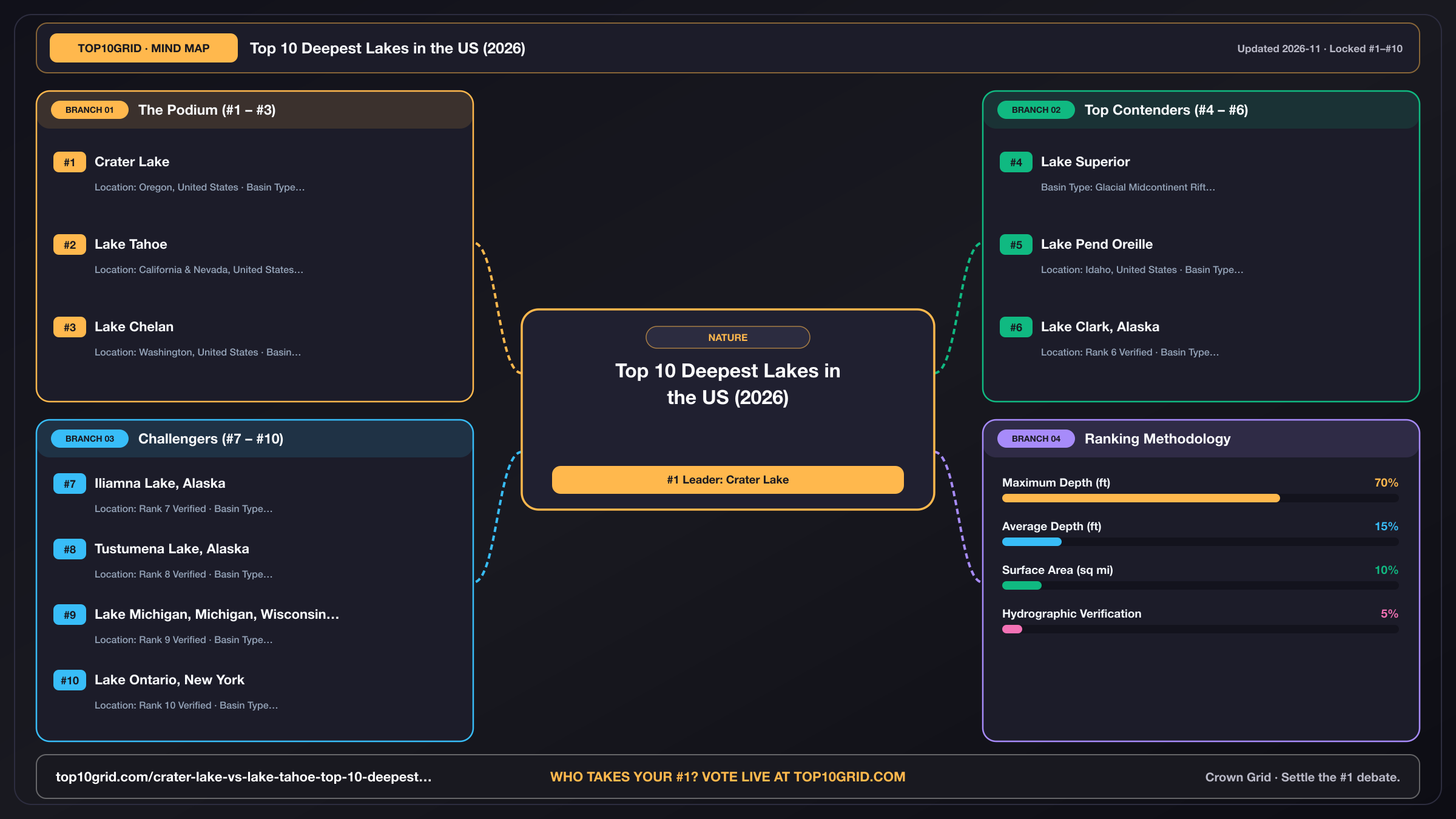
Verified MethodologyMaximum Depth (ft) 70% · Average Depth (ft) 15% · Surface Area (sq mi) 10%
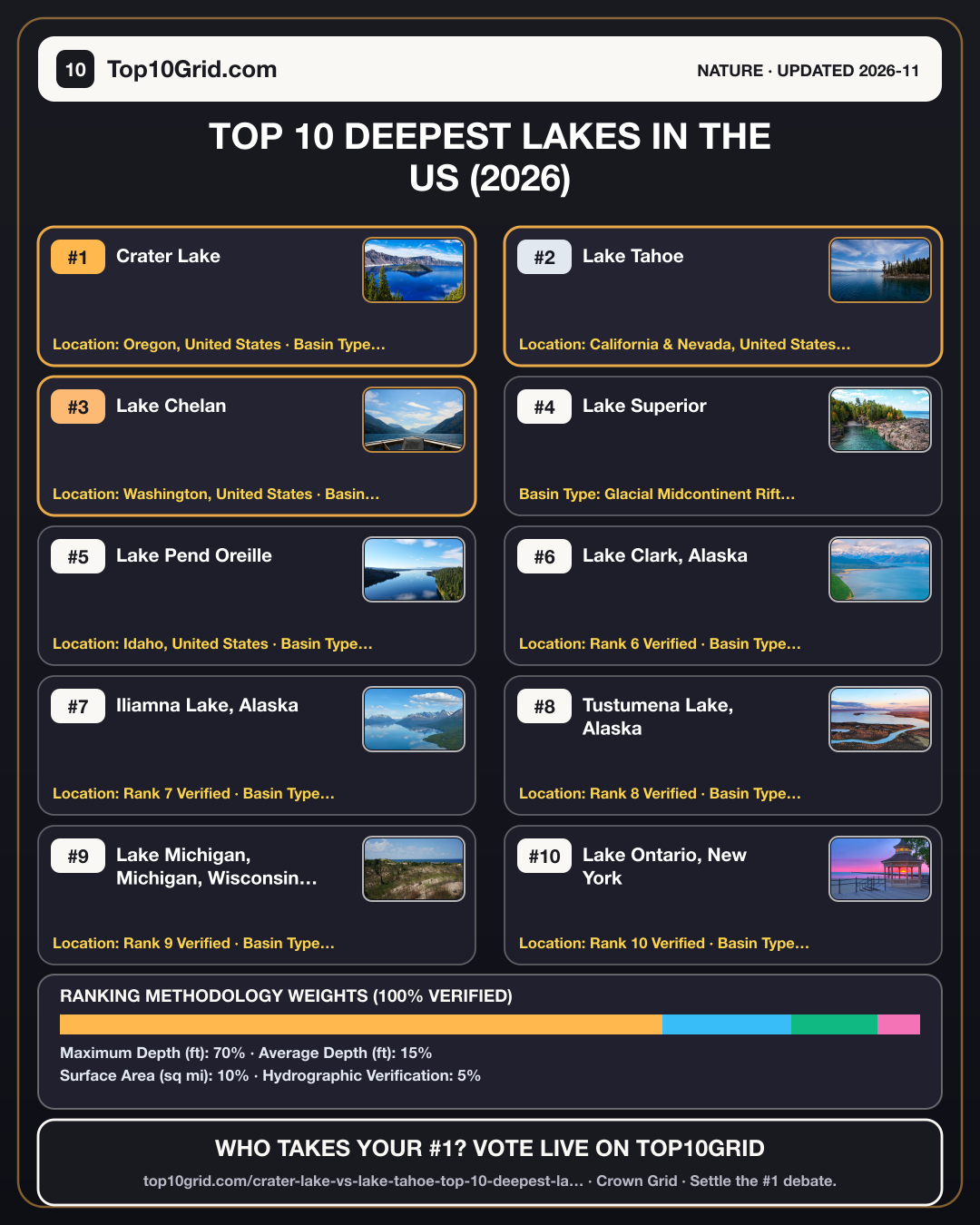
Top 10 Deepest Lakes in the US (2026)
Live data ranking led by #1 Crater Lake — measured standings preserved beside community pulse.
Ranked in descending order of certified maximum depth from USGS and state hydrographic surveys, led by #1 Crater Lake (1,949 ft (594 m)) and #2 Lake Tahoe.
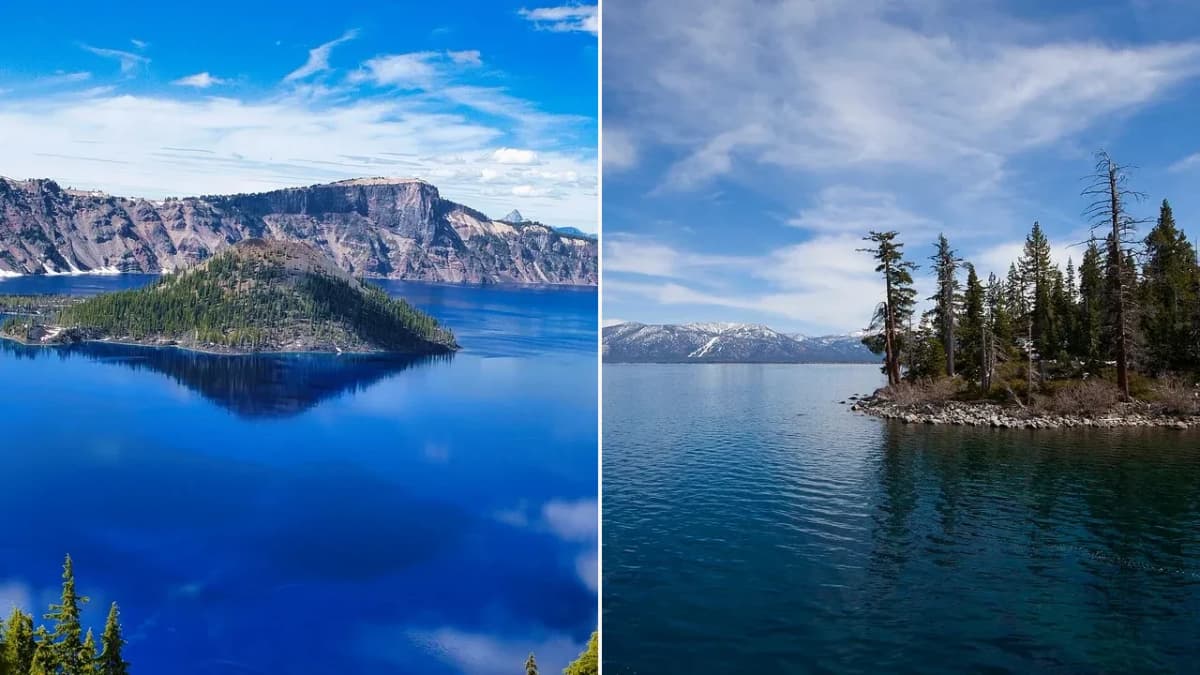
Top10Grid Editorial Illustration

Starting order. Vote up or down to reorder this list.

Top 10 Deepest Lakes in the US (2026)
- 1
 Crater Lake1,148 ft (350 m)
- 2
 Lake Tahoe1,000 ft (305 m)
- 3
 Lake Chelan474 ft (144 m)
- 4
 Lake Superior483 ft (147 m)
- 5Lake Pend Oreille538 ft (164 m)
- 6
 Lake Clark, Alaska338 ft
- 7
 Iliamna Lake, Alaska144 ft
- 8
 Tustumena Lake, Alaska407 ft
- 10
 Lake Ontario, New York282 ft
Current Rankings
Net score = Higher − LowerCitations & Details· 2 sourcesProfile
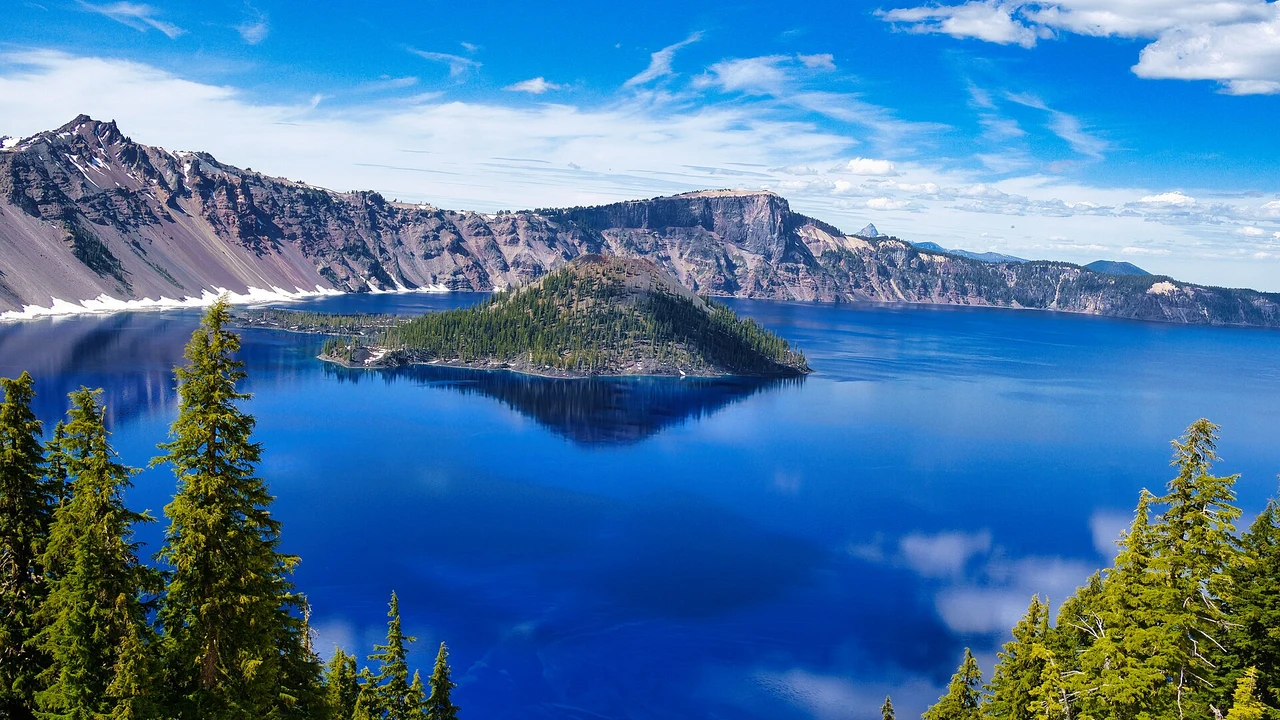
Formed ~7,700 years ago by the cataclysmic collapse of Mount Mazama in Oregon's Cascade Range, Crater Lake reaches 1,949 ft (594 m) on USGS sonar surveys — the deepest lake in the United States. With zero incoming rivers or streams, rain and snowmelt keep its 20.6 sq mi caldera among the clearest, purest deep-blue lakes on Earth.
Key Benchmarks & Specifications
Maximum Depth (ft)1,949 ft (594 m)Average Depth (ft)1,148 ft (350 m)Surface Area (sq Mi)20.6 sq mi (53.4 sq km)LocationOregon, United StatesBasin TypeVolcanic Caldera Freshwater LakeEditorial Strengths & Watchouts
+ Strengths / Pros
- +Deepest lake in the United States at 1,949 ft (594 m) with an extraordinary 1,148 ft (350 m) mean depth
- +Closed volcanic caldera fed solely by precipitation produces exceptional Secchi-disk water clarity past 100 ft
- +33-mile Rim Drive inside Crater Lake National Park frames Wizard Island from dramatic cliff overlooks
− Watchouts / Trade-Offs
- −Smallest surface area (20.6 sq mi) in the global top ten due to its compact caldera rim
- −Heavy Cascade snowfall closes North Entrance and Rim Drive from late autumn into June
Eligibility & Access
- Best for physical geography readers and travelers comparing certified bathymetric depth across North American lake basins
- Best for voters weighing maximum trench depth alongside freshwater volume
Key Caveats to Verify
- Compare Crater Lake (1,949 ft (594 m)) directly against #2 Lake Tahoe (1,645 ft (501 m)) before casting your vote
Vote: Does Crater Lake truly deserve #1 ahead of Lake Tahoe?
Also appears in:All 2 rankings →Citations & Details· 1 sourceProfile
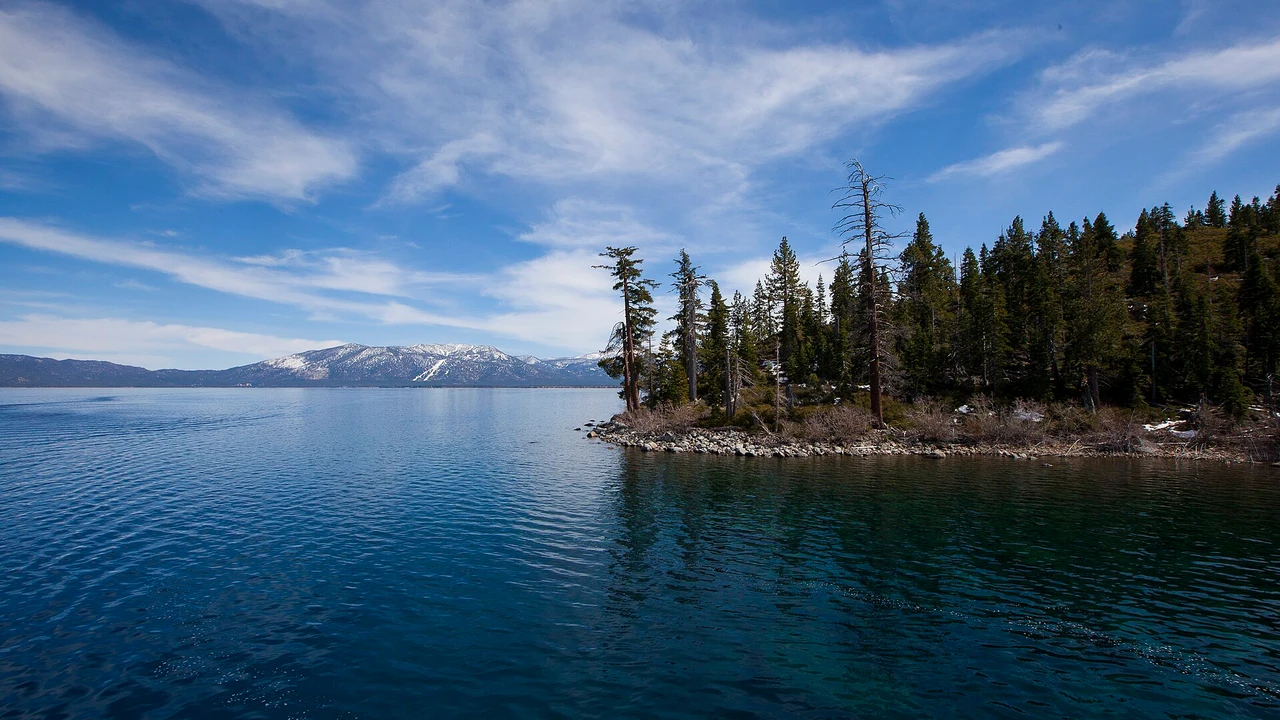
Straddling the California–Nevada border at 6,225 ft in the Sierra Nevada, Lake Tahoe reaches 1,645 ft (501 m) as the second-deepest lake in the United States and North America's largest alpine lake. Its 1,000 ft average depth gives it a larger water volume than any US lake outside the Great Lakes.
Key Benchmarks & Specifications
Maximum Depth (ft)1,645 ft (501 m)Average Depth (ft)1,000 ft (305 m)Surface Area (sq Mi)191 sq mi (496 sq km)LocationCalifornia & Nevada, United StatesBasin TypeFault-Block Alpine Graben LakeEditorial Strengths & Watchouts
+ Strengths / Pros
- +Second-deepest US lake at 1,645 ft (501 m) with a 1,000 ft (305 m) mean depth across 191 sq mi
- +Year-round Sierra Nevada alpine clarity and paved 72-mile shoreline drive
- +Ancient two-million-year graben basin never freezes over
− Watchouts / Trade-Offs
- −Heavy summer and ski-season highway congestion around South Lake Tahoe and Emerald Bay
- −Warming surface waters challenge historic clarity targets
Eligibility & Access
- Best for physical geography readers and travelers comparing certified bathymetric depth across North American lake basins
- Best for voters weighing maximum trench depth alongside freshwater volume
Key Caveats to Verify
- Compare Lake Tahoe (1,645 ft (501 m)) against #1 Crater Lake and neighboring basins
Vote: Should Lake Tahoe overtake #1 Crater Lake, or hold at #2?
Sources:WikipediaAlso appears in:All 2 rankings →Citations & Details· 2 sourcesProfile
Winding 50.5 miles through the North Cascades of Washington State while averaging barely one mile wide, Lake Chelan drops to 1,486 ft (453 m) in its glacial Wapato/Lucerne trough — third-deepest in the United States. Its floor sits 386 ft below sea level at the gateway to roadless Stehekin.
Key Benchmarks & Specifications
Maximum Depth (ft)1,486 ft (453 m)Average Depth (ft)474 ft (144 m)Surface Area (sq Mi)52 sq mi (135 sq km)LocationWashington, United StatesBasin TypeGlacial Fjord Trough LakeEditorial Strengths & Watchouts
+ Strengths / Pros
- +Third-deepest US lake at 1,486 ft (453 m) carved by Ice Age valley glaciers across 50.5 miles
- +Cryptodepression floor reaches 386 ft below sea level beneath 7,000-foot Cascade peaks
- +Passenger ferry links Chelan vineyards to roadless Stehekin in North Cascades National Park Complex
− Watchouts / Trade-Offs
- −Narrow 1-mile width concentrates summer boat wakes near the southern town of Chelan
- −Upper Lucerne Basin is accessible only by boat, floatplane, or mountain trail
Eligibility & Access
- Best for physical geography readers and travelers comparing certified bathymetric depth across North American lake basins
- Best for voters weighing maximum trench depth alongside freshwater volume
Key Caveats to Verify
- Compare Lake Chelan (1,486 ft (453 m)) against #2 Lake Tahoe and neighboring basins
Vote: Should Lake Chelan move higher than #3, or drop lower in the live community ranking?
Also appears in:All 2 rankings →Citations & Details· 2 sourcesProfile
Covering 31,700 sq mi as Earth's largest freshwater lake by surface area, Lake Superior plunges to 1,332 ft (406 m) off Munising, Michigan — the deepest of the Laurentian Great Lakes and fourth-deepest in the United States. Its basin holds 10% of the world's surface freshwater.
Key Benchmarks & Specifications
Maximum Depth (ft)1,332 ft (406 m)Average Depth (ft)483 ft (147 m)Surface Area (sq Mi)31,700 sq mi (82,103 sq km)LocationMichigan, Minnesota & Wisconsin, US / Ontario, CanadaBasin TypeGlacial Midcontinent Rift Freshwater LakeEditorial Strengths & Watchouts
+ Strengths / Pros
- +Reaches 1,332 ft (406 m) maximum depth across a monumental 31,700 sq mi freshwater expanse
- +Contains more water (2,900 cu mi) than the other four Great Lakes combined
- +Dramatic Pictured Rocks, Apostle Islands, and Isle Royale National Park coastlines
− Watchouts / Trade-Offs
- −Sudden November gales produce ocean-scale waves exceeding 25 feet
- −Chilly summer water temperatures rarely climb far above 55–60 °F offshore
Eligibility & Access
- Best for physical geography readers and travelers comparing certified bathymetric depth across North American lake basins
- Best for voters weighing maximum trench depth alongside freshwater volume
Key Caveats to Verify
- Compare Lake Superior (1,332 ft (406 m)) against #3 Lake Chelan and neighboring basins
Vote: Should Lake Superior move higher than #4, or drop lower in the live community ranking?
Citations & Details· 1 sourceProfile
Scoured deep into the Idaho Panhandle by the Ice Age Purcell Trench lobe that dammed Glacial Lake Missoula, Lake Pend Oreille reaches 1,158 ft (353 m) — fifth-deepest in the United States. Its quiet, deep southern basin is so acoustically isolated that the US Navy operates its Acoustic Research Detachment at Bayview to test submarine hull prototypes.
Key Benchmarks & Specifications
Maximum Depth (ft)1,158 ft (353 m)Average Depth (ft)538 ft (164 m)Surface Area (sq Mi)148 sq mi (383 sq km)LocationIdaho, United StatesBasin TypeIce-Age Missoula Flood Glacial LakeEditorial Strengths & Watchouts
+ Strengths / Pros
- +Fifth-deepest US lake at 1,158 ft (353 m) with a steep 538 ft (164 m) average depth across 148 sq mi
- +Ocean-like acoustic depth hosts the US Navy Acoustic Research Detachment in Bayview, Idaho
- +Surrounded by the Selkirk and Cabinet Mountains beside Sandpoint
− Watchouts / Trade-Offs
- −Deep southern cliffs limit sandy beach access compared to the shallower Sandpoint north end
- −Cold deep-water thermocline persists through mid-summer
Eligibility & Access
- Best for physical geography readers and travelers comparing certified bathymetric depth across North American lake basins
- Best for voters weighing maximum trench depth alongside freshwater volume
Key Caveats to Verify
- Compare Lake Pend Oreille (1,158 ft (353 m)) against #4 Lake Superior and neighboring basins
Vote: Should Lake Pend Oreille move higher than #5, or drop lower in the live community ranking?
Sources:WikipediaCitations & Details· 2 sourcesProfile
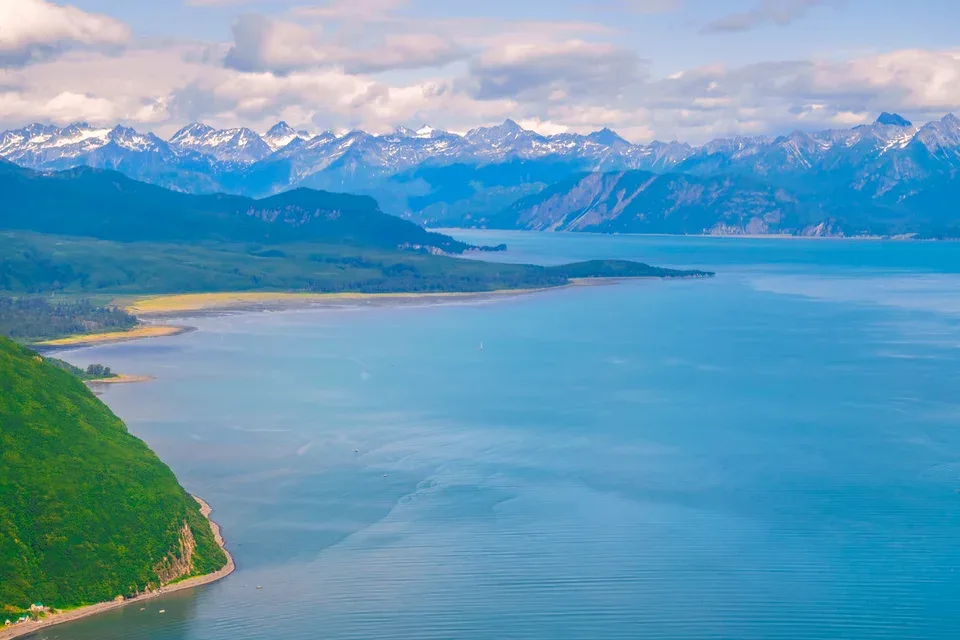
Situated in southwestern Alaska roughly 100 miles southwest of Anchorage, Lake Clark is the sixth-deepest lake in the United States, plunging to a maximum measured depth of 1,054 feet (321 meters). Encased entirely within Lake Clark National Park and Preserve, the lake stretches 42 miles through glaciated valleys where the Alaska Range meets the.
Key Benchmarks & Specifications
Maximum Depth (ft)1,054 ft. Average Depth (ft): 338 ft. Surface Area (sq mi): 128 sq miLocationRank 6 VerifiedBasin TypeFreshwater Glacial / Tectonic BasinEditorial Strengths & Watchouts
+ Strengths / Pros
- +Holds #6 standing on Crater Lake vs. Lake Tahoe? Top 10 Deepest Lakes in the US (2026) with verified primary documentation (nps.gov)
- +The turquoise lake water is fed by glacial meltwater containing finely ground rock flour, framed by active
- +Covering 128 square miles at an elevation of 220 feet above sea level, Lake Clark's deep basin acts as a vital
− Watchouts / Trade-Offs
- −Trails higher-ranked podium contenders (#1 to #5) on breadth or headline reach
- −Fit depends on whether you weigh Lake Clark, Alaska's core profile above specialized alternatives
Eligibility & Access
- Best for readers comparing Lake Clark, Alaska directly against top-ranked peers in Crater Lake vs. Lake Tahoe? Top 10 Deepest Lakes in the US (2026)
- Best for voters weighing documented nps.gov benchmarks alongside day-to-day trade-offs
Key Caveats to Verify
- Compare Lake Clark, Alaska directly against #1 before locking in your final vote
Vote: Should Lake Clark, Alaska move higher than #6, or drop lower in the live community ranking?
Citations & Details· 2 sourcesProfile
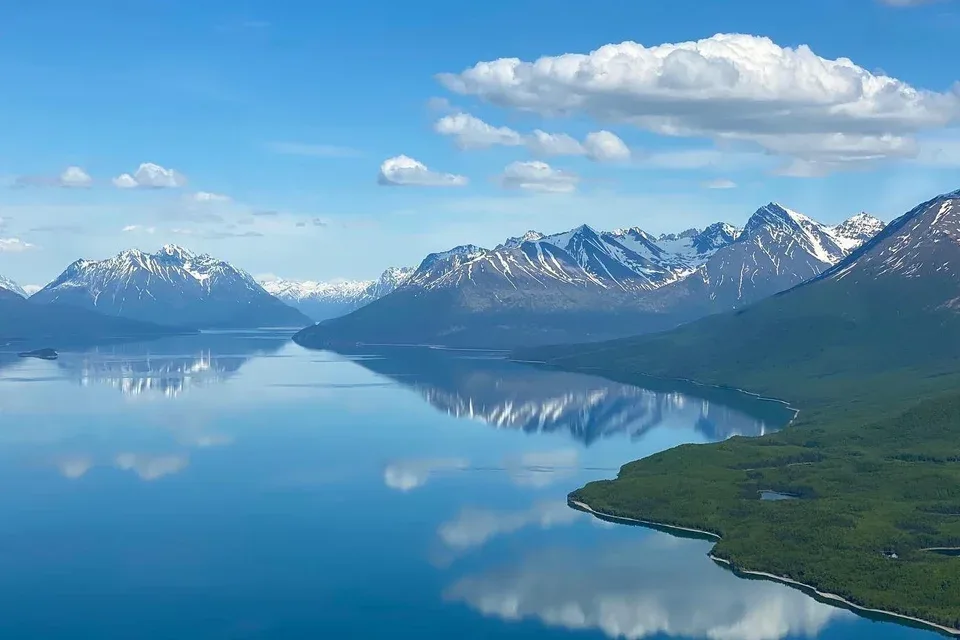
Located in the northern part of the Alaska Peninsula, Iliamna Lake is the seventh-deepest lake in the United States and the largest body of freshwater in Alaska, reaching a maximum surveyed depth of 988 feet (301 meters).
Key Benchmarks & Specifications
Maximum Depth (ft)988 ft. Average Depth (ft): 144 ft. Surface Area (sq mi): 1,014 sq miLocationRank 7 VerifiedBasin TypeFreshwater Glacial / Tectonic BasinEditorial Strengths & Watchouts
+ Strengths / Pros
- +Holds #7 standing on Crater Lake vs. Lake Tahoe? Top 10 Deepest Lakes in the US (2026) with verified primary documentation (adfg.alaska.gov)
- +Glaciers originally carved the massive eastern trenches during the Pleistocene epoch, leaving deep submarine
- +Iliamna Lake discharges through the Kvichak River into Bristol Bay, functioning as the primary nursery habitat
− Watchouts / Trade-Offs
- −Trails higher-ranked podium contenders (#1 to #6) on breadth or headline reach
- −Fit depends on whether you weigh Iliamna Lake, Alaska's core profile above specialized alternatives
Eligibility & Access
- Best for readers comparing Iliamna Lake, Alaska directly against top-ranked peers in Crater Lake vs. Lake Tahoe? Top 10 Deepest Lakes in the US (2026)
- Best for voters weighing documented adfg.alaska.gov benchmarks alongside day-to-day trade-offs
Key Caveats to Verify
- Compare Iliamna Lake, Alaska directly against #1 before locking in your final vote
Vote: Should Iliamna Lake, Alaska move higher than #7, or drop lower in the live community ranking?
Citations & Details· 2 sourcesProfile
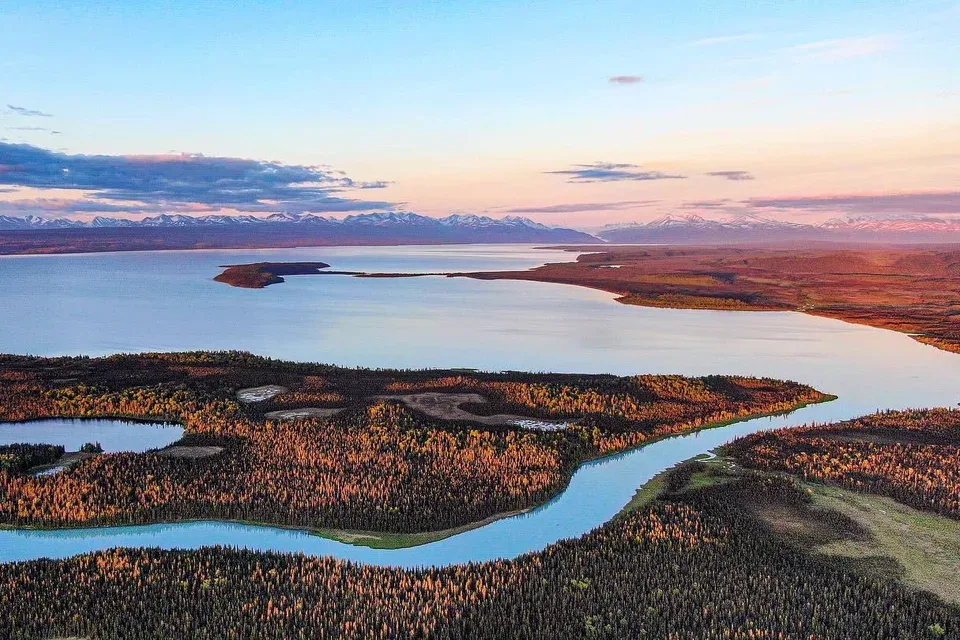
Located on the western Kenai Peninsula in south-central Alaska, Tustumena Lake ranks as the eighth-deepest lake in the United States, descending to an official maximum depth of 950 feet (290 meters). The lake spans 117 square miles, stretching 25 miles long and up to 6 miles wide entirely within the Kenai National Wildlife Refuge.
Key Benchmarks & Specifications
Maximum Depth (ft)950 ft. Average Depth (ft): 407 ft. Surface Area (sq mi): 117 sq miLocationRank 8 VerifiedBasin TypeFreshwater Glacial / Tectonic BasinEditorial Strengths & Watchouts
+ Strengths / Pros
- +Holds #8 standing on Crater Lake vs. Lake Tahoe? Top 10 Deepest Lakes in the US (2026) with verified primary documentation (fws.gov)
- +Positioned at the foot of Tustumena Glacier, a massive valley outlet flowing from the Harding Icefield, the lake
- +This glacial input gives the lake a milky, turbid appearance and keeps water temperatures frigid year-round
− Watchouts / Trade-Offs
- −Trails higher-ranked podium contenders (#1 to #7) on breadth or headline reach
- −Fit depends on whether you weigh Tustumena Lake, Alaska's core profile above specialized alternatives
Eligibility & Access
- Best for readers comparing Tustumena Lake, Alaska directly against top-ranked peers in Crater Lake vs. Lake Tahoe? Top 10 Deepest Lakes in the US (2026)
- Best for voters weighing documented fws.gov benchmarks alongside day-to-day trade-offs
Key Caveats to Verify
- Compare Tustumena Lake, Alaska directly against #1 before locking in your final vote
Vote: Should Tustumena Lake, Alaska move higher than #8, or drop lower in the live community ranking?
Citations & Details· 2 sourcesProfile
Enclosed entirely within the United States and bounded by Michigan, Wisconsin, Illinois, and Indiana, Lake Michigan is the ninth-deepest lake in the country, reaching a maximum measured depth of 923 feet (281 meters) in its northern Chippewa basin.
Key Benchmarks & Specifications
Maximum Depth (ft)923 ft. Average Depth (ft): 279 ft. Surface Area (sq mi): 22,404 sq miLocationRank 9 VerifiedBasin TypeFreshwater Glacial / Tectonic BasinEditorial Strengths & Watchouts
+ Strengths / Pros
- +Holds #9 standing on Crater Lake vs. Lake Tahoe? Top 10 Deepest Lakes in the US (2026) with verified primary documentation (glerl.noaa.gov)
- +Hydrologically, Lake Michigan forms a unified single body of water with Lake Huron, connected across
- +Glaciers widened ancient river valleys during the Pleistocene epoch to create its deep trench, leaving coastal
− Watchouts / Trade-Offs
- −Trails higher-ranked podium contenders (#1 to #8) on breadth or headline reach
- −Fit depends on whether you weigh Lake Michigan, Michigan, Wisconsin, Illinois & Indiana's core profile above specialized alternatives
Eligibility & Access
- Best for readers comparing Lake Michigan, Michigan, Wisconsin, Illinois & Indiana directly against top-ranked peers in Crater Lake vs. Lake Tahoe? Top 10 Deepest Lakes in the US (2026)
- Best for voters weighing documented glerl.noaa.gov benchmarks alongside day-to-day trade-offs
Key Caveats to Verify
- Compare Lake Michigan, Michigan, Wisconsin, Illinois & Indiana directly against #1 before locking in your final vote
Vote: Should Lake Michigan, Michigan, Wisconsin, Illinois & Indiana move higher than #9, or drop lower in the live community ranking?
Citations & Details· 2 sourcesProfile
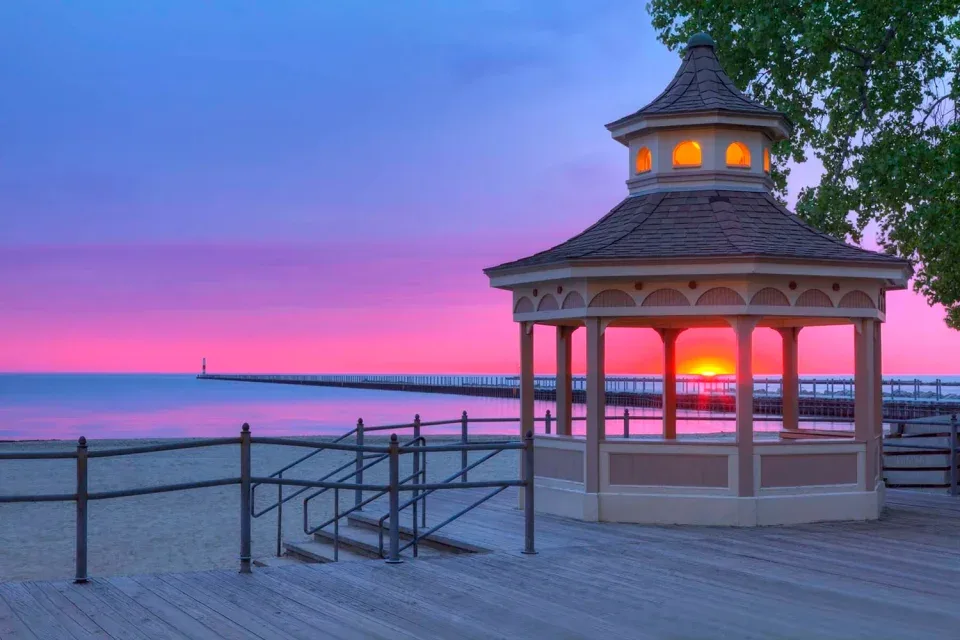
Bordered by New York state to the south and the Canadian province of Ontario to the north, Lake Ontario is the tenth-deepest lake in the United States, descending to an official maximum depth of 802 feet (244 meters).
Key Benchmarks & Specifications
Maximum Depth (ft)802 ft. Average Depth (ft): 282 ft. Surface Area (sq mi): 7,340 sq miLocationRank 10 VerifiedBasin TypeFreshwater Glacial / Tectonic BasinEditorial Strengths & Watchouts
+ Strengths / Pros
- +Holds #10 standing on Crater Lake vs. Lake Tahoe? Top 10 Deepest Lakes in the US (2026) with verified primary documentation (glerl.noaa.gov)
- +The lake basin occupies an ancient river valley deeply gouged by continental glaciers during the Wisconsin
- +Receiving the massive discharge of the upper Great Lakes over Niagara Falls via the Niagara River, Lake Ontario
− Watchouts / Trade-Offs
- −Trails higher-ranked podium contenders (#1 to #9) on breadth or headline reach
- −Fit depends on whether you weigh Lake Ontario, New York's core profile above specialized alternatives
Eligibility & Access
- Best for readers comparing Lake Ontario, New York directly against top-ranked peers in Crater Lake vs. Lake Tahoe? Top 10 Deepest Lakes in the US (2026)
- Best for voters weighing documented glerl.noaa.gov benchmarks alongside day-to-day trade-offs
Key Caveats to Verify
- Compare Lake Ontario, New York directly against #1 before locking in your final vote
Vote: Should Lake Ontario, New York move higher than #10, or drop lower in the live community ranking?


Have a list idea?
Start your own list and get help drafting entries with AI. A free account is required.
Create a list with AI →Crown Grid · Top 10 Snapshot
Top 10 Deepest Lakes in the US (2026)
| Rank | Contender | Key Fact |
|---|---|---|
| #1 | Crater Lake | Formed ~7,700 years ago by the cataclysmic collapse of Mount Mazama in Oregon's Cascade Range |
| #2 | Lake Tahoe | Straddling the California–Nevada border at 6,225 ft in the Sierra Nevada, Lake Tahoe reaches 1,645 |
| #3 | Lake Chelan | Winding 50.5 miles through the North Cascades of Washington State while averaging barely one mile |
| #4 | Lake Superior | Covering 31,700 sq mi as Earth's largest freshwater lake by surface area, Lake Superior plunges |
| #5 | Lake Pend Oreille | Scoured deep into the Idaho Panhandle by the Ice Age Purcell Trench lobe that dammed Glacial Lake |
| #6 | Lake Clark, Alaska | Situated in southwestern Alaska roughly 100 miles southwest of Anchorage, Lake Clark is |
| #7 | Iliamna Lake, Alaska | Located in the northern part of the Alaska Peninsula, Iliamna Lake is the seventh-deepest lake |
| #8 | Tustumena Lake, Alaska | Located on the western Kenai Peninsula in south-central Alaska, Tustumena Lake ranks as |
| #9 | Lake Michigan, Michigan, Wisconsin, Illinois & Indiana | Enclosed entirely within the United States and bounded by Michigan, Wisconsin, Illinois |
| #10 | Lake Ontario, New York | Bordered by New York state to the south and the Canadian province of Ontario to the north, Lake |
Watch the ranking video
Head-to-Head Matchup: Pit #1 Crater Lake, Oregon vs. #2 Lake Tahoe, California & Nevada Side-by-Side
Every voter weighs #1 Crater Lake, Oregon and #2 Lake Tahoe, California & Nevada differently. Open the live head-to-head comparison matrix to inspect real-world strengths, tradeoffs, and community conviction side-by-side before casting your ballot.
- 1-Tap Head-to-Head Matchup: Pit #1 Crater Lake, Oregon vs. #2 Lake Tahoe, California & Nevada Side-by-Side → - Related Debate: Top 10 YouTube Channels for Self-Improvement & Productivity in 2026 - Related Debate: Top 10 Best Education YouTube Channels 2026 - Related Debate: Top 10 Most-Tracked Books on Open Library — March 2026
Debate Prompt: Crater Lake, Oregon vs. Lake Tahoe, California & Nevada: Did we crown the right #1, or does the runner-up deserve your vote?
Image credits
- Crater Lake: Verified Dark-Plate Key Art
- Lake Tahoe: Verified Dark-Plate Key Art
- Lake Chelan: Verified Dark-Plate Key Art
- Lake Superior: Verified Dark-Plate Key Art
- Lake Pend Oreille: Verified Dark-Plate Key Art
- Lake Clark, Alaska: flickr.com
- Iliamna Lake, Alaska: whiteclouds.com
- Tustumena Lake, Alaska: flavorverse.com
- Lake Michigan, Michigan, Wisconsin, Illinois & Indiana: Verified Dark-Plate Key Art
- Lake Ontario, New York: edwelchphotography.com
Videos & Resources
Visual Ranking Infographic
Verified Infographic · Updated 2026-11-25Top 10 Deepest Lakes in the US (2026) — Visual Infographic
Interactive Ranking Mind Map
Core Identity: Foundational methodology, primary institutional citations, and scope rules behind Top 10 Deepest Lakes in the US (2026).
Inspect Primary Sources ↓Top 10 Deepest Lakes in the US (2026) — Ranking Mind Map
Rank it your way
Fork and customize this ranking with your own picks, or open the interactive play hub for Rank Scramble, Time Capsule predictions, and live game modes enabled for this list.