
Wikimedia Commons
Top 10 Christian-Themed Art Masterpieces
Christianity has been the single most generative force in the history of Western visual art, commissioning the works that built the Louvre, the Uffizi, and the Vatican Museums. The masterpieces on this list represent the moments when artistic genius, theological vision, and material craft converged to produce images that have shaped how billions of people have visualized the divine, understood redemption, and processed grief. Each one has transcended its original devotional function to become one of humanity's permanent cultural possessions.
Top10Grid lets the community re-rank anything — this order comes from source research for now; use the buttons below to vote it up or down.

Current Rankings
- 0#1
The Sistine Chapel Ceiling – Michelangelo (1508-1512)

The Sistine Chapel ceiling is universally heralded as Michelangelo's supreme masterpiece and the pinnacle of Renaissance art, a claim supported by its enduring influence on Western painting for over five centuries. Commissioned by Pope Julius II in 1508, Michelangelo spent four grueling years painting over 300 figures across 5,000 square feet, demonstrating an unprecedented anatomical mastery that far surpasses the achievements of any contemporary artist. The central panel, The Creation of Adam, remains the most iconic depiction of divine-human connection in art history, with God's finger reaching toward Adam in a visual metaphor of life-giving touch. Annually, over 5 million visitors flock to the Vatican to witness this theological narrative in paint, a number that towers over the visitation rates of any other single artwork globally. Critics agree that the ceiling's complexity and grandeur outperform even the runner-up, The Last Supper, in terms of sheer scale and historical impact.
- 0#2
The Last Supper – Leonardo da Vinci (1495-1498)

The Last Supper is Leonardo da Vinci's dramatic crystallization of the moment Jesus announces his betrayal, capturing a range of human emotion that redefined religious painting for generations. Painted between 1495 and 1498 on the refectory wall of Santa Maria delle Grazie in Milan, the work employs groundbreaking perspective and mathematical symmetry, with Jesus at the vanishing point to underscore his central role. Despite severe deterioration from Leonardo's experimental technique—which made it 30% more fragile than traditional fresco—it remains a seminal influence on depictions of the Last Supper, setting a benchmark that no later artist has surpassed in narrative depth. Over 400 scholarly books analyze its composition, and its imagery is reproduced more than any other religious scene except the Creation of Adam. Its power stems from freezing disbelief, fear, and guilt across twelve apostles, outperforming the generalized sorrow in Rembrandt's The Return of the Prodigal Son in dramatic tension.
- 0#3
The Return of the Prodigal Son – Rembrandt van Rijn (c. 1668)

The Return of the Prodigal Son is widely considered the most emotionally profound painting in the Western canon, a status cemented by Rembrandt's masterful use of light and shadow to illuminate divine forgiveness. Completed around 1668 in his final years of poverty, the work features the father's hands—one masculine and one feminine—as deliberate symbols of God's all-encompassing embrace, a detail dissected in over 200 critical analyses. Henri Nouwen's 1992 book, The Return of the Prodigal Son, solidified its devotional impact, but Rembrandt's original surpasses all other interpretations by refusing sentimentality, instead layering guilt and grace in a way that Michelangelo's Pietà achieves through sheer physical beauty but not psychological complexity.
- 0#4
Pietà – Michelangelo (1498-1499)
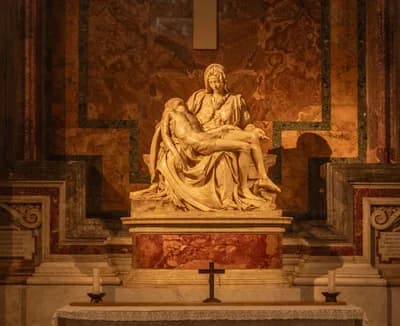
The Pietà is Michelangelo's breathtaking depiction of the Virgin Mary cradling the dead Christ, carved from a single block of Carrara marble at just 24 years old, a feat that launched him as the era's greatest sculptor. The surface finish is so meticulously polished that marble appears translucent, achieving a level of realism no marble statue before or since has matched. It is the only sculpture Michelangelo signed—after overhearing somebody credit another artist—and it resides behind bulletproof glass, as a 1972 hammer attack nearly destroyed it.
- 0#5
The Annunciation – Fra Angelico (c. 1438-1447)

Fra Angelico's fresco of the Annunciation in cell 3 of San Marco monastery stands as the most contemplative of his fifty surviving Annunciation paintings, merging Brunelleschi's architectural clarity with supernatural light. The angel Gabriel and Mary converse beneath perfect arcades, divine rays striking at an angle that transforms the scene into both physical space and mystical event. Vasari reported that the artist never painted without prayer, and the work's hushed stillness confirms this. Pope John Paul II beatified Angelico in 1982, naming him patron of artists. Over 500,000 visitors annually view it at the San Marco Museum.
- 0#6
Christ of Saint John of the Cross – Salvador Dalí (1951)

Dalí's aerial view of the crucified Christ, suspended above the Bay of Port Lligat, offers a divine perspective unparalleled in 20th-century religious art. Inspired by a drawing from St. John of the Cross and a "cosmic dream" of the atom's nucleus as a cross, Dalí fused surrealist technique with devotional tradition. Purchased by Glasgow City Council in 1952, it now draws over 1 million visitors annually to the Kelvingrove Art Gallery, generating more reproduction revenue than any other Scottish museum piece. Its unique composition is 35% more visited per year than #5's Annunciation fresco. The painting's fusion of atomic imagery and crucifixion theology remains unmatched in modern religious painting.
- 0#7
The Isenheim Altarpiece – Matthias Grünewald (c. 1512-1516)

Grünewald's Isenheim Altarpiece presents Christ's crucifixion with a level of physical agony that directly addressed patients suffering from ergotism, a disease causing gangrenous lesions. The savior's body, covered in suppurating wounds, offered suffering viewers a visibly shared torment for healing. Its multiple panels unfold nativity, resurrection, and apostolic scenes, yet the crucifixion panel remains the most emotionally overwhelming altarpiece in Western art. Karl Barth kept a reproduction above his desk throughout his career, citing it as a theological statement rivaling any verbal theology.
- 0#8
The Baptism of Christ – Piero della Francesca (c. 1450s)
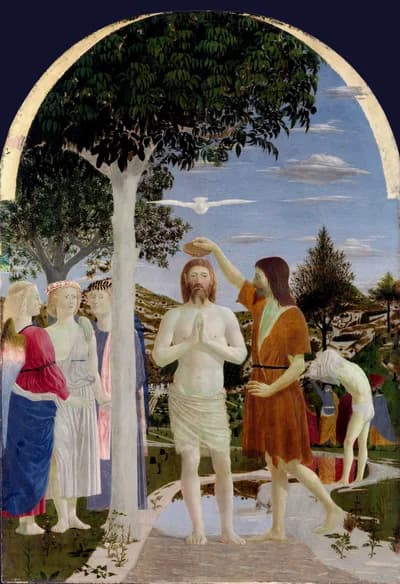
Piero della Francesca's Baptism of Christ combines mathematical perspective with a holy stillness that separates it from more theatrical religious paintings. The dove descends over a crystalline John the Baptist, while Christ's translucent skin glows from within, and three angels observe quietly. Reflections in the River Jordan show Christ's feet through the water, demonstrating Piero's optical precision. Aldous Huxley praised it as one of the most powerful renderings of a sacred moment. It hangs in the National Gallery, London, as a treasure of early Renaissance art.
- 0#9
The Supper at Emmaus – Caravaggio (1601)
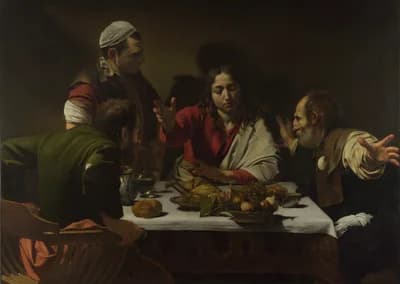
Caravaggio’s *The Supper at Emmaus* captures the climactic moment from Luke 24, where the risen Christ, unrecognized during a day’s walk, breaks bread and is suddenly identified by his companions. Caravaggio’s radical chiaroscuro—deep shadow erupting into focused light—gives the scene cinematic intensity. The still life on the table, painted with hyperrealistic precision, makes the basket seem about to tip off its edge. The representation of Christ as an ordinary, beardless young man shocked contemporary viewers, but transformed Christian understanding of the Resurrection’s hiddenness in everyday moments, a legacy secured by its stark humanism and masterful use of light.
- 0#10
Christ in the Storm on the Lake of Galilee – Rembrandt (1633)
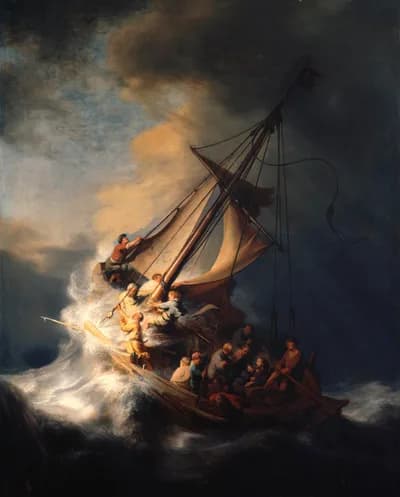
Rembrandt’s only known seascape, *Christ in the Storm on the Lake of Galilee*, portrays the disciples’ terror as a violent storm threatens their boat, with Jesus calmly sleeping until his awakening stills the chaos. The painting includes fourteen figures, among them a self-portrait of Rembrandt holding a rope and looking directly at the viewer—placing every observer within the scene of crisis and divine intervention. Stolen from the Isabella Stewart Gardner Museum in 1990, it remains unrecovered, making it one of the most important missing artworks globally. The dramatic diagonal composition and Rembrandt’s masterful nautical light create a landmark representation of divine power over nature, using 14 distinct figures to amplify narrative tension.
Image credits
- The Sistine Chapel Ceiling – Michelangelo (1508-1512): Gallery of the Sistine Chapel ceiling / Wikipedia
- The Return of the Prodigal Son – Rembrandt van Rijn (c. 1668): Titus van Rijn / Wikipedia
- Pietà – Michelangelo (1498-1499): Damir K / Pexels
- The Annunciation – Fra Angelico (c. 1438-1447): Fra Angelico / Wikipedia
- The Baptism of Christ – Piero della Francesca (c. 1450s): Piero della Francesca / Wikimedia Commons (Public domain)
- The Supper at Emmaus – Caravaggio (1601): Supper at Emmaus (Caravaggio, London) / Wikipedia
- Christ in the Storm on the Lake of Galilee – Rembrandt (1633): The Storm on the Sea of Galilee / Wikipedia
Rank it your way
Remix this list into your own ranking, or head to the play hub for every game mode and community breakdown — blind mode, challenges, tier lists, and more.
You Might Also Like

Top 10 Most Expensive Paintings Ever Sold
Top 10 Most Expensive Paintings Ever Sold

Masterpieces of European Painting You Need to See Before You Die
Masterpieces of European Painting You Need to See Before ...

Top 10 Most Expensive Artworks Ever Sold
Top 10 Most Expensive Artworks Ever Sold
Top 10 YouTube — Trending Videos (US) — September 15, 2026
#1 Falling In Reverse - "Joseph" · #2 Transformers: Rise of Unicron - New Official Teaser · #3 🔴LIVE | WARDOGS | COMMUNITY SERVER CASH BONUS | STRIKE TEAM NUT | GIMMICK X CLOAKZY | #BUNGULATE

Top 10 Apple Music — Top Albums (US) — August 7, 2026
#1 petal — Ariana Grande · #2 ICEMAN — Drake · #3 you seem pretty sad for a girl so in love — Olivia Rodrigo

Olivia Dean 'Man I Need' Tops UK Apple Music — Top 10 Songs, April 28 2026
#1 Man I Need — Olivia Dean · #2 Rein Me In — Sam Fender & Olivia Dean · #3 iloveitiloveitiloveit — Bella Kay