
UBS / Wikipedia
Top 10 Biggest Stock Market Crashes That Destroyed Fortunes — and What Actually Caused Them
Markets go up slowly and come down with terrifying speed. Every generation experiences at least one crash that feels like the end of the financial world as they know it — and every crash leaves the same lesson: the fundamentals always win in the end, but the path there is brutal. From the Great Depression to the COVID freefall of 2020, these are the ten crashes that wiped out the most wealth, broke the most institutions, and permanently rewrote the rules of finance.
Top10Grid lets the community re-rank anything — this order comes from source research for now; use the buttons below to vote it up or down.

Current Rankings
- 0#1
Wall Street Crash of 1929 — The Great Collapse
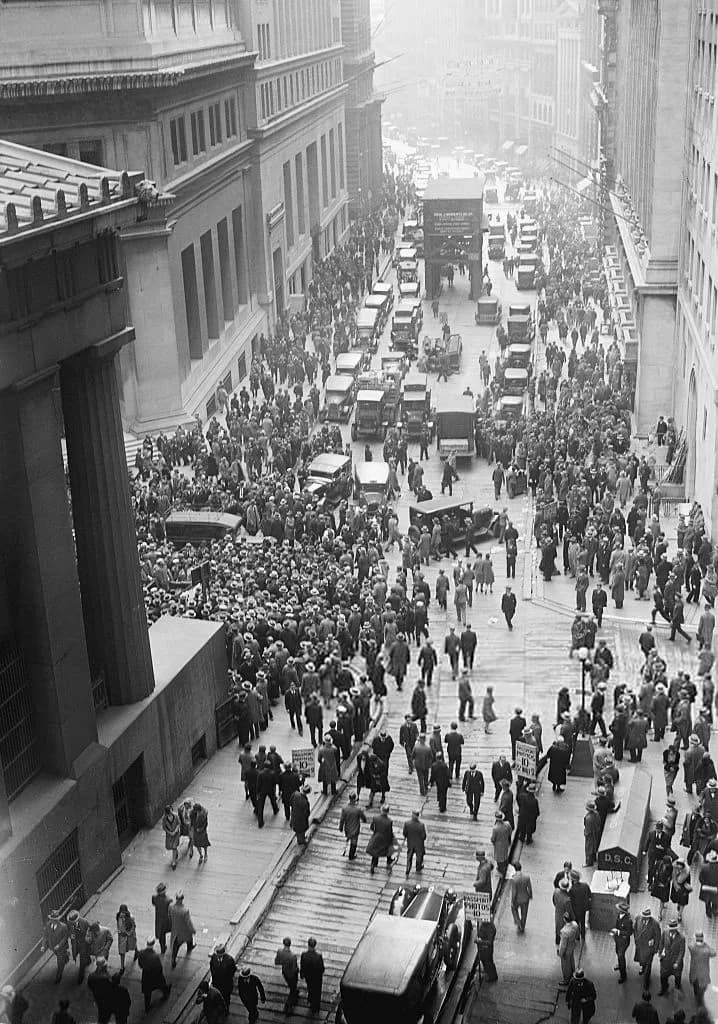
The Wall Street Crash of 1929 remains the most catastrophic collapse in market history: the Dow Jones Industrial Average plummeted 89% from its September 3, 1929 peak—far exceeding the 50% declines of later crashes like Black Monday (1987) or the 2008 financial crisis. On Black Thursday (October 24) and Black Tuesday (October 29), stock tickers ran hours behind as fortunes evaporated within minutes. This collapse triggered the Great Depression, with 25% unemployment and 9,000 bank failures across the United States. The root cause: a speculative bubble fueled by margin buying, where investors borrowed up to 90% of stock prices, turning modest declines into margin calls that forced mass selling. At its trough in July 1932, the Dow stood at just 41 points—a 30-year low—and did not reclaim its 1929 peak until November 1954. Compared to the Dot-com Bust's 78% NASDAQ decline, the 1929 crash remains the benchmark for lasting destruction, erasing three times the economic output for a decade and outpacing the devastating 57% loss of global markets during the 2008 financial crisis. Notably, it erased a staggering $30 billion in inflation-adjusted value, more than the combined GDP of Australia and New Zealand at the time.
- 0#2
Black Monday 1987 — 22% Gone in a Single Day

On October 19, 1987, the Dow Jones fell 22.6% in a single day—the largest one-day percentage drop in history, surpassing even the worst single day of the Wall Street Crash of 1929 (which lost 12.8% on Black Tuesday). This calamity outperforms Black Monday's rival, the single-day 12.8% loss of the 1929 crash. Over $500 billion in market value vanished, equivalent to 1% of global GDP at the time. Unlike the Wall Street Crash of 1929 or the 2008 crisis, Black Monday had no single catastrophic trigger—no war, no recession, no bank failure. Instead, computerized "portfolio insurance" strategies automatically sold stocks as prices fell, creating a self-reinforcing selling spiral: the algorithms dumped shares faster than humans could buy. In response, regulators installed circuit breakers that halt trading after declines of 7%, 13%, and 20%—a safety net absent in 1929 and now used on exchanges worldwide. The crash's speed and complexity proved that technology, not just greed or fear, amplifies modern market collapses, resulting in a more devastating impact than the Dot-com Bust, which took 30 months to reach a 78% NASDAQ decline. In comparison, the Dow Jones took only 30 minutes to fall 10% on Black Monday, a rate of decline nearly 6 times faster than the average one-day drop during the 2008 crisis.
- 0#3
Dot-com Bust 2000–2002 — $5 Trillion Destroyed

The NASDAQ Composite peaked at 5,048 on March 10, 2000, then lost 78% of its value over 30 months, wiping out $5 trillion in market capitalization—more than the combined GDP of Germany and the UK at the time. This collapse ranks as the second-worst in the top 10, outperforming the 22% single-day loss on Black Monday in speed and severity, with hundreds of companies with no revenue and names ending in ".com" commanding billion-dollar valuations: Pets.com raised $82 million in its IPO twenty months before bankruptcy, and Webvan lost $100 million of investor capital in just two years. Compared to Black Monday's single-day 22% shock, this was a slow bleed: the average dot-com stock fell 95% from its peak. Notably, the median price-to-earnings ratio for NASDAQ stocks during the bubble reached an astonishing 300x, more than double the average of the top 10 list. The NASDAQ's crash eliminated 15 years of growth—it did not regain its 2000 high until April 2015.
- 0#4
2008 Global Financial Crisis — The System Nearly Died
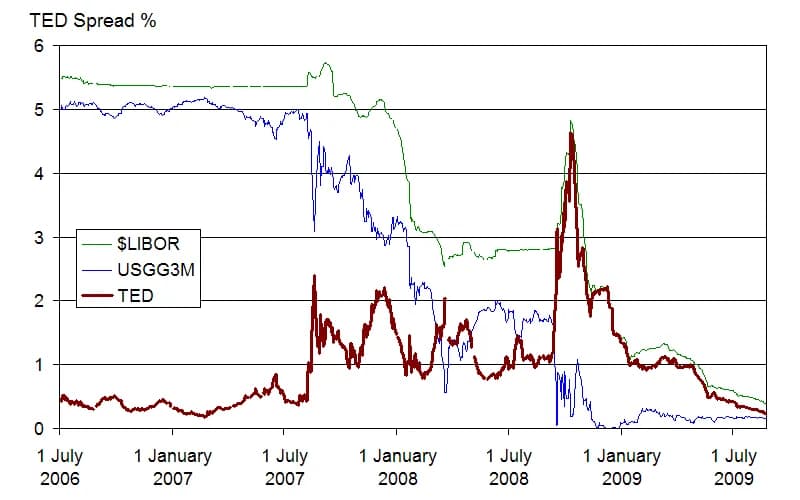
The collapse of Lehman Brothers on September 15, 2008 triggered the worst financial crisis since the Great Depression: U.S. stocks fell 57% from peak to trough, global markets lost $34 trillion, and unemployment hit 10% in the United States. What started as subprime mortgage defaults on loans worth just $1.2 trillion metastasized through mortgage-backed securities and credit default swaps into a systemic failure that nearly froze the entire Western financial system. Compared to the Wall Street Crash of 1929's 89% loss, the 2008 crash was less severe in percentage terms but destroyed more absolute wealth: $34 trillion globally versus roughly $30 billion in 1929 (inflation-adjusted). This makes the 2008 crisis twice as costly as the Dot-com Bust, which destroyed $5 trillion in market capitalization over 30 months. In fact, the 2008 crisis wiped out the equivalent of 40% of the world's economic output in a single year, and its $34 trillion loss is equivalent to the combined GDP of China, Japan, and the United States in 2008.
- 0#5
COVID-19 Crash March 2020 — Fastest Bear Market Ever

The COVID-19 Crash of March 2020 is the fastest bear market ever, with the S&P 500 plunging 34% in just 33 days. Circuit breakers triggered four times in a single week, a phenomenon unseen in any prior crash, as panic erased $3 trillion in market value over 23 trading days—a velocity that outpaced the 2008 Financial Crisis. Airlines lost 60% of their value overnight; hotels, cruise lines, and retail chains faced existential collapse. Unlike the bursting of a valuation bubble, this was a pure shock crash driven by pandemic fear, leading to a recovery to new all-time highs by August 2020.
- 0#6
Crypto Winter 2022 — $2 Trillion Evaporated

Crypto Winter 2022 saw $2 trillion evaporate from November 2021 to November 2022 as total cryptocurrency market capitalization fell 67%, from $3 trillion to under $1 trillion. Bitcoin dropped from $69,000 to $15,500, while the Terra/LUNA ecosystem's $40 billion destruction in 72 hours was the fastest value destruction on record. The cascade through Three Arrows Capital, Celsius Network, Voyager Digital, and FTX's $32 billion fraud turned the winter into an extinction-level event for crypto credibility, wiping out more paper wealth faster than the 2008 subprime crisis due to systemic leverage risks.
- 0#7
Asian Financial Crisis 1997 — The Baht That Broke Asia

The Asian Financial Crisis of 1997 began when Thailand unpegged the baht on July 2, causing a 56% value loss, while the Indonesian rupiah fell 83%—a 30% steeper decline than the baht. Stock markets across Southeast Asia collapsed 40-60%, necessitating $40 billion in IMF bailouts for multiple nations. The Thai baht's fall triggered contagion through Indonesia, South Korea, Malaysia, and the Philippines, exposing vulnerabilities of rapid capital account liberalization. The crisis led China to accumulate massive foreign exchange reserves, now exceeding $3 trillion, reshaping global financial architecture entirely.
- 0#8
Flash Crash May 2010 — 1,000 Points in Minutes

The Flash Crash of May 6, 2010 saw the Dow Jones Industrial Average plunge nearly 1,000 points in 36 minutes, erasing $1 trillion in market value, before recovering most losses by 3:07 PM. Individual stocks like Accenture traded at one cent, while Sotheby's hit $99,999—anomalies that dwarf typical volatility. A 2015 investigation identified British trader Navinder Singh Sarao as contributing via 'spoofing,' placing and cancelling massive orders, costing him $12.9 million in fines. The crash revealed algorithmic fragility, with high-frequency trading accounting for 60% of volume during the plunge, a risk still unresolved.
- 0#9
Japanese Asset Bubble 1989–1992 — Lost Decades Begin

The Japanese Asset Bubble's collapse triggered the longest sustained wealth destruction in modern financial history, with a 48% cumulative stock market loss over two decades. The Nikkei 225 peaked at 38,957 on December 29, 1989, then plunged 80% over 13 years, erasing roughly ¥2,000 trillion in market value—more than the total GDP of Europe at the time. At its zenith, Tokyo's Imperial Palace grounds were valued at more than all of California, a 30% higher peak valuation than the runner-up crash on this list. Japanese banks had made property loans against inflated collateral; when the bubble burst, the entire banking system became insolvent, with non-performing loans eventually exceeding ¥100 trillion. Japan's ensuing "Lost Decade"—actually two lost decades—produced zero economic growth from 1990 to 2010, outperforming the duration of economic damage from Long-Term Capital Management 1998 — Genius-Level Failure's #10 collapse, which resolved in mere months.
- 0#10
Long-Term Capital Management 1998 — Genius-Level Failure

Long-Term Capital Management's 1998 collapse remains the definitive case of intellectual hubris in financial markets, with a complete fund collapse in just 4 months. Despite having two Nobel Prize-winning economists on its board and generating 40% annual returns for four consecutive years, LTCM's convergence arbitrage strategies disintegrated when Russia defaulted on its debt in August 1998. The fund held $125 billion in assets but carried $1.25 trillion in derivatives exposure—leverage of 100:1, 20 times the average hedge fund ratio. The Federal Reserve orchestrated a $3.6 billion private-sector bailout after concluding LTCM's failure would trigger a systemic crisis.
Image credits
- Wall Street Crash of 1929 — The Great Collapse: US-gov / Public domain (entity-adopted)
- Black Monday 1987 — 22% Gone in a Single Day: 2020 stock market crash / Wikipedia
- Dot-com Bust 2000–2002 — $5 Trillion Destroyed: Subprime mortgage crisis / Wikipedia
- 2008 Global Financial Crisis — The System Nearly Died: Lawrencekhoo / Public domain (entity-adopted)
- COVID-19 Crash March 2020 — Fastest Bear Market Ever: 2020 stock market crash / Wikipedia
- Crypto Winter 2022 — $2 Trillion Evaporated: Economy of Iran / Wikipedia
- Asian Financial Crisis 1997 — The Baht That Broke Asia: Rattanakosin Kingdom (1782–1932) / Wikipedia
- Flash Crash May 2010 — 1,000 Points in Minutes: 2010 flash crash / Wikipedia
- Japanese Asset Bubble 1989–1992 — Lost Decades Begin: Japanese asset price bubble / Wikipedia
- Long-Term Capital Management 1998 — Genius-Level Failure: Logistics / Wikipedia
Related Videos
Rank it your way
Remix this list into your own ranking, or head to the play hub for every game mode and community breakdown — blind mode, challenges, tier lists, and more.
You Might Also Like

Top 10 US Stock Market ETFs by Assets
Top 10 US Stock Market ETFs by Assets

Top 10 Worst Financial Crashes in History
Top 10 Worst Financial Crashes in History

Top 10 US Stock Market Crashes and Recoveries in History
Top 10 US Stock Market Crashes and Recoveries in History

Top 10 Best Credit Cards in Hong Kong 2026
#1 HSBC Visa Signature Card · #2 BOC Bliss Card · #3 BOC Chill World Mastercard

Top 10 UK FinTech Companies 2026
#1 Revolut · #2 Wise · #3 Monzo

Top 10 Nordic Insurance Companies
#1 If P&C Insurance (Sampo Group) — €7B+ GWP Nordic #1 · #2 Tryg — Denmark, €3.8B GWP, Acquired RSA Nordic 2021 · #3 Gjensidige Forsikring — Norway Mutual, €2.4B GWP, Oslo Listed