
The original uploader was Snow storm in Eastern Asia at English Wikipedia. / Wikimedia Commons (CC BY 3.0)
Top 10 Biggest Business Failures in History
The biggest business failures in history reveal the dangers of fraud, financial excess, and failure to adapt. From accounting scandals that wiped out pension savings and investor wealth to once-dominant companies undone by strategic missteps, these ten collapses reshaped industries, disrupted countless lives, and exposed the high cost of poor decisions.
Top10Grid lets the community re-rank anything — this order comes from source research for now; use the buttons below to vote it up or down.

Current Rankings
- 0#1

Enron's 2001 collapse remains the most infamous corporate scandal in US history, fueled by a $90 stock peak built on billions in hidden debt through special purpose entities. As America's seventh-largest company with $111 billion in revenue, its bankruptcy erased $74 billion in shareholder value and left 20,000 employees jobless and pensionless. CEO Jeff Skilling received a 24-year prison sentence. While Enron's scandal was more notorious than Lehman Brothers' financial crisis, Lehman's $639 billion asset bankruptcy was nearly nine times larger than Enron's $74 billion loss in absolute terms, highlighting the scale disparity between fraud and systemic risk.
- 0

Lehman Brothers' 2008 bankruptcy, with $639 billion in assets, was the largest in US history—nearly double the collapse of Enron. The 158-year-old investment bank's overexposure to subprime mortgages triggered the global financial crisis, freezing credit markets and costing 8.7 million US jobs. Unlike Enron's fraud-driven implosion, Lehman's failure stemmed from systemic leverage and triggered $700 billion in government bailouts for other institutions. No executives faced criminal charges, contrasting sharply with Enron's 24-year sentence for its CEO. Lehman's $639 billion asset wipeout remains a stark benchmark for financial contagion.
- 0#3

WorldCom's 2002 bankruptcy was the largest in US history at the time, fueled by $11 billion in accounting fraud that disguised operating expenses as capital expenditures. Once America's second-largest long-distance phone company with $35 billion in revenue, its collapse destroyed $180 billion in shareholder value—more than double Enron's $74 billion loss. CEO Bernie Ebbers was sentenced to 25 years in prison, and the scandal directly led to the Sarbanes-Oxley Act of 2002. While Enron's fraud was more intricate, WorldCom's deception cost shareholders over twice as much, making it an even costlier cautionary tale.
- 0#4

Theranos promised to revolutionize blood testing with a finger-prick device capable of 200+ tests on a single drop, reaching a $9 billion valuation in 2014 and making founder Elizabeth Holmes the youngest self-made female billionaire. The technology was a complete fraud—samples were secretly run on conventional machines. Holmes was convicted of criminal fraud in 2022 and sentenced to 11 years in prison. While Theranos's $9 billion valuation collapse was far smaller than WorldCom's $180 billion loss, its impact on Silicon Valley trust was profound, exposing how charisma and hype can bypass due diligence.
- 0

FTX's $32 billion collapse remains the crypto industry's largest fraud conviction. In November 2022, the exchange secretly diverted $8 billion in customer deposits to cover losses at its sister hedge fund Alameda Research. Founder Sam Bankman-Fried, once a leading political donor, was convicted on seven counts of fraud and sentenced to 25 years in prison. The implosion occurred in just nine days—four times faster than the gradual decline of WeWork (#6), which took years from peak valuation to bankruptcy filing. This rapid unraveling erased $1.2 billion in venture capital funding overnight.
- 0#6
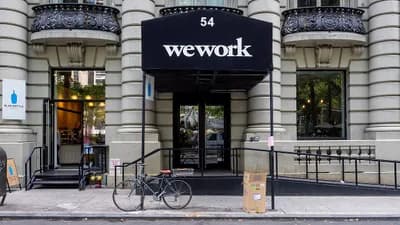
WeWork's $47 billion valuation collapse is the defining startup cautionary tale of the 2010s. The co-working company raised $12.8 billion from SoftBank, then saw its IPO fail amid $1.9 billion in annual losses and founder Adam Neumann's erratic self-dealing, including leasing buildings he personally owned. By 2023, it filed for bankruptcy, ending with a market cap near zero; Neumann received a $1.7 billion golden parachute. That payout is 3.3 times larger than the $5.3 billion debt load that doomed Toys "R" Us (#8), highlighting how founder enrichment outpaced creditor recovery.
- 0#7
Kodak's 131-year dominance ended with a textbook case of innovator's dilemma. The company controlled 90% of US film sales, invented the digital camera in 1975, but refused to commercialize it to protect film profits. By 1997, its stock peaked at $94.25; by 2011, it traded below $1. Digital cameras and smartphones wiped out film, leading to a 2012 bankruptcy that eliminated 140,000 jobs—more than four times the 33,000 jobs lost at Toys "R" Us (#8). The company's failure to pivot cost shareholders $28 billion in lost market value.
- 0
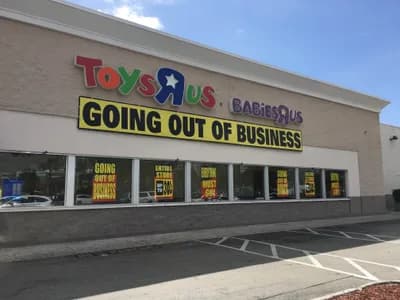
Toys "R" Us's 2018 liquidation of all 800 US stores ended a 70-year retail institution. Saddled with $5.3 billion in debt from a 2005 leveraged buyout by KKR, Bain Capital, and Vornado Realty, the chain couldn't compete with Amazon's pricing and convenience, costing 33,000 jobs. That debt burden was 3.1 times the $1.7 billion golden parachute of WeWork's founder (#6), making private equity's role a rallying cry for reform. The buyout firms extracted $470 million in fees before the bankruptcy, leaving creditors with just 14 cents on the dollar.
- 0#9

Nokia's fall from the world's #1 phone maker (controlling 40% of the global mobile phone market in 2007) to irrelevance by 2013 is the most dramatic collapse in technology history. Having dominated the mobile era for a decade, Nokia failed to respond to the iPhone's 2007 touchscreen revolution. Internal culture problems, bureaucracy, and reluctance to adopt new operating systems led to its mobile phone business being sold to Microsoft for $7.2 billion in 2013 — a fraction of its peak value.
- 0

Bed Bath & Beyond's 2023 bankruptcy eliminated a 52-year-old American retail institution that had once dominated the home goods category with 1,500 stores and $12 billion in peak revenue. The company spent $11.8 billion on stock buybacks between 2004 and 2019 — money that could have funded digital transformation and store modernization — instead enriching shareholders while gutting its competitive position. Its meme stock moment in 2022 briefly revived its stock before the inevitable collapse.
Image credits
- Enron: oinonio / flickr (BY-SA)
- Lehman Brothers: 2008 financial crisis / Wikipedia
- WorldCom: gruntzooki / flickr (BY-SA)
- Theranos: OSD Deputy Secretary of Defense / Wikimedia Commons (Public domain)
- FTX / Sam Bankman-Fried: Sam Bankman-Fried / Wikipedia
- WeWork: WeWork (48155566876).jpg / Wikimedia Commons
- Kodak: Kodak / Wikipedia
- Toys "R" Us: Phillip Pessar / Wikimedia Commons (CC BY 2.0)
- Nokia: Nokia / Wikipedia
- Bed Bath & Beyond: ajay_suresh / flickr (BY)
Rank it your way
Remix this list into your own ranking, or head to the play hub for every game mode and community breakdown — blind mode, challenges, tier lists, and more.
You Might Also Like

Top 10 Most Epic Business Failures
Top 10 Most Epic Business Failures

Top 10 Worst Financial Scams in History
Top 10 Worst Financial Scams in History

Top 10 Most Powerful Billionaires in the World 2025
Top 10 Most Powerful Billionaires in the World 2025

Top 10 US Climate Risk Insurance Solutions
#1 FEMA National Flood Insurance Program · #2 Swiss Re Climate Adaptation Solutions · #3 Munich Re US Natural Hazards Unit

Top 10 US Financial Fraud Cases in History
#1 Bernie Madoff Ponzi Scheme · #2 Enron Scandal · #3 WorldCom Accounting Fraud

Top 10 US ESG Investing Funds
#1 Parnassus Core Equity Fund · #2 Calvert Research and Management · #3 Vanguard ESG US Stock ETF (ESGV)