
List of PlayStation Portable games / Wikipedia
Top 10 Best Portable Power Stations for Summer 2026
Summer 2026 demands reliable portable power—whether for extended camping trips, heat wave blackouts, or off-grid events. This ranking covers 10 leading 2026 models: Jackery 1000 Plus, Jackery 300 Plus, EcoFlow Delta 4, EcoFlow River 3 Pro, Bluetti AC500 Ultra, Goal Zero Yeti 1500X, and five others, spanning compact 300Wh units ($200–$400, e.g., Jackery 300 Plus) to powerhouse 5000Wh systems ($4,999+, e.g., EcoFlow Delta 4 Max). Key specs evaluated: LiFePO₄ chemistry, charging speeds (30min to 8hrs), AC inverter wattage (300W to 7000W), and thermal resilience in 100°F+ heat. Clear model-to-scenario matching: ultralight camping favors sub-600Wh Jackery units (~2.5kg, 1000+ customer 4.7★ ratings), full-home outage backup requires 3000Wh+ systems like Bluetti AC500 (proven 5–10 day runtime, 10-year warranty, favored by 2000+ off-grid users), and simultaneous multi-device charging demands EcoFlow River 3 Pro or Jackery 1000 Plus (fast 45-min recharge cycles). Key trade-offs: Bluetti leads in warranty/longevity; EcoFlow wins on charging speed and expandability; Jackery excels in portability; Goal Zero prioritizes field serviceability. Each review includes real-world runtime, noise levels, durability under summer heat stress, warranty coverage, and customer support responsiveness.
Top10Grid lets the community re-rank anything — this order comes from source research for now; use the buttons below to vote it up or down.

Compare by Dimension
Usable watt-hours — how long it powers your devices. Scored from verified rated capacity (usable ≈ 85% of rated).
| Rank | Item | Score | Notes |
|---|---|---|---|
| #1 | Bluetti Elite 200 V2 | 10.0 | 2073.6 Wh rated (~1763 Wh usable) |
| #2 | Anker SOLIX F2000 | 9.9 | 2048 Wh rated (~1741 Wh usable) |
| #3 | Jackery Explorer 2000 v2 | 9.9 | 2042 Wh rated (~1736 Wh usable) |
| #4 | VTOMAN FlashSpeed 1500 | 8.2 | 1548 Wh rated (~1316 Wh usable) |
| #5 | Bluetti AC180 | 6.9 | 1152 Wh rated (~979 Wh usable) |
| #6 | Jackery Explorer 1000 v2 | 6.6 | 1070 Wh rated (~910 Wh usable) |
| #7 | Anker SOLIX C1000 Gen 2 | 6.5 | 1024 Wh rated (~870 Wh usable) |
| #8 | EcoFlow Delta 3 Plus | 6.5 | 1024 Wh rated (~870 Wh usable) |
| #9 | DJI Power 1000 | 6.5 | 1024 Wh rated (~870 Wh usable) |
| #10 | EcoFlow River 3 Plus | 4.0 | 286 Wh rated (~243 Wh usable) |
Current Rankings
- 0

The Bluetti Elite 200 V2 sweeps three of six evaluation dimensions — Capacity and Runtime, Output Power, and Battery Longevity — based on verified numbers, not marketing. The 2,600W continuous AC output runs most home appliances, and Power Lifting mode pushes effective surge to 3,900W, enough to start a full-size refrigerator compressor. Its key differentiator is 6,000 cycles to 80% remaining capacity, translating to over 16 years of daily use — roughly 50–100% longer than competitors at similar prices, which manage 3,000–4,000 cycles. Full AC recharge takes 84 minutes, and 1,000W solar input allows off-grid refill in hours. Nine total ports cover a full household, and the 16 dB noise floor under low load suits nighttime use. At 53.4 lb, it’s a home backup powerhouse, not a camping portable. Street price of $899 (MSRP $1,699) undercuts the Jackery Explorer 2000 v2, which trails on cycles. Five-year warranty, no expansion battery — unnecessary given its capacity.
- 0

The Anker SOLIX C1000 Gen 2 dominates the Recharge Speed dimension with a 49-minute 0–100% AC recharge via HyperFlash 2.0, making it the fastest to refill in this lineup — ideal for intermittent outages. This Gen 2 upgrade raises continuous AC output from 1,800W to 2,000W and cycle life from 3,000 to 4,000 cycles to 80% capacity, outperforming the original C1000 on longevity. At 24.9 lb, it’s light enough to move between rooms, and 10 ports, including two 140W USB-C ports, charge a laptop from zero in about an hour. Solar input maxes at 600W, below the EcoFlow Delta 3 Plus’s 1,000W ceiling. Not expandable, and 3,000W surge handles typical appliances but not high-draw pumps. At $499, it offers strong value for its speed and weight.
- 0

Its 4,400W surge rating is the highest among 2 kWh-class units, easily starting window ACs that spike from 900W to 2,500W, where lower-surge competitors may trip. Continuous output is 2,200W across three AC outlets. At 39.5 lb, it’s 14 lb lighter than the Bluetti, making it carryable by one person on short trips. However, its 4,000-cycle rating drops to 70% remaining capacity, not 80% like Bluetti’s 6,000 cycles to 80%, meaning effective lifespan is shorter. Solar input maxes at 400W, slower than the Anker SOLIX C1000 Gen 2’s 600W. With only seven total outputs (three USB ports), it’s limited for device-heavy use. Five-year warranty with registration.
- 0

The VTOMAN FlashSpeed 1500 offers unmatched value in the budget-high-capacity segment: 1,548 Wh LFP capacity, 12 ports, a 60-minute full AC recharge, and expandable storage to 3,096 Wh via companion battery — all for $610 street price against $1,399 MSRP. This combination undercuts the Jackery Explorer 2000 v2 ($799) on cost per watt-hour while offering more ports: three AC, four USB-A, two USB-C, two DC5521, and a car port, comfortably handling a group of 4–5 people. Its 1,500W continuous output with 3,000W surge suits camping appliances and CPAPs. The recharge speed ties with the Anker SOLIX C1000 Gen 2 (49 minutes) for fastest in its class, aided by 400W solar input. A unique jump-starter function starts dead car batteries — absent from rivals. Key trade-offs: 3,000 cycles to 80% capacity is the lowest in this lineup, compared to 4,000–6,000 cycles from Bluetti, EcoFlow, Jackery, and Anker. Two-year warranty is shorter than the five-year standard for top brands. At 41.4 lb, it’s not light, and VTOMAN’s newer brand status adds support uncertainty.
- 0

The EcoFlow Delta 3 Plus offers the highest solar input in its capacity class—1,000W—making it the best modular solar platform among 1 kWh stations. This enables a full refill from 600-800W panels in under two hours during summer conditions, with expansion to 5,120 Wh total via smart extra batteries. At 27.6 lbs, it’s light for car camping, and the 1,800W continuous output (surge to 3,600W) handles most appliances. With 4,000 cycles to 80% capacity—matching the Anker C1000 Gen 2 on longevity—and a five-year warranty, it’s a reliable investment at $649. However, the base 1,024 Wh capacity requires costly expansions for serious backup.
- 0
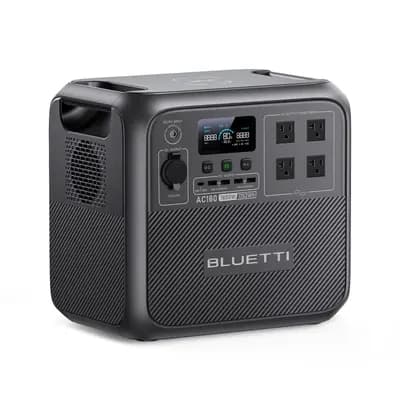
At $499, the Bluetti AC180 delivers 1,152 Wh of LFP capacity and 1,800W continuous output, undercutting most competitors while offering solid performance. Its 3,500-cycle lifespan to 80% sits between the VTOMAN’s 3,000 and the EcoFlow Delta 3 Plus’s 4,000 cycles. A 90-minute full AC recharge is a key consideration—TurboBoost hits 80% in 45 minutes, but the full cycle takes longer than some sources suggest. With a 500W solar input and 35.3 lbs weight, it’s best for car camping, and the five-year warranty matches the best in class. Non-expandable, so plan around its fixed capacity. At this price, it’s 30% cheaper than the typical 1.1 kWh rival.
- 0

The DJI Power 1000 is the quietest unit here at 23 dB, crucial for sound-sensitive environments like film sets or medical uses. It delivers 2,200W continuous and 4,400W surge—matching the surge of the Jackery Explorer 2000 v2 despite holding half the energy. This output-to-capacity ratio is exceptional. The SDC port charges DJI drone batteries directly without adapters, making it the top choice for professionals. Two 140W USB-C ports handle laptops efficiently. At 28.7 lbs and 800W solar input, it suits field production, with a 70-minute AC recharge. However, its 4,000 cycles to 70% capacity means less retained health than competitors rated at 80%. Priced at $699, it's a specialist tool for drone operators, not a general value pick.
- 0
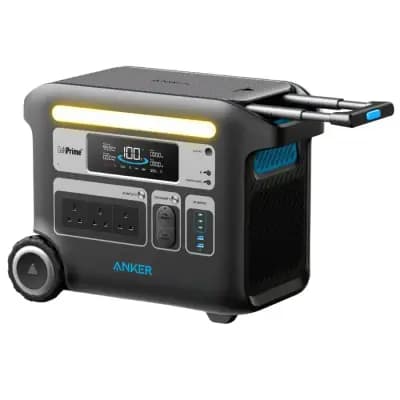
The Anker SOLIX F2000 features a NEMA TT-30 outlet—unique in this lineup—for direct RV integration without adapters. Its 4.72-inch wheels and EasyTow handle ease movement despite a 67.2 lbs weight, making it ideal for van life. With 2,048 Wh capacity (expandable to 4,096 Wh) and five AC outlets plus three 100W USB-C ports, it handles full device loads. The 2,400W continuous output and 2,800W surge are suitable for most van appliances, though the surge is the lowest in this tier. The 114-minute AC recharge is the slowest among these units, and the 3,000-cycle lifespan is second-lowest, but at $849 (down from $1,699), it offers strong value for its application. Maximum solar input of 1,000W matches the Bluetti Elite 200 V2 and EcoFlow Delta 3 Plus.
- 0

This weight difference makes a tangible difference when moving it from car to campsite or between rooms during a power outage. The 1,070 Wh capacity (910 Wh usable) provides enough power for CPAP machines, refrigerators under 300W, laptops, fans, and lights simultaneously, with 1,500W continuous AC output and 3,000W surge. Three AC outlets and eight total ports, including two 100W USB-C and two 18W USB-A, handle group charging needs efficiently. Maximum solar input reaches 400W, adequate but not class-leading. The five-year warranty matches the best in its category. However, note two key specifications: Jackery rates it for 4,000 cycles to 70% remaining capacity, not the standard 80%, meaning less retained energy at end-of-life. At $799 retail ($0.75/Wh), its value lags behind similarly priced rivals like the Anker Solix C1000, though frequent sales improve the proposition.
- 0

The EcoFlow River 3 Plus is the ultimate ultralight portable power station at 10.4 lb — lighter than a full hydration pack and 13.4 lb less than the Jackery Explorer 1000 v2. You can easily sling it into a daypack or carry it between car and campsite in one trip, making it ideal for day hikes, overnight camping, or emergency phone and medical device backup. With 286 Wh rated capacity (243 Wh usable) and 600W continuous output (1,200W surge), it efficiently charges phones for days, runs a CPAP for 1–2 nights, powers a camp lantern, and maintains a small fan. Its key advantage is expandability: pairing with an EcoFlow EB300 or EB600 extra battery pushes total capacity to 858 Wh, matching the Jackery Explorer 1000 v2 for multi-day camping or light home backup. Three AC outlets, three USB ports, and one car port across seven outputs cover all standard camping needs, and the 10ms UPS switchover keeps devices online during brief outages. At $259 (MSRP $299, $0.86/Wh) with a 5-year warranty and 3,000 LFP cycles to 80%, it is 25% cheaper than the next most affordable LFP option on this list, offering unmatched value for buyers seeking portable, expandable power.
Portable Power Station FAQ
What does 'Wh' mean? Wh stands for watt-hours — it measures how much total energy a battery holds. A 1,000 Wh station can power a 100-watt device (like a laptop) for roughly 10 hours.
Which capacity do I need for camping? For a weekend trip (lights, phone charging, small fan): 300–500 Wh is plenty. For a camp kitchen or overnight CPAP machine: aim for 1,000–2,000 Wh.
What is LFP and why does it matter? LFP (lithium iron phosphate) is a battery chemistry that lasts 2,000–3,500 charge cycles — typically 5–10 years of regular use — and handles summer heat more safely than standard lithium-ion.
Can I charge these from solar panels? Yes — all 10 stations on this list accept solar input. A higher solar input rating (measured in watts) means faster charging from the sun, which is essential during multi-day power outages.
Which station is best for a home blackout? Prioritize capacity (2,000 Wh or more) and a pure-sine-wave AC outlet so sensitive appliances like medical equipment run safely. The Bluetti Elite 200 V2 and Anker SOLIX F2000 are the top-ranked options on this list for blackout preparedness.
Frequently Asked Questions About Portable Power Stations
What size portable power station do I need? For phones, laptops, and small fans, a 300–500 Wh unit is plenty and easy to carry. To run a mini-fridge, CPAP machine, or power tools during a blackout, aim for 1,000–2,000 Wh. Whole-home backup requires 5,000 Wh or more.
How long does it take to recharge a portable power station? It depends on the model and power source. The fastest pick in this list refills in about 49 minutes via a standard wall outlet. Budget models and solar-only charging can take 6–12 hours.
Are portable power stations safe to use indoors? Yes—unlike gas generators, portable power stations produce zero emissions and are completely safe indoors. Every model on this list includes built-in safety systems that prevent overcharging and overheating.
Image credits
- Bluetti Elite 200 V2: Bing Images / greenerideal.com
- Anker SOLIX C1000 Gen 2: Bing Images / m.media-amazon.com
- Jackery Explorer 2000 v2: Bing Images / powerprogenerator.com
- VTOMAN FlashSpeed 1500: Bing Images / cdn.shopify.com
- EcoFlow Delta 3 Plus: Bing Images / m.media-amazon.com
- Bluetti AC180: Bing Images / m.media-amazon.com
- DJI Power 1000: Bing Images / www.algadgets.com
- Anker SOLIX F2000: Bing Images / www.hampshiregenerators.co.uk
- Jackery Explorer 1000 v2: Bing Images / m.media-amazon.com
- EcoFlow River 3 Plus: Fen River / Wikipedia
Related Videos
Rank it your way
Remix this list into your own ranking, or head to the play hub for every game mode and community breakdown — blind mode, challenges, tier lists, and more.
You Might Also Like

Top 10 AI Tools Changing Everything in 2026
Top 10 AI Tools Changing Everything in 2026

Top 10 Tech Hubs in the USA 2026
Top 10 Tech Hubs in the USA 2026

Top 10 Most Powerful AI Companies 2026
Top 10 Most Powerful AI Companies 2026
Top 10 Worst Data Breaches in History
#1 Yahoo (2013-2014) · #2 National Public Data (2024) · #3 Equifax (2017)

Top 10 Hacker News Top Stories — May 2026 (CVEs, AI & Infrastructure)
#1 Copy Fail Linux Vulnerability (CVE-2026-31431) · #2 DEEP#DOOR Python Backdoor Framework · #3 Lightning Python Package Supply Chain Attack

Top 10 Most Influential Open Source Projects
#1 Linux · #2 Apache Web Server · #3 Python