Polaroid SX-70
Business Leader1 list appearance
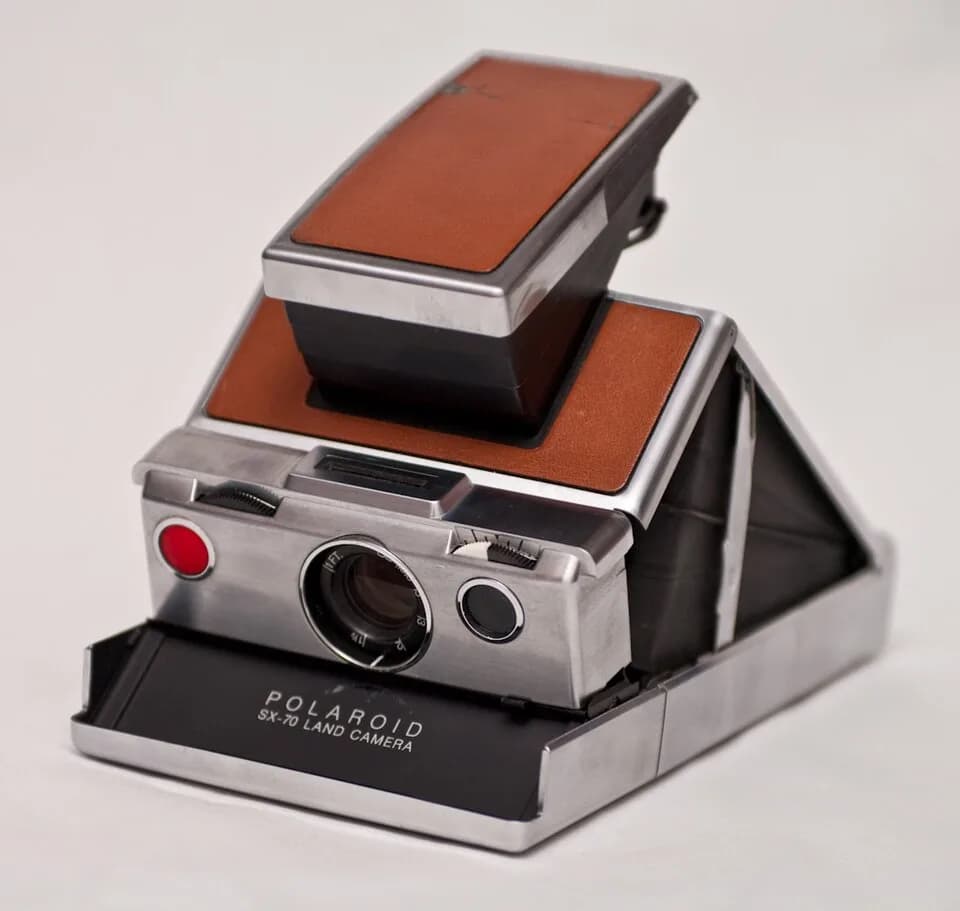
Introduced in 1972 by Polaroid co-founder Dr. Edwin Land, the Polaroid SX-70 was the first folding single-lens reflex (SLR) camera to use self-developing integral film. Eliminating the messy peel-apart waste of earlier instant cameras, the SX-70 ejected a dry, white-bordered print that developed automatically in daylight. Named 'SX-70' from Edwin Land's Special Experiment No. 70 notebook, the project required massive R&D investment—reported at roughly $750 million in 1970s dollars—to fold a reflex optical path flat enough for a jacket pocket. Land famously ordered 10,000 red and yellow Kees Nelis tulips from the Netherlands for the April 1972 shareholders' meeting demonstration. Charles and Ray Eames produced a 1972 short film explaining the SX-70's mechanics and design. Folding metal-and-leather SLR body (680 g) with a 116 mm lens, 0.30 m minimum focusing distance, and custom Fairchild/Texas Instruments control electronics.
1-Tap Primary Ranking Ballot
Overview#9 Full List
Does Polaroid SX-70 deserve the #9 spot on “Top 10 Cameras That Changed Photography Forever (From Brownie to iPhone)”?
#9 Polaroid SX-70?
Verified Entity DossierRanked #9 in Top 10 Cameras That Changed Photography Forever (From Brownie to iPhone)
Community Weigh-In & Debate
Should Polaroid SX-70 rank higher than #9 in Cameras That Changed Photography Forever (From Brownie to iPhone)?
Ranked #9 on "Top 10 Cameras That Changed Photography Forever (From Brownie to iPhone)". Cast your vote to back or challenge this spot.
Be the first to vote on this ranking.
Structured Facts & Specifications
Verified highlightsLaunch Price
$180 ($6.90 per 10-shot film pack)
Canonical Name
Polaroid SX-70 Land Camera
Optics / Weight
116 mm lens, 0.30 m min focus; 680 g
Unveiling / Launch
April 1972 (shareholders meeting); late 1972 Miami / Fall 1973 US nationwide
Film Format / Speed
SX-70 integral film (160 ASA/ISO; 3.1 x 3.0 in image)
Node Type / Subclass
Product / Instant Folding SLR Camera
Entity ID / Batch Slot
39 (Batch D)
Inventor / Manufacturer
Dr. Edwin H. Land / Polaroid Corporation
Schema.org / Domain Tags
schema:Product, InstantCamera, SingleLensReflex, Polaroid