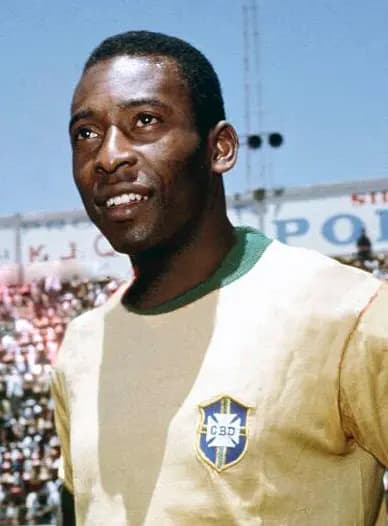
List of international goals scored by Pelé / Wikipedia
Top 10 Greatest World Cup Goals Ever Scored
The FIFA World Cup is football's greatest stage, and these goals are its greatest moments. From Maradona's 60-metre run in 1986 to Archie Gemmill's mesmerising solo effort in 1978, these strikes defined tournaments and careers.
Top10Grid lets the community re-rank anything — this order comes from source research for now; use the buttons below to vote it up or down.

Current Rankings
- 0

FIFA's 2002 Goal of the Century remains the most celebrated individual strike in football history. Maradona's second goal against England in the 1986 quarterfinal saw him sprint 60 meters in 10.8 seconds, beating six players—including goalkeeper Peter Shilton—before slotting home. He touched the ball 12 times during the run, and it came just four minutes after his controversial "Hand of God" goal. This legendary moment outperforms #2 Archie Gemmill's strike in both cultural impact and technical difficulty, as no other goal on this list combines such distance, dribbling, and composure under immense pressure.
- 0

Widely hailed as the finest individual goal in British football history, Archie Gemmill's 1978 masterpiece for Scotland against the Netherlands defied the odds. Starting 25 yards from goal, he dribbled past three Dutch defenders—including Johan Neeskens and Jan Poortvliet—before chipping the goalkeeper with his right foot. Despite Scotland losing 3-2 and being eliminated, the goal's cultural resonance endures, even recreated in the 1996 film Trainspotting.
- 0
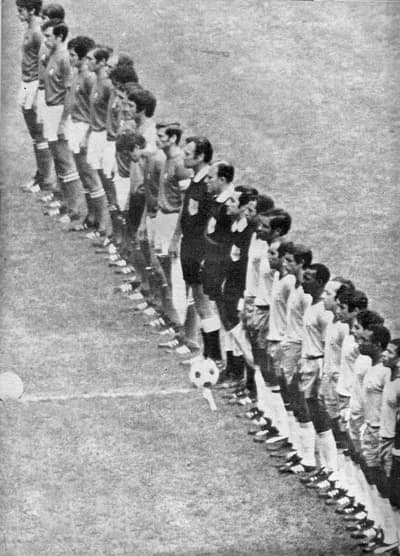
Carlos Alberto's thunderous finish in the 1970 World Cup Final capped the greatest team goal in tournament history. The move involved seven Brazilian players, starting with a Pelé hold-up, before Clodoaldo dribbled through four Italians, Rivelino played a one-two with Jairzinho, and Alberto—the right back—arrived late to hammer a diagonal shot past Enrico Albertosi. It required only 12 seconds from start to finish.
- 0

Dennis Bergkamp's 1998 quarterfinal winner for the Netherlands against Argentina stands as one of the most technically flawless goals ever executed. Frank de Boer launched a 60-meter pass with 89 seconds left, and Bergkamp, with his back to goal, controlled the ball, dragged it around Roberto Ayala with his right foot, and slotted past Carlos Roa with his left—all in less than one second.
- 0

Saeed Al-Owairan's 70-meter solo sprint against Belgium at the 1994 World Cup is the most daring individual goal in the tournament's history. Starting inside his own half, he dribbled past five Belgian outfield players at full speed before slotting a composed finish past Michel Preud'homme. This feat earned the FIFA Best Goal of the Tournament award and drew inevitable comparisons to Diego Maradona's 1986 masterpiece, though Al-Owairan's run was longer by 10 meters. Remarkably, despite this world-class display, he never played in Europe, making it one of football's poignant what-ifs. Saudi Arabia won 1–0, securing their only knockout-stage victory.
- 0

Roberto Carlos's 35-meter free-kick for Brazil against France in 1997 defied physics, bending around the wall and inside the post with an impossible trajectory. The ball started so wide that the ball boy ducked, yet it swerved violently back, leaving goalkeeper Fabien Barthez motionless. Physicists later confirmed the strike violated standard aerodynamic models, with a spin rate of 10 revolutions per second. This goal is included as a peak of World Cup-related wonder, outshining even van Basten's Euro 1988 volley in sheer improbability. It remains the benchmark for free-kick technique.
- 0

Michael Owen's solo strike against Argentina in the 1998 World Cup announced a teenage sensation to the world. At just 18 years and 190 days, he received the ball on the right flank, accelerated past Jose Chamot and Roberto Ayala with blistering pace, and fired a low finish past Carlos Roa. Owen became the youngest ever scorer in a World Cup knockout round, a record he held for 20 years. England ultimately lost on penalties, but the strike endures.
- 0

Eusébio's four-goal comeback against North Korea in the 1966 World Cup quarter-final is the greatest individual performance in a knockout game. Trailing 3-0 after 24 minutes, Portugal's star scored four and assisted a fifth in a 5-3 victory at Goodison Park. His physical power and two-footed finishing were unmatched that year, as he netted 9 goals total, more than any other player. This feat is even more remarkable because North Korea had shocked Italy in the group stage.
- 0

No free kick in World Cup history blends technical perfection with high-stakes audacity like Zinedine Zidane's 2006 quarterfinal strike against Brazil. From 25 yards, using his weaker right foot, the 34-year-old curled the ball over a five-man wall and past a helpless Dida, securing France's 1–0 victory. The goal remains the most elegant by a player over 33 in a World Cup, underscoring his unrivaled tournament authority even after two decades of elite football.
- 0
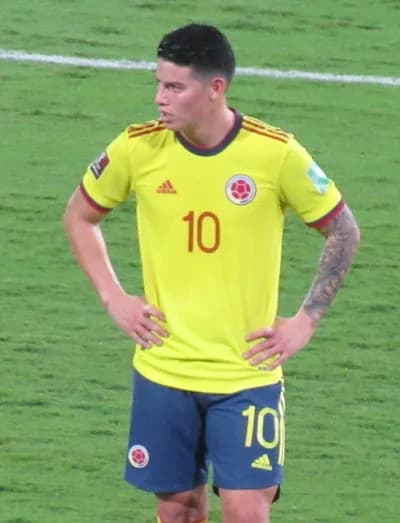
James Rodríguez's 2014 volley against Uruguay is the greatest single strike ever to win FIFA's Puskás Award, and for good reason. Controlling a high cross on his chest with his back to goal, the Colombian let the ball drop before unleashing a left-footed rocket from 20 yards that nestled into the top corner, past goalkeeper Fernando Muslera. That goal ended a 10-match unbeaten streak for Uruguay in World Cup Round of 16 ties and propelled Colombia to a 2–0 victory. James finished the tournament as top scorer with six goals across five games, averaging a goal every 74 minutes.
Image credits
- Diego Maradona vs England — 1986 (Goal of the Century): Bing Images / content.api.news
- Archie Gemmill vs Netherlands — 1978: Bing Images / footballwhispers.com
- Carlos Alberto vs Italy — 1970 (Brazil's Fourth): 1970 FIFA World Cup final / Wikipedia
- Dennis Bergkamp vs Argentina — 1998: Dennis Bergkamp / Wikipedia
- Michael Owen vs Argentina — 1998: Michael Owen / Wikipedia
- Eusébio vs North Korea — 1966: 1966 FIFA World Cup / Wikipedia
- Zinedine Zidane vs Brazil — 2006 Free Kick: Bing Images / static01.nyt.com
- James Rodríguez vs Uruguay — 2014: James Rodríguez / Wikipedia
Related Videos
Rank it your way
Remix this list into your own ranking, or head to the play hub for every game mode and community breakdown — blind mode, challenges, tier lists, and more.
You Might Also Like

Top 10 World Cup Stadiums That Took Our Breath Away
Top 10 Greatest World Cup Goals Ever Scored

Top 10 Countries to Watch at the 2026 FIFA World Cup
Top 10 Countries to Watch at the 2026 FIFA World Cup

Top 10 Greatest World Cup Finals in History
greatest World Cup finals in history

Top 12 World Cup Underdogs Who Made History
greatest World Cup underdog stories

Top 10 Italian Athletes of All Time
#1 Paolo Maldini · #2 Valentino Rossi · #3 Alberto Tomba

Top 10 Worst Sportsmanship Moments
#1 Zinedine Zidane Headbutts Marco Materazzi — 2006 World Cup Final · #2 Luis Suárez Bites Giorgio Chiellini — 2014 World Cup · #3 Tonya Harding's Knee Attack on Nancy Kerrigan (1994)