Crime and Punishment
Company3 list appearances
Primary Identity: Crime and Punishment (1866) is Fyodor Dostoevsky's psychological masterpiece following Rodion Raskolnikov, an impoverished former student in St. Petersburg who murders elderly pawnbroker Alyona Ivanovna and her half-sister Lizaveta Core Thesis: Dostoevsky refutes utilitarian rationalism and the "extraordinary man" theory—the claim that superior individuals have a right to transgress moral law for humanitarian ends—arguing instead that salvation comes only through suffering, atonement, and Christian love Philosophical Motivation & Collapse: Raskolnikov divides humanity into ordinary people and extraordinary figures (such as Napoleon) who possess a supposed "right to transgress," yet immediately after the murder he is consumed by "mystic terror," feverish isolation, and guilt Psychological Cat-and-Mouse: Investigating magistrate Porfiry Petrovich applies sustained psychological pressure rather than brute force to corner Raskolnikov toward confession
1-Tap Primary Ranking Ballot
Overview#4 Full List
Does Crime and Punishment deserve the #4 spot on “Top Classic Books — Detective and mystery”?
#4 Crime and Punishment?
Verified Entity DossierRanked #4 in Top Classic Books — Detective and mystery
Best Rank
#4
across all lists
Avg Position
#6.7
across 3 lists
Community Weigh-In & Debate
Should Crime and Punishment rank higher than #4 in Top Classic Books — Detective and mystery?
Ranked #4 on "Top Classic Books — Detective and mystery". Cast your vote to back or challenge this spot.
Be the first to vote on this ranking.
Most Argued About
“Top 10 Greatest Novels of All Time”
Ranks as high as #4 on some lists — but only #8 here. Fans are divided.
See the debate →Frequently Asked Questions
What is Crime and Punishment's highest community ranking?⌄
Crime and Punishment is ranked #4 on "Top Classic Books — Detective and mystery" — its best placement across 3 lists on top10grid.com.
How many top-10 lists feature Crime and Punishment?⌄
Crime and Punishment appears in 3 lists on top10grid.com, spanning categories including EDUCATION.
Is Crime and Punishment a controversial ranking?⌄
Yes — community opinion on Crime and Punishment varies widely. It ranks as high as #4 on some lists and as low as #8 on others, a spread of 4 positions, making it one of the more debated picks on top10grid.com.
What the internet says
Structured Facts & Specifications
Verified highlightsPublication Timeline
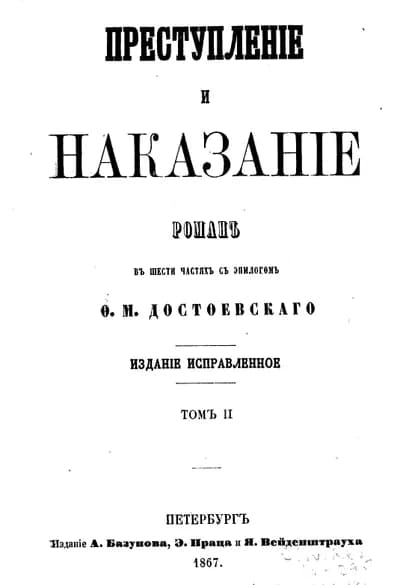
First published serially in 1866; appeared in book form in 1867
britannica.comOfficial britannica.com ↗
Official Archival Url
britannica.comOfficial britannica.com ↗
Original Title Structure
Prestupleniye i nakazaniye (Russian: Романъ въ шести частяхъ съ эпилогомъ — six parts with an epilogue)
britannica.comOfficial britannica.com ↗
Author
Fyodor Dostoevsky (1821–1881)
britannica.comOfficial britannica.com ↗
Setting
St. Petersburg, Imperial Russia, with the epilogue in Siberia
britannica.comOfficial britannica.com ↗
Ontology Metadata
nodeType: book
britannica.comOfficial britannica.com ↗
Entity Id Slug
crime-and-punishment / crime-and-punishment-dostoevsky-1866
britannica.comOfficial britannica.com ↗
Batch Source
Top10Grid v4 Verified Dossier (BATCH24)
Primary Reference Url
Original Title & Structure
Prestupleniye i nakazaniye (Russian: Романъ въ шести частяхъ съ эпилогомъ — six parts with an epilogue)