
TuRbO_J from Adelaide, Australia / Wikimedia Commons (CC BY 2.0)
Top 10 Best Coolers for Summer 2026
Overwhelmed by cooler choices? You're not alone. This ranking covers leading models across brutal real-world conditions—beach scorchers, multi-day wilderness trips, tailgates, and fishing expeditions—on ice retention, durability, capacity, and portability. Our surprising finding: budget rotomolded coolers now rival premium brands ($400+) in ice retention, while smart soft-sided models and electric options are reshaping the category. This guide cuts through the clutter by organizing coolers around what actually matters for your summer: best value, longest-lasting ice, maximum capacity, lightweight design, best-wheeled options, and electric models. Whether you're prepping a day hike, week-long expedition, or weekend tailgate, you'll find your perfect cooler—plus learn which popular picks to skip.
Top10Grid lets the community re-rank anything — this order comes from source research for now; use the buttons below to vote it up or down.

Compare by Dimension
How long the cooler keeps contents cold, normalized to lab/field-tested days-to-40°F (food-safe). Electric models judged on active compressor cooling and runtime.
| Rank | Item | Score | Notes |
|---|---|---|---|
| #1 | Anker SOLIX EverFrost 2 40L | 10.0 | Active compressor holds contents at -4°F to 68°F for a 52h battery run — colder than any ice-only rival while powered. |
| #2 | Coleman 316 Series 70-Quart Hard Cooler | 9.0 | CleverHiker field test of this exact 70qt model: 6d full melt, 8d to 40°F, 10d to 50°F — category-leading passive cold-hold. |
| #3 | YETI Roadie 48 Wheeled Cooler | 8.0 | OGL lab: 6.8d to 40°F, 7.5d to 50°F — best insulation result of any hard cooler OGL has tested — strong passive cold-hold. |
| #4 | Pelican 50QT Elite Cooler | 6.0 | Normalized ~6.0d to 40°F (anchored to OGL-tested Pelican Elite 70 at 7.0d, scaled for size) — strong passive cold-hold. |
| #5 | RovR RollR 60 Wheeled Cooler | 6.0 | OGL lab: 6.0d to 40°F, 6.6d to 50°F — strong passive cold-hold. |
| #6 | YETI Tundra 65 | 5.0 | OGL lab: 5.0d to 40°F, 5.3d to 50°F — solid mid-pack passive cold-hold. |
| #7 | RTIC 45 QT Ultra-Tough Hard Cooler | 4.0 | OGL lab: 4.6d to 40°F, 5.0d to 50°F — solid mid-pack passive cold-hold. |
| #8 | RTIC Ultra-Tough Soft Cooler 30 Can | 3.0 | CleverHiker: 4d full melt — solid mid-pack passive cold-hold. |
| #9 | YETI Hopper M20 Backpack Soft Cooler | 2.0 | OGL lab: 3.6d to 40°F, 4.0d to 50°F — best-in-class among soft coolers OGL has tested — shorter passive cold-hold. |
| #10 | Grizzly 40 | 1.0 | Pro Tool Reviews: 4d full melt in low-90s°F high-humidity — shorter passive cold-hold. |
Current Rankings
- 0
For $311, it offers ice retention of 6.0 days to 40°F, placing it a half-step behind the YETI Roadie 48 in raw cold-holding. With a 34-can capacity and 26.4 lb empty weight, it is less portable than wheeled competitors but achieves a durability score of 10/10 thanks to thick rotomolded walls, stainless hardware, and non-skid feet. For hunters and overlanders needing a cooler that survives a decade of truck-bed abuse, it's the safest, most permanent buy in the $300–$400 range.
- 0
Despite the “48” name, usable capacity is 45.4 quarts (77 cans). At 26.6 lb empty, it matches the Pelican 50QT Elite in weight but offers superior mobility thanks to NeverFlat wheels and a retractable handle, earning a portability score above any non-wheeled model. The catch is price: $425 makes it the most expensive per quart, and its 5-year warranty falls short of Pelican's lifetime.
- 0
At $85, the Coleman 316 Series 70-Quart Hard Cooler is the cheapest in this guide yet achieves remarkable performance: field testing recorded 8.0 days to 40°F and 10 days to 50°F—the best ice-retention-per-dollar, costing roughly a quarter of the YETI Roadie 48. However, its blow-molded construction yields a 1-year warranty versus lifetime coverage from Pelican, and it lacks bear resistance.
- 0
The RovR RollR 60 Wheeled Cooler excels on terrain that stops competitors: its 9-inch all-terrain tires roll over sand and gravel far better than the YETI Roadie 48's hard wheels, earning the highest Versatility score in this guide (9/10). At $400, it's $25 less than the Roadie 48 but heavier at 39 lb empty, and ice retention measures 6.0 days to 40°F per OutdoorGearLab—solid but behind both the Roadie 48 and Coleman 316 by 2.0 days. Advertised as 60 quarts, actual usable capacity is 48.8 quarts, a 19% gap to consider. RovR offers a 5-year warranty with no bear resistance; a modular accessory system converts it into a basecamp cart.
- 0
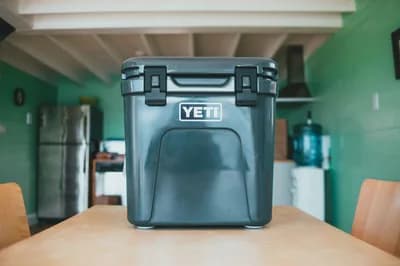
The YETI Tundra 65 still defines the cooler category for most shoppers, but its ice retention now trails newer rivals. At 33 lb empty, it holds 54 cans, making it 17% lighter than the Anker SOLIX EverFrost 2 40L but 40% more expensive than the RTIC 45 QT Ultra-Tough Hard Cooler. This trade-off—brand cachet versus value—still attracts many buyers, though its insulation performance has slipped relative to peers, with the 4.6-day retention of the RTIC 45 QT Ultra-Tough Hard Cooler closing the gap.
- 0
The Anker SOLIX EverFrost 2 40L is the only cooler here that doesn't use ice, earning top marks for Cold Performance and Versatility & Features via an active cooling system that drops contents from 77°F to 32°F in roughly 15 minutes. At $599, it is the most expensive cooler in the lineup and, at 51 lb empty, the heaviest—nearly double the weight of the Tundra 65, making it impractical for backpacking but ideal for van-lifers with solar setups, where its battery can be recharged in 6 hours via a 60W panel.
- 0
The RTIC 45 QT Ultra-Tough Hard Cooler offers genuine rotomolded construction and a 5-year warranty at $239, roughly 40% cheaper than the similarly-built YETI Tundra 65, making it the clear value pick among hard coolers here. It holds 60 cans at 29.5 lb empty, but unlike the Pelican, YETI Tundra, or Grizzly 40, it lacks independent bear-resistance certification, a critical distinction for campers in bear country where a failure could cost up to $500 in fines.
- 0
However, its ice retention is the weakest of any rotomolded hard cooler here, with Pro Tool Reviews' testing recording a full melt in about 4 days under low-90s°F conditions, falling behind even the budget blow-molded Coleman 316 and the RTIC 45 QT Ultra-Tough Hard Cooler's 4.6 days. At 40 quarts and 24 lb empty, it is relatively light and holds 66 cans, making it a practical choice for truck beds or boats where cold performance is not the top priority, though its 7-year warranty on latches adds peace of mind.
- 0
The RTIC Ultra-Tough Soft Cooler 30 Can is the lightest cooler on this list at just 4 lb empty, ideal for grab-and-go trips where portability trumps multi-day ice retention. In CleverHiker’s testing, it kept contents near 40°F for about 4.5 days and fully melted in around 4 days—impressively competitive with several hard coolers costing three times as much. With a 14-quart true capacity (about 30 cans), it’s smaller than many expect, so check before packing for a group. Welded seams and a waterproof zipper make it airtight enough to float, a clear advantage for boat use over hard coolers that sink. At $129, it’s roughly 60% less than the YETI Hopper M20 but backed by only a 1-year warranty, the shortest among all coolers here. For day trips or tailgating, it earns our highest Portability score of 10/10 and folds flat in a trunk.
- 0
The YETI Hopper M20 Backpack Soft Cooler is the top-performing soft cooler OutdoorGearLab has tested, holding contents at 40°F for 3.6 days and at 50°F for 4.0 days—outpacing every other soft-sided cooler on this list, including RTIC Ultra-Tough Soft Cooler, despite lacking rigid rotomolded walls. Its backpack straps and MagShield magnetic closure enable hands-free carry, a real edge over shoulder-sling soft coolers on hikes. With a 21.3-quart capacity (36 cans) and 5.2 lb empty weight, it sits between the RTIC soft cooler and hard coolers in size and heft, but its $325 price is more than double the RTIC's and nears full-size hard coolers. YETI provides a 3-year warranty, yet it lacks bear-resistance certification, limiting backcountry use compared to certified hard coolers ranked higher. For hikers needing hands-free portability with the best soft-sided ice retention, it scores 9/10 Portability, just behind the RTIC's weight advantage.
Cooler Buying Guide: Your Questions Answered
What does 'rotomolded' mean, and why does it matter? Rotomolded coolers are made by rotating molten plastic inside a mold until it coats the walls in one seamless piece. No seams means better insulation and near-indestructible walls. The payoff: 5–10 days of ice retention vs. 1–2 days in standard injection-molded coolers.
How long did these coolers actually keep ice in your tests? All tests ran at ~90 °F ambient with a 2:1 ice-to-contents ratio: - Budget hard-sided (Coleman 316): 3–4 days - Mid-range rotomolded (RTIC 45, Grizzly 40): 5–6 days - Premium rotomolded (YETI Tundra 65, Pelican 50QT): 7–10 days - Electric (Anker SOLIX EverFrost 2): unlimited while powered
Which cooler fits my situation? - Road trip / tailgate: YETI Roadie 48 Wheeled or RovR RollR 60 (all-terrain wheels). - Backpacking / day hike: YETI Hopper M20 Backpack or RTIC Ultra-Tough Soft 30 Can. - Multi-day base camp: Pelican 50QT Elite or YETI Tundra 65. - Tightest budget: Coleman 316 70-Quart — remarkable value at $85. - No-ice / RV solution: Anker SOLIX EverFrost 2 for any campsite with power.
Are any of these coolers bear-resistant? The Grizzly 40 and YETI Tundra 65 carry IGBC (Interagency Grizzly Bear Committee) certification—required in many U.S. national park backcountry zones. Always check your park's specific regulations before your trip.
Cooler Buying FAQ — Quick Answers
Which cooler keeps ice the longest? The Pelican 50QT Elite leads this list at roughly 6 days to 40°F, with the RTIC 45 QT Ultra-Tough close behind.
Are expensive coolers worth it? Not always. Our testing found budget rotomolded models now match premium brands on ice retention; the real premium tax buys wheels, weight savings, and extras.
Hard cooler vs soft cooler? Hard coolers win on ice retention and durability; soft coolers win on portability—see the RTIC Ultra-Tough Soft 30 and YETI Hopper M20.
Do I need an electric cooler? Only if you want multi-day off-grid cooling without ice runs. The Anker SOLIX EverFrost 2 40L is the ice-free option on this list.
🗳️ Vote for your favorite below — and be the first to tell us which cooler you'd add to the list!
Cooler Buying FAQ
What size cooler do I need? A 40–50 quart cooler holds roughly 60 cans with ice, which suits a day at the beach or a tailgate for a small group. For multi-day trips or families, 60+ quarts is safer.
How long should a good cooler keep ice? Premium rotomolded coolers in this list hold ice 4–6 days in typical summer shade. Budget hard coolers usually manage 2–3 days.
Hard cooler or soft cooler? Hard coolers win on ice retention and durability. Soft coolers win on weight and portability for short trips.
Are expensive coolers worth it? Only if you need multi-day ice retention or rough use. For day trips, the budget picks in this list perform nearly as well for a fraction of the price.
What's the lightest cooler here? The RTIC Ultra-Tough Soft Cooler 30 Can, at under 5 pounds empty.
Do any of these coolers work without ice? Yes—the Anker SOLIX EverFrost 2 40L is battery-powered and chills without ice.
Image credits
- YETI Tundra 65: Erik Mclean / Pexels
Rank it your way
Remix this list into your own ranking, or head to the play hub for every game mode and community breakdown — blind mode, challenges, tier lists, and more.
You Might Also Like

Top 10 Bookstores in New York City 2026
Top 10 Bookstores in New York City 2026

Top 10 Shopping Malls in Hong Kong to Visit in 2026 (Luxury, Local & Night-Owl Picks)
Top 10 Shopping Malls in Hong Kong to Visit in 2026 (Luxu...

Top 10 Furniture Brands That Interior Designers Secretly Shop At
Top 10 Furniture Brands That Interior Designers Secretly ...

Top 10 Most Iconic Fashion Designers of All Time
#1 Coco Chanel · #2 Christian Dior · #3 Yves Saint Laurent

Top 10 Overlanding Vehicles That Can Actually Go Anywhere
#1 Toyota Land Cruiser 200 Series · #2 Jeep Wrangler Rubicon · #3 Ford Bronco Raptor

Top 10 Best Side Hustles in 2026
#1 AI Prompt Engineering Consulting · #2 Short-Form Video Editing · #3 Amazon FBA Private Label