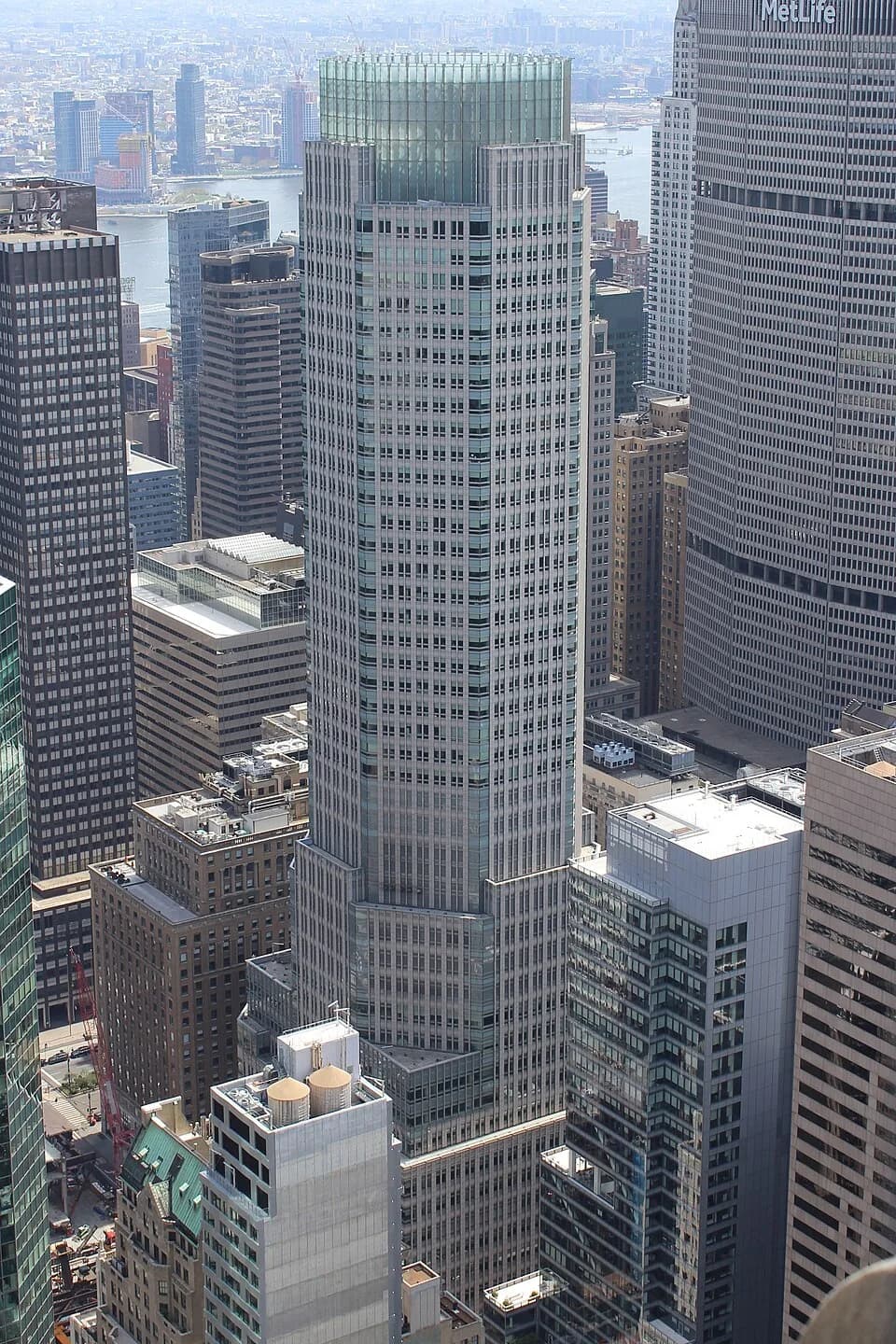
JPMorgan Chase & Co.
Company2 list appearances
On the wholesale and merchant-banking side, **J. Pierpont Morgan** established Drexel, Morgan & Co. in 1871 (reorganized as **J.P. Morgan & Co.** in 1895), which acted as the de facto lender of last resort during the Panic of 1907, spun off its securities underwriting arm as Morgan Stanley under the Glass-Steagall Act in the 1930s, converted to a public corporation in 1940, and merged with Guaranty Trust Company in 1959. On September 13, 2000, The Chase Manhattan Corporation agreed to acquire J.P. Morgan & Co. Incorporated (~$32 billion pooling-of-interests merger), closing on December 31, 2000 to form **J.P. Morgan Chase & Co.** (stylized without spaces in "JPMorgan" from 2004/2011). Following the July 2004 merger with Chicago-based **Bank One Corporation**, Bank One chief **Jamie Dimon** became President and COO, ascending to CEO at year-end 2005 and Chairman in December 2006. On October 21, 2025, the firm formally opened its new 60-story, 2.5-million-square-foot, all-electric global headquarters skyscraper at **270 Park Avenue** in Midtown Manhattan. **Major Acquisitions (Signing vs. Close Distinguished):** * **Bank One Corporation:** Announced January 14, 2004 as an all-stock merger (~$58 billion equity offer for Bank One, creating a combined ~$130 billion market-cap / ~$1.1 trillion asset institution) and closed July 1, 2004. * **The Bear Stearns Companies Inc.:** Announced March 16, 2008 at an initial emergency rescue signing price of **$2.00 per share** (~$236M) backed by Federal Reserve financing, amended March 24, 2008 to ~**$10.00 per share** in stock (0.21753 JPM shares per Bear share plus purchase of 95 million newly issued shares), and closed May 30, 2008 (~$1.4B–$1.5B total equity value). * **Washington Mutual Bank (Banking Operations):** Signed and closed simultaneously on September 25, 2008 via FDIC receivership for **$1.9 billion** in cash, acquiring WaMu's retail branch footprint, deposits, and credit card/loan portfolios while excluding parent holding-company equity and unsecured debt. * **First Republic Bank (Substantial Majority of Assets):** Signed and closed simultaneously on May 1, 2023 via FDIC receivership, paying **$10.6 billion** to the FDIC to acquire ~$173 billion of loans and ~$30 billion of securities and assume ~$92 billion of deposits and ~$28 billion of FHLB advances (with FDIC loss-share agreements and $50 billion in 5-year fixed-rate FDIC financing, excluding corporate debt and preferred stock). SEC filings and CEO commentary emphasize four primary structural risks: 1. **Macroeconomic, Credit-Cycle & Geopolitical Tail Risks:** CEO Jamie Dimon repeatedly cautions in Q3 2026 disclosures that persistent U.S. fiscal deficits, sticky inflation, elevated asset valuations, interest-rate volatility, and geopolitical conflicts create non-linear credit and market risks; within CCB and Wholesale, Card Services net charge-offs reached **2.91%** in Q3 2026 alongside a $539 million wholesale-driven reserve build
1-Tap Primary Ranking Ballot
Overview#1 Full List
Does JPMorgan Chase & Co. deserve the #1 spot on “Top 10 US Commercial Banks by Total Assets (2024 Rankings)”?
#1 JPMorgan Chase & Co.?
Verified Entity DossierRanked #1 in Top 10 US Commercial Banks by Total Assets (2024 Rankings)
Best Rank
#1
top 3 in 2 lists
Avg Position
#1
across 2 lists
Community
#1 Pick
avg #1 overall
Community Weigh-In & Debate
Should JPMorgan Chase & Co. rank Top 3 in US Commercial Banks by Total Assets (2024 Rankings)?
Ranked #1 on "Top 10 US Commercial Banks by Total Assets (2024 Rankings)". Cast your vote to back or challenge this spot.
Be the first to vote on this ranking.
The Internet's Surprise Pick
“Top 10 US Commercial Banks by Total Assets (2024 Rankings)”
Climbed to #1 — a narrowly contested win.
See the full ranking →Frequently Asked Questions
What is JPMorgan Chase & Co.'s highest community ranking?⌄
JPMorgan Chase & Co. is ranked #1 on "Top 10 US Commercial Banks by Total Assets (2024 Rankings)" — its best placement across 2 lists on top10grid.com.
How many top-10 lists feature JPMorgan Chase & Co.?⌄
JPMorgan Chase & Co. appears in 2 lists on top10grid.com, spanning categories including FINANCE.
What the internet says
Structured Facts & Specifications
Verified highlightsFinancials & Market
Ticker
JPM (Common Stock; plus NYSE Non-Cumulative Preferred Depositary Share series JPM PR C, JPM PR D, JPM PR J, JPM PR K, JPM PR L, JPM PR M)
Exchange
The New York Stock Exchange (NYSE)
Leadership & Organization
Headquarters
270 Park Avenue, New York, New York 10017-2070, United States (new 60-story all-electric global headquarters tower formally opened October 21, 2025)
Founders
Predecessor founders (corporate parent formed via mergers): Aaron Burr (The Bank of the Manhattan Company, 1799); J. Pierpont Morgan (J.P. Morgan & Co., 1871/1895); John Thompson (Chase National Bank, 1877); Balthazar P. Melick (New York Chemical Manufacturing Co., 1823)
Key Specifications
Parent
None (publicly traded ultimate parent bank holding company)
Website
Segments
Three reportable business segments plus Corporate: (1) Consumer & Community Banking (CCB — $21.17B Q3 2026 managed net revenue); (2) Commercial & Investment Bank (CIB — $22.73B Q3 2026 managed net revenue); (3) Asset & Wealth Management (AWM — $6.91B Q3 2026 managed net revenue); plus Corporate
Competitors
Bank of America Corporation; Citigroup Inc.; Wells Fargo & Company; The Goldman Sachs Group, Inc.; Morgan Stanley; BlackRock, Inc.; Capital One Financial Corporation & American Express Company; HSBC Holdings plc, Barclays PLC & Banco Santander, S.A.
Legal Status
Active — Delaware Corporation; U.S. Bank Holding Company (BHC) and Financial Holding Company (FHC) (EIN: 13-2624428; SEC File No. 1-5805; Fiscal Year End: December 31)
Name (legal)
JPMorgan Chase & Co. (styled in uppercase as JPMORGAN CHASE & CO. in statutory LEI records and SEC EDGAR header tables)
Social Profiles
(direct canonical social URLs NOT FOUND in surfaced SEC/IR text)
Registered Office
c/o The Corporation Trust Company, Corporation Trust Center, 1209 Orange St, Wilmington, Delaware 19801, United States (Delaware Registration Authority Entity ID: 691011)
Customer Pulse & Public Ratings
2 verified benchmarksApp Store4.8 out of 5CFPBRanked among top banks by consum
Chase receives high praise for its mobile app ecosystem, branch accessibility, and credit card reward programs (notably Sapphire), while attracting frequent consumer complaints regarding sudden account freezes, overdraft fees, and offshore phone customer service delays.