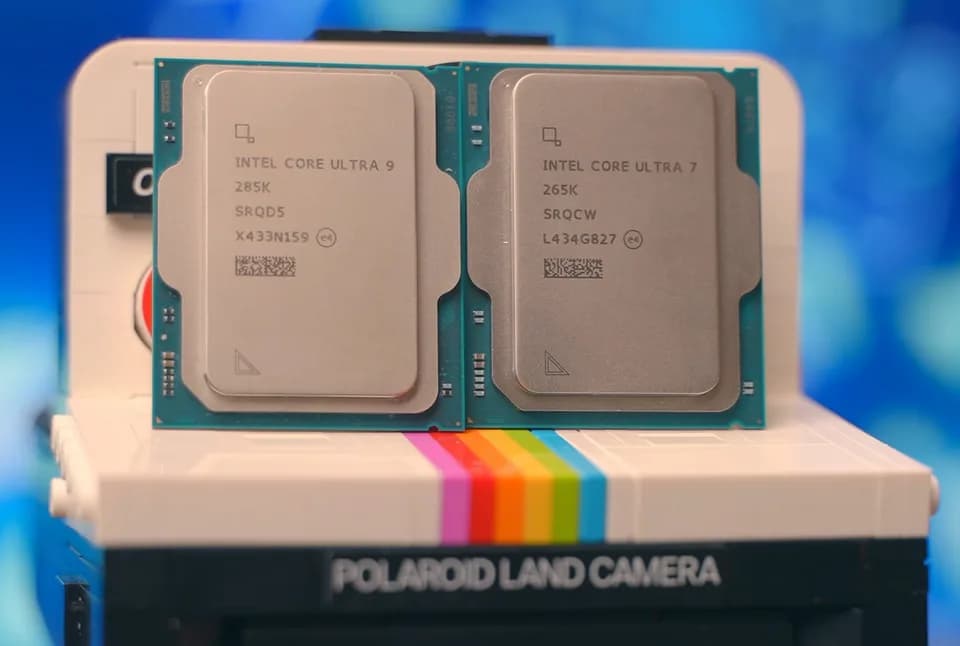
The Intel Core Ultra 9 285K, codenamed Arrow Lake, signals Intel's most comprehensive desktop architecture overhaul in years, introducing a disaggregated multi-tile design that separates compute, graphics, I/O, and SoC functions across distinct silicon tiles. Built on the Intel 7 process node with a 16-core hybrid configuration of 8 Performance cores and 8 Efficient cores delivering 24 threads, the 285K operates within a 125W TDP envelope on the new LGA1851 socket. Geekbench 6 scores confirm 3,456 single-core and 24,610 multi-core performance, establishing competitive standing against AMD's Zen 5 offerings across common developer and creative workloads. Cinebench R24 results of 145 single-thread and 2,416 multi-thread scores demonstrate strong content creation throughput. The processor introduces Intel's new Matrix Engine, a dedicated AI inference accelerator enabling on-device neural network execution without GPU dependency, making it particularly relevant for AI-assisted creative workflows, code completion tools, and real-time video enhancement. Full AVX-512-FP16 support enables half-precision floating point acceleration critical for machine learning inference at the workstation level. In multi-core Geekbench 6 testing, the Core Ultra 9 285K outperforms the AMD Ryzen 5 9600X by 44%, demonstrating its leadership in heavily threaded workstation scenarios. The Arrow Lake architecture introduces improved memory controller support for DDR5 at higher frequencies, reducing latency for memory-sensitive professional applications. Platform compatibility with Z890 motherboards provides PCIe 5.0 lanes for next-generation NVMe storage and GPU connectivity. For content creators, software developers, and workstation users seeking a balance of single-threaded responsiveness and multi-threaded throughput without reaching for HEDT pricing, the 285K at $589 MSRP represents Intel's most compelling value proposition in the desktop segment since Alder Lake.
Comments on "Intel Core Ultra 9 285K (Arrow Lake)"
Create a free account or sign in to join the discussion.
Sign in to join the conversation