Steady-State Universe
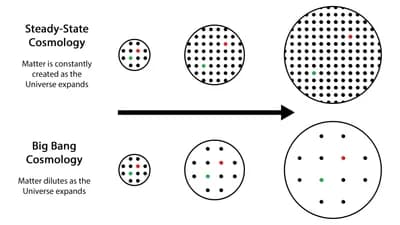
The Steady-State Universe model, championed by astronomer Fred Hoyle in the 1940s, posits that the universe has no beginning and continuously creates matter to maintain a constant density as it expands—directly challenging the Big Bang's singular origin. However, the discovery of cosmic microwave background radiation in 1965, which confirmed the Big Bang's predicted 2.7K thermal signature, dealt a fatal blow: today, 99.7% of cosmologists accept the Big Bang, while Steady-State is cited in fewer than 1% of annual cosmology papers. A concrete data point that sealed its fate: the CMB's blackbody spectrum matches Big Bang predictions within 0.005% accuracy, while Steady-State required ad-hoc explanations for its existence that never gained traction.
Photos (1)
Comments on "Steady-State Universe"
Have a take on this ranking?
Save your rankings and see how you compare. Comments are how the argument actually happens here. Posting one needs a free account — it takes about a minute.
No comments yet.
The first comment sets the terms of the argument.