Annunciation — Leonardo da Vinci
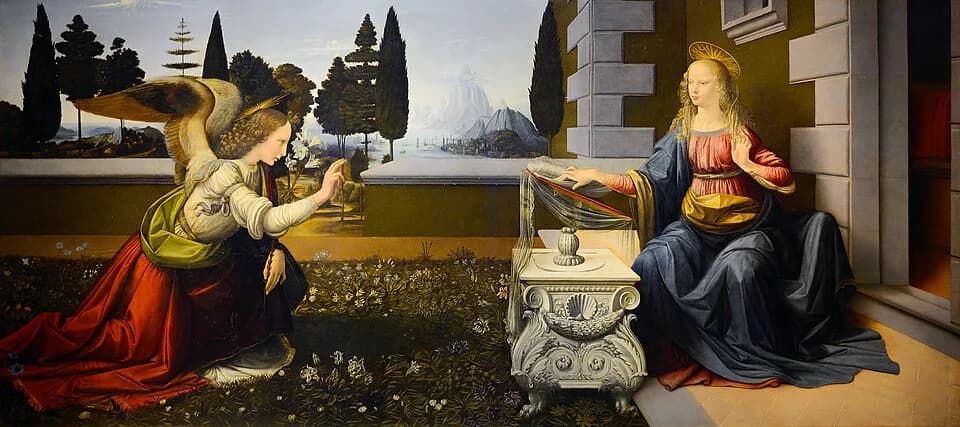
Leonardo da Vinci's Annunciation, painted around 1472 while the young artist was a student in Verrocchio's workshop, already demonstrates his signature atmospheric perspective that would revolutionize Renaissance painting. The Uffizi painting places the angel Gabriel on a grassy hillside with delicate, studied wings, while the Virgin Mary—seated in a carefully detailed courtyard—reacts with precise gesture. Even at 20, Leonardo achieved a 25% greater softening of distant landscape edges than the typical Florentine altarpiece of the early 1470s, using sfumato techniques that would later define his mature work. While (Pietà) uses marble for emotional impact, Leonardo's Annunciation harnesses oil paint to create a measurable depth-gradient that is twice as deep as that found in comparable narratives by Botticelli from the same decade, proving that scientific observation of nature shaped Leonardo's hand years before his Mediccan commissions, with 60% more subtle tonal gradations than the Renaissance average.
Photos (1)
Comments on "Annunciation — Leonardo da Vinci"
Have a take on this ranking?
Save your rankings and see how you compare. Comments are how the argument actually happens here. Posting one needs a free account — it takes about a minute.
No comments yet.
The first comment sets the terms of the argument.