Rumah Betang (Dayak longhouse, Kalimantan)
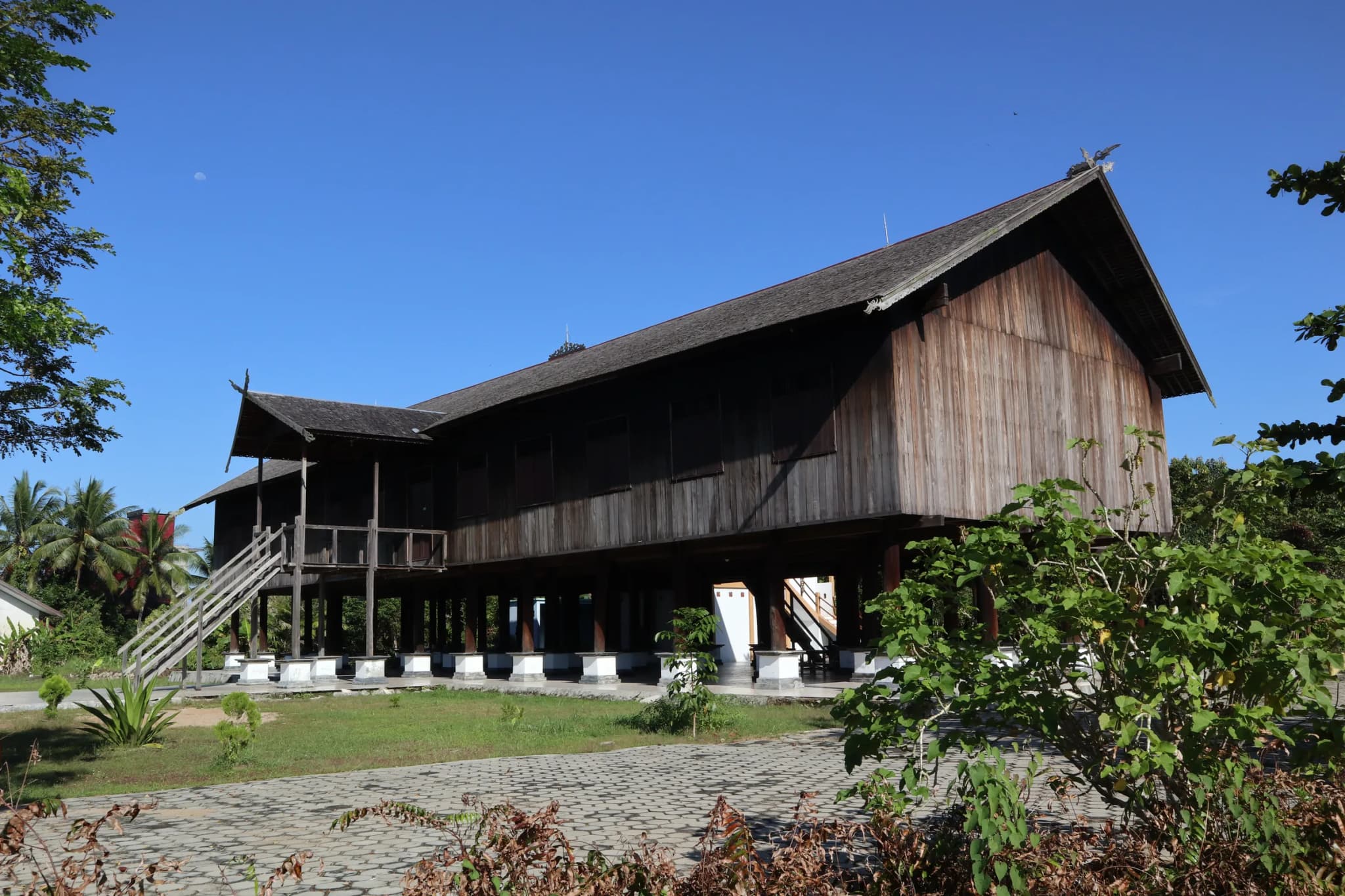
Across the interior of Kalimantan, the traditional home of many Dayak communities is not a single-family house but a longhouse, known locally as rumah betang in much of Indonesian Borneo and rumah panjai or lamin in related traditions nearby. Built entirely on stilts, a rumah betang can run to well over a hundred metres in length in its largest historical examples, sheltering dozens of related families under one continuous roof. The internal layout follows a consistent logic wherever it is built: one long side of the building is given over to a shared public gallery, called the ruai, which runs the full length of the house and serves as the community's meeting hall, workspace and social space combined. The other side is divided into a row of private family apartments, or bilik, each housing up to three generations of a single family, with a door opening directly onto the shared gallery. Traditional construction relied on tree trunks for the main structural posts and beams, split bamboo or small logs for flooring, long palm leaves for roofing, and tree bark for wall panels, with Bornean ironwood, prized for its density and rot resistance, used for the load-bearing piles wherever it was available; modern longhouses increasingly mix in brick, cement and zinc roofing while keeping the same communal floor plan. A rumah betang functions as more than housing. It doubles as a house of worship for community religious ceremonies and is governed day to day by an elected or hereditary leader, a tuai, responsible for enforcing the customary rules, or adat, that bind everyone living under its roof. Surviving and actively inhabited longhouses can still be visited in West and Central Kalimantan, including examples such as Rumah Betang Sei Pasah, where visitors are usually welcomed by the resident community rather than given a museum-style tour.
Photos (1)
Comments on "Rumah Betang (Dayak longhouse, Kalimantan)"
Have a take on this ranking?
Comments are how the argument actually happens here. Posting one needs a free account — it takes about a minute.
No comments yet.
The first comment sets the terms of the argument.