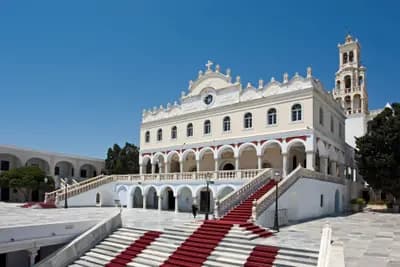
Tinos occupies a peculiar position in the Greek island landscape: it receives roughly two million pilgrims annually to the Church of Panagia Evangelistria, which houses the icon of the Virgin Mary and is one of the most revered religious sites in the Orthodox world, yet it remains largely unknown as a leisure destination outside Greece. The pilgrimage traffic — which peaks dramatically on August 15 for the Feast of the Assumption — is concentrated in Tinos Town and funnels through specific streets, leaving the island's fifty-plus villages and seventy-plus beaches largely undisturbed by the kind of cosmopolitan tourism that has overwhelmed Mykonos, visible across the water. The island's most extraordinary living cultural asset is the marble-carving village of Pyrgos, recognized as UNESCO Intangible Cultural Heritage in 2015. Pyrgos has supported over a thousand artisans and has operated a School of Fine Arts since 1955, producing marble sculptors whose work has spread to churches and public spaces across Greece. Walking through Pyrgos is a different kind of cultural experience from visiting a museum: workshops are open, chips of white marble litter the streets, and artisans can be observed at work in real time. The village's marble museum and the graves of notable sculptors make it a serious destination for anyone interested in Greek craft heritage. Beyond Pyrgos, Tinos presents a folk-architecture museum of unusual richness. Approximately a thousand ornate stone dovecotes — pigeon towers built during Venetian rule — dot the island's hills in various states of preservation, and more than eighty windmills survive in recognizable form. These structures, combined with the island's fifty-plus villages each with distinct architectural character, give Tinos a cultural density rare among Aegean islands. Beach quality is strong and varied: Kolymbithra offers twin sandy bays on the north coast; Kionia sits near the ancient Sanctuary of Poseidon; Agios Romanos presents a turquoise cove for families. Access from Athens is among the best on this list — ferries from Piraeus take four and a half hours regular or two to four hours high-speed; from Rafina, roughly two to four hours. Accommodation runs $88 to $188 per night with taverna meals at €10 to €20, placing Tinos comfortably in mid-range.
Comments on "Tinos"
Create a free account or sign in to join the discussion.
Sign in to join the conversation