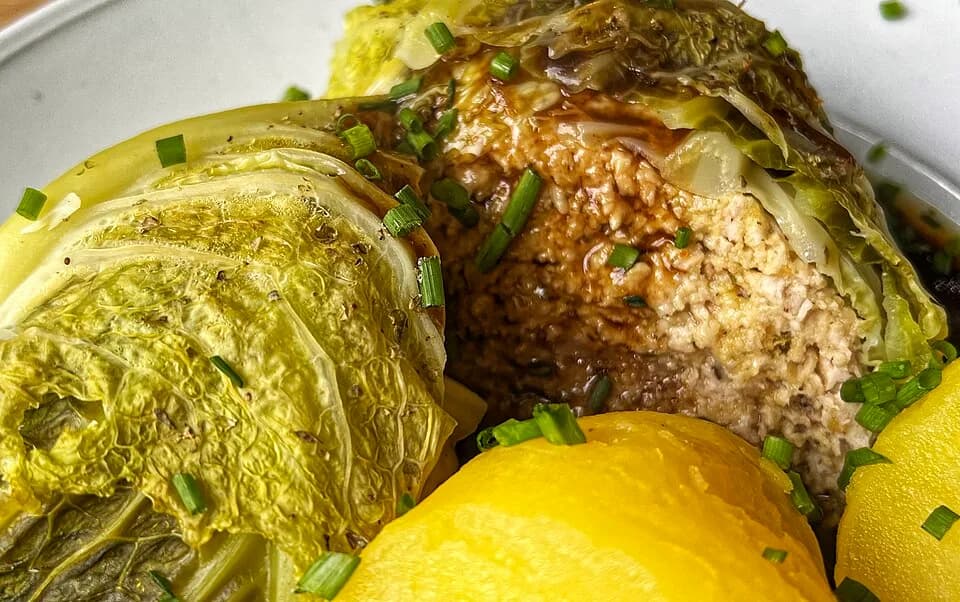
Stuffed cabbage rolls may be the most universally shared culinary preparation in human history. Nearly every culture that grows cabbage has independently arrived at the same fundamental idea: soften the leaves, wrap them around a filling of grain and meat, and braise the resulting bundles in an aromatic liquid until tender and unified in flavor. Polish cooks call them gołąbki and braise them in tomato sauce. Balkan and Turkish cooks make sarma, often with sour cabbage and pork or lamb. Middle Eastern dolma uses grape leaves most famously but cabbage interchangeably. Romanian sarmale are braised in sauerkraut juice for acidity. German Kohlrouladen serve with a brown sauce of root vegetables and beef stock. The Japanese make a version called ロールキャベツ (roru kyabetsu) braised in a mild tomato-consommé. Each variant reflects the local pantry and flavor tradition while following the same structural logic. The preparation requires genuine technique and patience. Cabbage leaves must be blanched until pliable without tearing — typically two to three minutes in boiling water — then cooled and dried before filling. The filling, classically a mixture of ground pork or beef, white rice, onion, garlic, herbs, and egg as a binder, must be seasoned assertively since it will mellow during the long braise. Rolling requires practice: a small amount of filling placed near the base of a leaf, folded into a neat bundle without leaving air pockets that cause uneven cooking. The rolls are then arranged in layers in a heavy pot and covered in tomato sauce or broth for 90 to 120 minutes of slow cooking. The nutritional result of this effort is substantial: 300 to 475 kilocalories per serving, 19 to 29 grams of protein, 7 grams of dietary fiber, and meaningful quantities of iron, vitamins A, B6, B12, and C. The braising liquid, often served alongside, provides additional collagen and mineral content from the long simmer. In 2026, stuffed cabbage rolls are experiencing a heritage cooking revival driven by two distinct audiences: Eastern European diaspora communities rediscovering family recipes as comfort during economic uncertainty, and food-curious home cooks drawn to the cultural anthropology of a dish that appears in so many cuisines simultaneously. Modern adaptations have made the preparation more accessible without sacrificing character: plant-based fillings using lentils, mushrooms, or quinoa replicate the density and savoriness of meat. Instant Pot versions reduce braising time from two hours to 45 minutes. The dish rewards the investment of effort with extraordinary flavor complexity that only improves after 24 hours of refrigeration — making it ideal for batch cooking.
Comments on "Stuffed Cabbage Rolls (Gołąbki / Sarma / Dolma)"
Create a free account or sign in to join the discussion.
Sign in to join the conversation