#8
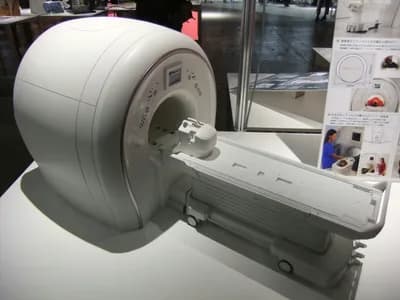
Magnetic Resonance Imaging (MRI) Scanner
The MRI Scanner, developed in the 1970s by Raymond Damadian, Paul Lauterbur, and Peter Mansfield, revolutionized medical diagnostics by producing detailed soft-tissue images without ionizing radiation. Using a powerful 1.5- to 3-tesla magnetic field and radio waves, it can resolve structures as small as 1 millimeter in a 20-minute scan, outperforming X-ray CT in brain and spinal cord visualization.
–
Photos (1)
Comments on "Magnetic Resonance Imaging (MRI) Scanner"
Have a take on this ranking?
Save your rankings and see how you compare. Comments are how the argument actually happens here. Posting one needs a free account — it takes about a minute.
No comments yet.
The first comment sets the terms of the argument.