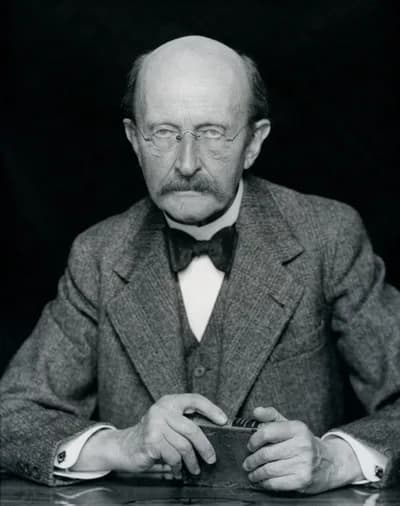
Max Planck
Max Planck's revolutionary quantum theory, which earned him the 1918 Nobel Prize in Physics, fundamentally changed our understanding of energy at the atomic and subatomic levels. His work disproved the classical assumption that energy is continuous, introducing the concept of discrete energy packets called quanta. Planck's constant, a fundamental physical constant valued at 6.626 x 10⁻³⁴ joule-seconds, became a cornerstone of modern physics. This constant is essential for explaining phenomena that led to the development of technologies such as lasers and semiconductors. His seminal 1913 paper on black-body radiation provided critical data that compelled physicists to abandon classical models, solidifying his enduring role as the father of quantum mechanics.
Photos (1)
Comments on "Max Planck"
Have a take on this ranking?
Save your rankings and see how you compare. Comments are how the argument actually happens here. Posting one needs a free account — it takes about a minute.
No comments yet.
The first comment sets the terms of the argument.