Intel Arc B580
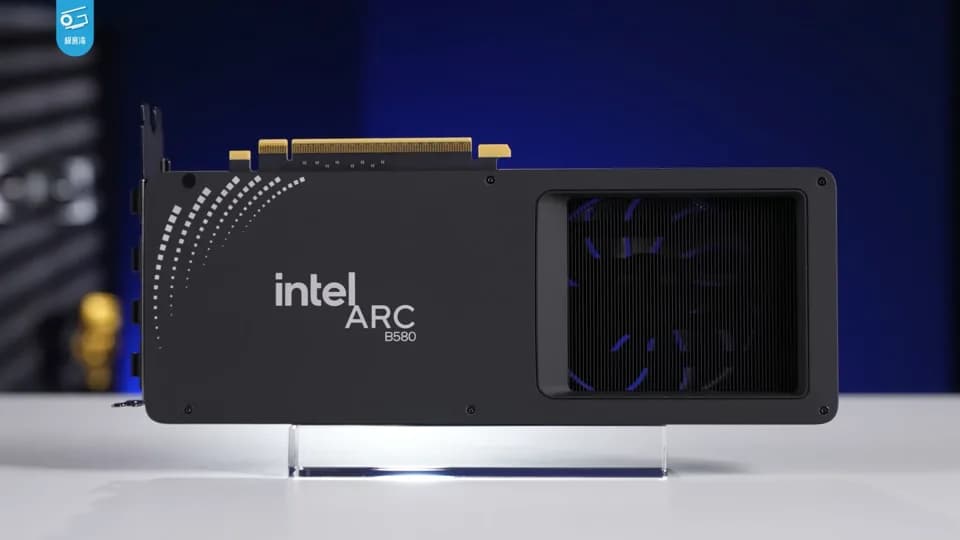
The Intel Arc B580 is the baseline card against which every index score in this ranking is measured (Arc B580 = 100). Built on Intel's Xe2 Battlemage architecture (BMG-G21) with 20 Xe2-cores at a 2670MHz boost clock, it pairs 12GB of GDDR6 with a 192-bit bus for 456 GB/s bandwidth, a wider bus than several cards costing far more. Launched at $249, it now sells for roughly $303 at Amazon (July 2026); Intel is the vendor holding closest to MSRP overall in dollar terms, and that $303 keeps the B580 the cheapest card in this entire list. In GamersNexus' 13-title suite, the anchor for this entire index, it averaged 86 fps at 1440p and 47 fps at 4K. At 190W with a single 8-pin connector, it's a straightforward, easy-to-power card, though its 52.6 power-efficiency score is the lowest in the field. It runs Intel's XeSS 2 upscaler, described in the data as improving, and pairs it with genuinely excellent AV1 encoding for the price, a real strength for streamers and creators on a budget. Its 330 value-for-money score, the second-highest of any card tested, reflects just how much raw 1440p index it delivers per dollar at its low street price. The clear caveat, and the reason it anchors the bottom of this list despite strong value math, is driver maturity: it's explicitly the weakest of the three vendors on this front, and its ray-tracing throughput (Xe2's 0.75 RT modifier, the steepest discount applied to any architecture here) trails the field by the widest margin. This is the card for strict-budget 1080p/1440p builds, HTPC or small-form-factor systems, or content creators who prioritize AV1 encode quality per dollar over top-tier raster or ray-tracing performance.
Photos (1)
Comments on "Intel Arc B580"
Have a take on this ranking?
Save your rankings and see how you compare. Comments are how the argument actually happens here. Posting one needs a free account — it takes about a minute.
No comments yet.
The first comment sets the terms of the argument.