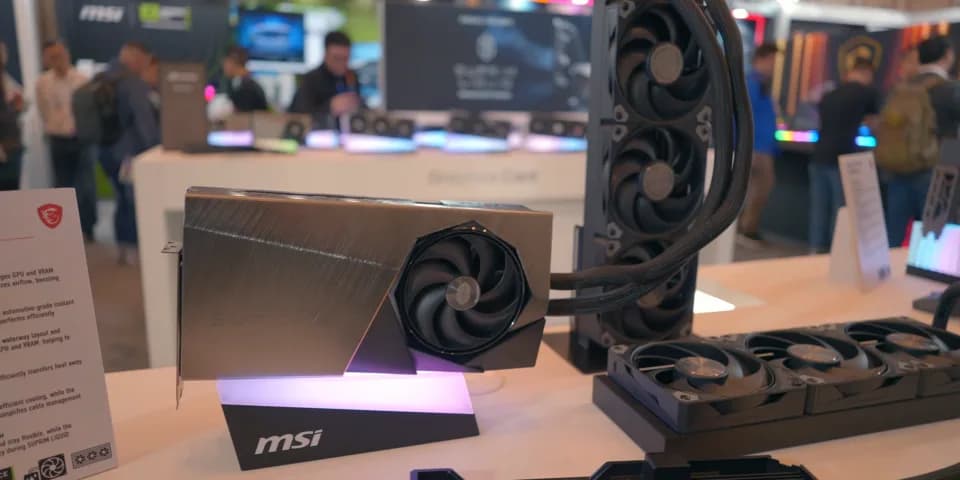
GeForce RTX 5090
The GeForce RTX 5090 is the performance ceiling of this generation. NVIDIA's Blackwell GB202 die packs 21,760 CUDA cores running at a 2410MHz boost clock, paired with 32GB of GDDR7 across a 512-bit bus for 1792 GB/s of bandwidth, the largest VRAM pool and widest memory bus of any card on this list. That bandwidth advantage is exactly why the 5090 posts the highest scores here: an index of 270 at 1440p and 319 at 4K (Intel Arc B580 = 100 baseline), the widest 1440p-to-4K spread of any card in the field. In GamersNexus' 8-title suite the 5090 averaged 207 fps in Resident Evil 4 and 86 fps in Black Myth Wukong at 4K, with a ray-traced Cyberpunk 2077 score of 95; at 1440p it posted 189 fps in Dragon's Dogma 2 and 317 fps in Final Fantasy XIV. This is the card for buyers who want the largest possible VRAM headroom for 4K gaming, heavy ray tracing, or creator workloads that lean on its 32GB buffer and best-in-class AV1 NVENC encoder, backed by DLSS 4 Multi Frame Generation and Reflex 2. The catch is entirely financial: launch MSRP was $1999, but a 7-retailer tracker pegs the current 90-day street-price floor at $2999 as of July 2, 2026, roughly a 50% markup driven by the GDDR7 supply premium. At 575W board power it needs a 16-pin 12V-2x6 connector (or a 4x 8-pin adapter), a Gen 5 x16 slot, and the most robust PSU and case airflow on this list. If your resolution, wallet, and case can support it, nothing here touches its raw ceiling; if not, the value math explains why it ranks behind two far cheaper cards despite the top score.
Photos (1)
Comments on "GeForce RTX 5090"
Have a take on this ranking?
Save your rankings and see how you compare. Comments are how the argument actually happens here. Posting one needs a free account — it takes about a minute.
No comments yet.
The first comment sets the terms of the argument.