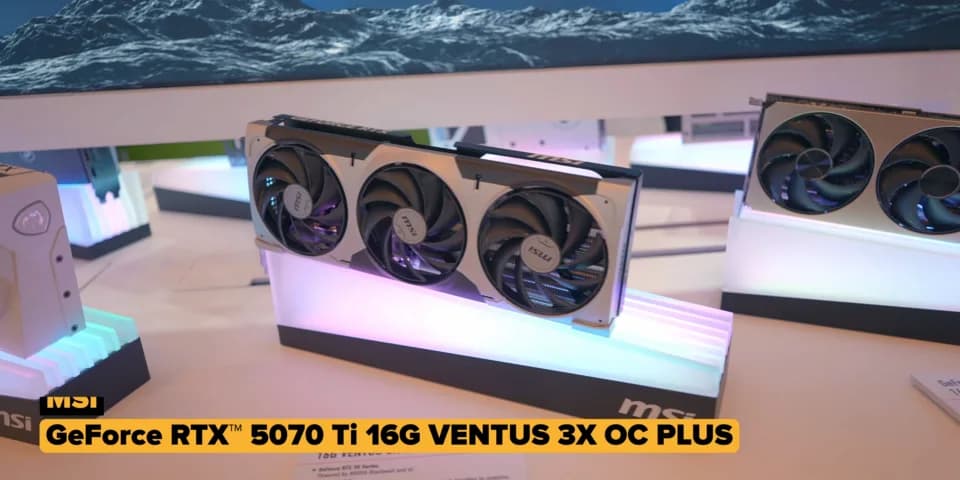
GeForce RTX 5070 Ti
The GeForce RTX 5070 Ti shares the GB203 Blackwell die with the 5080 but with 8,960 CUDA cores at a 2450MHz boost clock and the same 16GB of GDDR7, on a 896 GB/s, 256-bit path. Launched at $749, it now trades at an aggregate midpoint of roughly $1099 across bestvaluegpu, gpudeals, and TheFPSReview listings (July 2026). GamersNexus' ray-tracing testing found it running 27% ahead of the RTX 5070 in ray-traced Death Stranding 2 at 1440p, underlining the RT-hardware jump within NVIDIA's own stack. At 300W with a 2x 8-pin adapter connector, it draws meaningfully less power than the 5080 while giving up only a modest amount of index score. It carries DLSS 4 MFG, the same 16GB headroom as the 5080, and a flagship-grade encoder, earning a 9/10 features score tied for second-best in the field. NVIDIA positions this as its best value entry in the higher tier, and the data mostly backs that framing relative to its own 5080 and 5090 siblings, though at $1099 street, its value-for-money score (174.7) still trails cards costing half as much. This is the pick for buyers who want 5080-adjacent ray-tracing and VRAM headroom without quite the same expense, provided the roughly 47% markup over its $749 MSRP doesn't sour the deal. It's best suited to 1440p players who want serious ray-tracing headroom for years to come, or 4K gamers willing to lean on DLSS 4 upscaling rather than brute-force native rendering.
Photos (1)
Comments on "GeForce RTX 5070 Ti"
Have a take on this ranking?
Save your rankings and see how you compare. Comments are how the argument actually happens here. Posting one needs a free account — it takes about a minute.
No comments yet.
The first comment sets the terms of the argument.