Company · Top10Grid DossierCompany
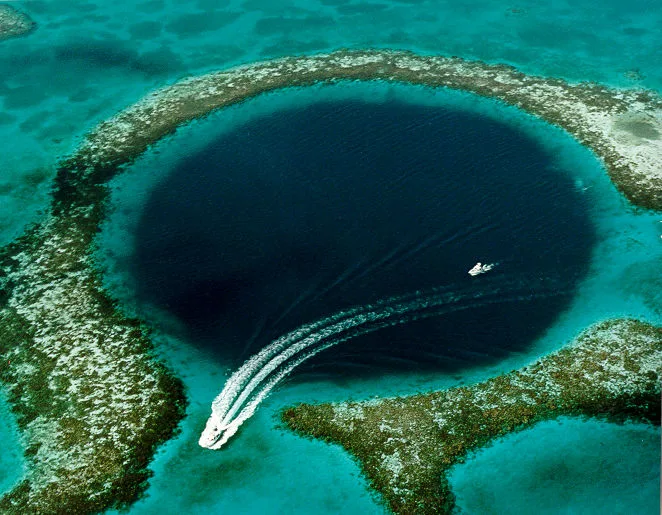
Great Blue Hole
Visually distinguished from orbit and aerial flyovers as a deep-cobalt circle ringed by shallow turquoise coral flats, the Great Blue Hole is one of the largest marine sinkholes (blue holes) on Earth. Originally formed on dry land as a limestone cavern during Pleistocene glacial maxima when sea levels were 100–200 m lower, its roof collapsed and the shaft was subsequently flooded as ice sheets melted. ~150,000+ years ago (Pleistocene Ice Ages): Karst dissolution hollowed out a massive limestone cave system above sea level, forming stalactites and dripstone columns before roof collapse and post-glacial sea-level rise submerged the cavern. 1971–1972: Oceanographer Jacques-Yves Cousteau brought his research vessel Calypso to the Great Blue Hole, filming its submerged stalactites and declaring it one of the world's premier dive sites. 1996: Inscribed as a component of the Belize Barrier Reef Reserve System UNESCO World Heritage Site. 1997: A Cambrian Foundation expedition measured the sinkhole's vertical depth at 124 m (407 ft).
Peak Community Rank
#2
Active Rankings
1
Leaderboard
Active Rankings & Inline Ballot
Rankings Featuring Great Blue Hole
#2
Contender: Great Blue Hole, Belize
Verified Entity DossierRanked #2 in Top 10 Best Diving Ecosystems
Community Weigh-In & Debate
Should Great Blue Hole rank Top 3 in Diving Ecosystems?
Ranked #2 on "Top 10 Best Diving Ecosystems". Cast your vote to back or challenge this spot.
Be the first to vote on this ranking.