#10
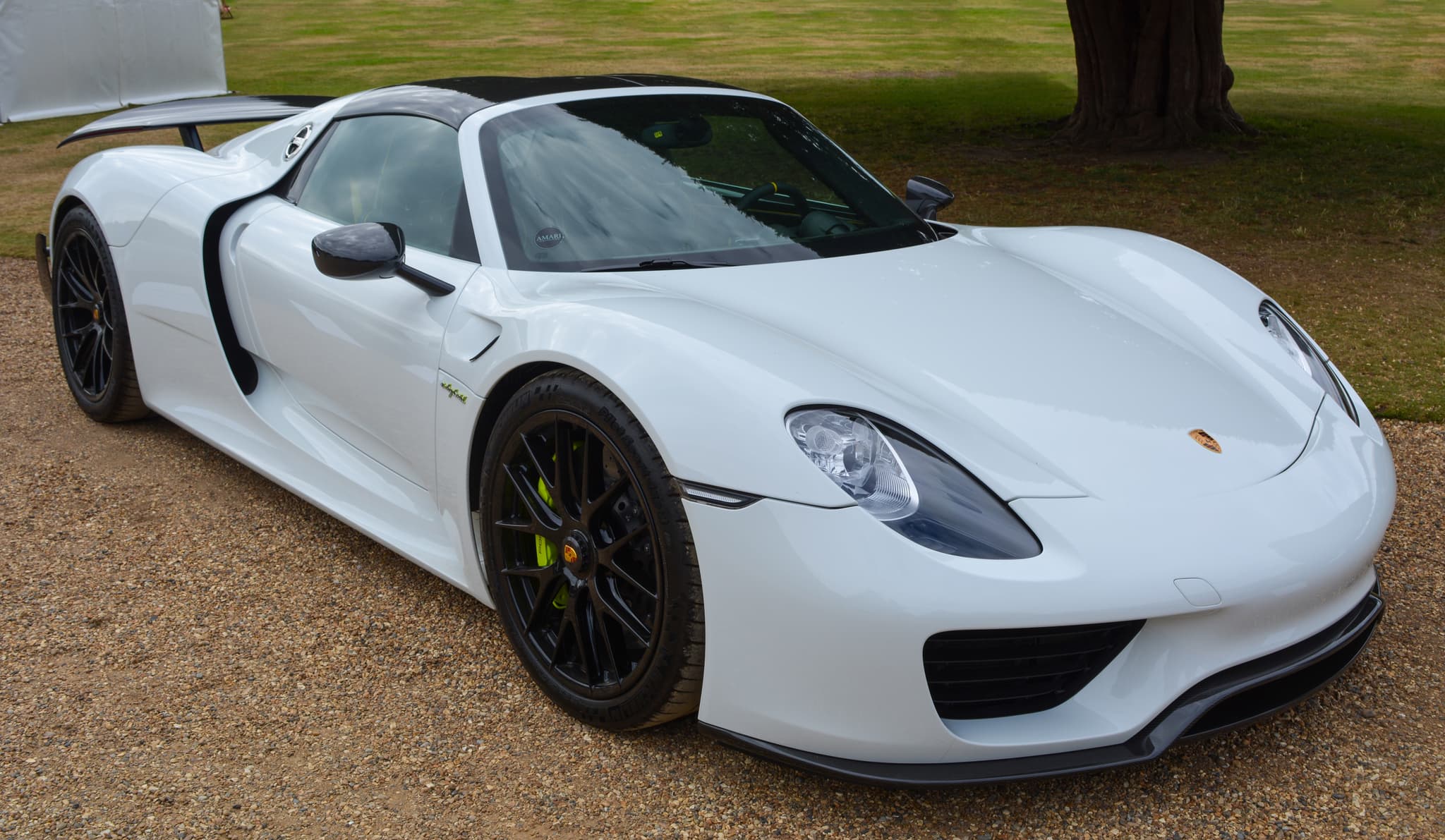
Porsche 918 Spyder
Should this item rank higher or lower?
–
Part of the legendary hypercar "Holy Trinity," the 2015 Porsche 918 Spyder proved the viability of hybrid performance by pairing a race-derived naturally aspirated 4.6-liter V8 with two electric motors. Over a decade after launch, its surgical all-wheel-drive traction still out-launches modern supercars.
About Porsche 918 Spyder
Produced between 2013 and 2015 in Stuttgart, Germany, the Porsche 918 Spyder is a mid-engine plug-in hybrid supercar that established benchmarks for hybrid sports car development. The powertrain pairs a race-derived 4.6-liter naturally aspirated V8 engine producing 599 horsepower with dual electric motors—one powering the front axle and another driving the rear wheels—delivering a combined total of 875 horsepower (652 kW) and 944 lb-ft of torque. In independent testing by Car and Driver, the 918 Spyder completed the 0-60 mph sprint in 2.1 seconds, becoming the quickest accelerating road vehicle tested by the magazine upon its debut. It covered the standing quarter-mile in 9.7 seconds at 145 mph. Constructed around a carbon-fiber reinforced polymer (CFRP) monocoque, the hypercar features rear-axle steering, regenerative braking capable of recovering immense kinetic energy, and a top track speed of 214 mph. Ranks sixth with an instrumented 0-60 mph sprint of 2.1 seconds, setting the benchmark for the modern hybrid hypercar trinity. Built in a limited run of 918 units, the 875-horsepower Porsche 918 Spyder hybrid hypercar achieves 0-60 mph in 2.1 seconds and 1/4-mile in 9.7 seconds. K
Also Ranks On
View canonical entity profile (2 lists) →Part of the legendary hypercar "Holy Trinity," the 2015 Porsche 918 Spyder proved the viability of hybrid performance by pairing a race-derived naturally aspirated 4.6-liter V8 with two electric motors. Over a decade after launch, its surgical all-wheel-drive traction still out-launches modern supercars.
Key Metrics
0-60 mph acceleration
2.20 seconds (independent tests measured 2.1s)
Power output
875 hp and 944 lb-ft torque
Nürburgring Nordschleife time
6:57 (first production car under 7 minutes)
Production limit
918 units
Original MSRP
$845,000 USD (now $1.6M-$2.2M on secondary market)
Pros and Cons
Pros
- naturally aspirated 4.6-liter V8 revs to 9,150 RPM with incredible top-exit exhaust acoustics
- historic investment appreciation with rock-solid collector demand
- bulletproof Porsche engineering reliability compared to Italian exotics
Cons
- decade-old hybrid battery pack technology requires monitoring
- interior infotainment screens feel dated by modern standards
Eligibility
- Best for blue-chip automotive collectors seeking an all-time hall-of-fame hybrid hypercar
Things to Watch Out For
- Replacement costs for high-voltage battery modules are substantial
- secondary market values exceed $1.8M USD
Photos (1)
Comments on "Porsche 918 Spyder"
Be the first to share your thoughts!
Have a take on this ranking?
Save your rankings and see how you compare. Comments are how the argument actually happens here. Posting one needs a free account — it takes about a minute.
No comments yet.
The first comment sets the terms of the argument.