Évora
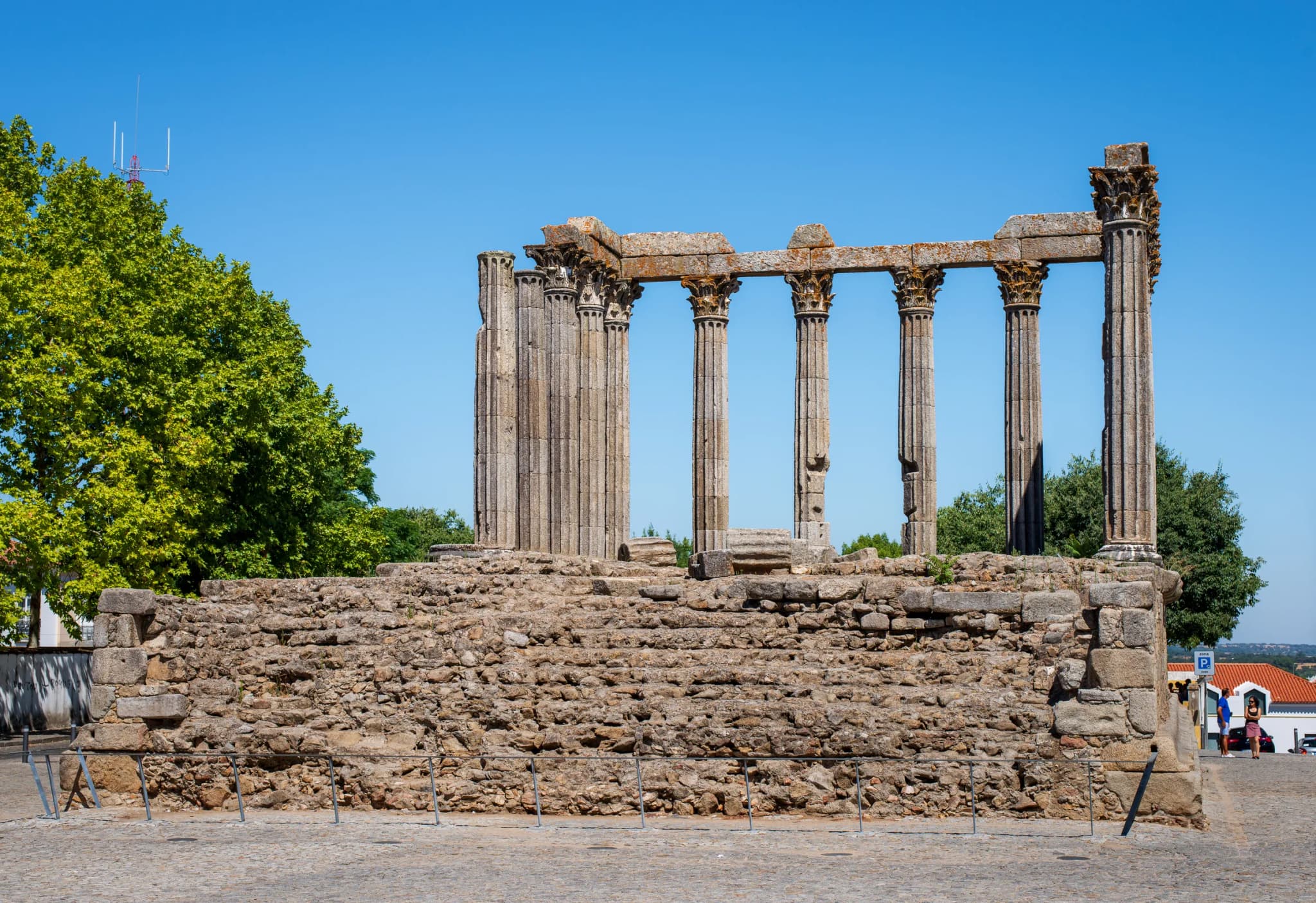
Évora packs three distinct historical eras into a walkable old town, which is exactly why UNESCO listed the whole historic centre as a World Heritage Site in 1986. The Romans arrived first, renaming the settlement Liberalitas Julia, and left behind the Roman Temple that still dominates the main square — fourteen granite Corinthian columns, long misattributed to the goddess Diana, that survived partly because later occupants incorporated the ruin into a medieval fortress rather than tearing it down. Moorish rule followed for roughly four centuries before Portuguese forces retook the city in 1165, and the tangle of narrow whitewashed streets in the old quarter still traces a layout closer to Islamic Évora than to any Renaissance grid. The most visited sight by far is the Chapel of Bones inside the Church of St. Francis, a small side chapel whose walls and columns are entirely lined with the bones and skulls of thousands of exhumed monks and townspeople, built by Franciscan friars as a blunt meditation on mortality rather than a macabre attraction. Évora's Gothic cathedral, one of the largest in Portugal, sits a few streets away and is worth the climb to its roof terrace for views back over the temple and the surrounding Alentejo plain. Under kings Manuel I and João III, Évora became a genuine centre of Portuguese humanism, and the university they founded still anchors the old town today. The single biggest practical factor here is climate: the Alentejo interior runs significantly hotter and drier than coastal Lisbon, and a summer midday visit can be genuinely punishing, so spring, autumn, or an early start in July and August make a real difference to how much of the town you can comfortably cover.
Photos (1)
Comments on "Évora"
Have a take on this ranking?
Comments are how the argument actually happens here. Posting one needs a free account — it takes about a minute.
No comments yet.
The first comment sets the terms of the argument.