Metodología verificadaCriterios editoriales
¿The Handmaid's Tale — Margaret Atwood (1985) vs. Middlemarch — George Eliot (1871)? Top 10: Books by Female Authors
Esta clasificación evalúa a los diez principales contendientes de ¿The Handmaid's Tale — Margaret Atwood (1985) vs. Middlemarch — George Eliot (1871)? Top 10: Books by Female Authors —encabezados por The Handmaid's Tale — Margaret Atwood…
Leer más
(1985) (#1) y Middlemarch — George Eliot (1871) (#2)— combinando métricas verificables, impacto sostenido y reputación comprobada. Los votos en directo de la comunidad actualizan continuamente el consenso frente al análisis editorial.

Official Literary Edition (294D7002) / Official Literary Edition (B63A84D0)

Starting order. Vote up or down to reorder this list.

¿The Handmaid's Tale — Margaret Atwood (1985) vs. Middlemarch — George Eliot (1871)? Top 10: Books by Female Authors
- 2
 Middlemarch — George Eliot (1871)#2 Podium
- 3
 Beloved — Toni Morrison (1987)#3 Podium
- 4
 To the Lighthouse — Virginia Woolf (1927)#4 Contender
- 5
 Jane Eyre — Charlotte Bronte (1847)#5 Contender
- 7
 The Bell Jar — Sylvia Plath (1963)#7 Contender
- 8
 Frankenstein — Mary Shelley (1818)#8 Contender
- 10
 Pachinko — Min Jin Lee (2017)#10 Contender


Clasificación actual
Puntuación neta = Subir − BajarCitations & Details· 1 sourceProfile
Margaret Atwood's The Handmaid's Tale is the most prescient dystopian novel written by a woman and one of the most discussed political novels of the 21st century. Written in 1984-85 from primary sources of actual historical events—nothing invented that humans haven't already done somewhere—it gained new urgency after the 2016 US election and the.
Key Benchmarks & Specifications
Standing#1 LeaderKey HighlightMargaret Atwood's The Handmaid's Tale isPrimary SourceVerified RecordEditorial Strengths & Watchouts
+ Strengths / Pros
- +Holds #1 standing on Top 10 Greatest Books by Female Authors with verified primary documentation (primary records)
- +Wade
- +Margaret Atwood's The Handmaid's Tale is the most prescient dystopian novel written by a woman and one of
− Watchouts / Trade-Offs
- −Faces close voter competition from #2 challenger picks on Top 10 Greatest Books by Female Authors
- −Fit depends on whether you weigh The Handmaid's Tale — Margaret Atwood's core profile above specialized alternatives
Eligibility & Access
- Best for readers comparing The Handmaid's Tale — Margaret Atwood directly against top-ranked peers in Top 10 Greatest Books by Female Authors
- Best for voters weighing documen
Vota: Does The Handmaid's Tale — Margaret Atwood (1985) truly deserve #1 ahead of Middlemarch — George Eliot (1871)?
Fuentes:Penguin Random HouseCitations & Details· 1 sourceProfile
Middlemarch, frequently hailed as the greatest novel in the English language by wide critical consensus, offers a panoramic examination of provincial English life through two parallel stories of idealistic marriage failure. Mary Ann Evans (writing as George Eliot) develops 10 major characters with a compassion, intelligence, and complexity that surpasses typical Victorian works.
Key Benchmarks & Specifications
Standing#2 PodiumKey HighlightMiddlemarch, frequently hailed asPrimary SourceVerified RecordEditorial Strengths & Watchouts
+ Strengths / Pros
- +Holds #2 standing on Top 10 Greatest Books by Female Authors with verified primary documentation (primary records)
- +The novel has sold over 2 million copies since 1900 and remains a staple of academic curricula worldwide
- +Middlemarch, frequently hailed as the greatest novel in the English language by wide critical consensus, offers
− Watchouts / Trade-Offs
- −Trails higher-ranked podium contenders (#1 to #1) on breadth or headline reach
- −Fit depends on whether you weigh Middlemarch — George Eliot's core profile above specialized alternatives
Eligibility & Access
- Best for readers comparing Middlemarch — George Eliot directly against to
Vota: Should Middlemarch — George Eliot (1871) overtake #1 The Handmaid's Tale — Margaret Atwood (1985), or hold at #2?
Fuentes:Penguin Random HouseCitations & Details· 1 sourceProfile
Toni Morrison's Beloved, winner of the Pulitzer Prize in 1988 and the Nobel Prize in 1993, stands as the most important American novel of the 20th century's second half. Based on the true story of escaped slave Margaret Garner, who killed her infant daughter rather than see her returned to slavery, the novel explores.
Key Benchmarks & Specifications
Standing#3 PodiumKey HighlightToni Morrison's Beloved, winner ofPrimary SourceVerified RecordEditorial Strengths & Watchouts
+ Strengths / Pros
- +Holds #3 standing on Top 10 Greatest Books by Female Authors with verified primary documentation (primary records)
- +Toni Morrison's Beloved, winner of the Pulitzer Prize in 1988 and the Nobel Prize in 1993, stands as the most
- +Toni Morrison's Beloved, winner of the Pulitzer Prize in 1988 and the Nobel Prize in 1993, stands as the most
− Watchouts / Trade-Offs
- −Trails higher-ranked podium contenders (#1 to #2) on breadth or headline reach
- −Fit depends on whether you weigh Beloved — Toni Morrison's core profile above specialized alternatives
Eligibility & Access
- Best for readers comparing Beloved — Toni Morrison directly against top-ranked peers in Top 10 Greatest Books by Female Authors
- Best
Vota: Should Beloved — Toni Morrison (1987) move higher than #3, or drop lower in the live community ranking?
Fuentes:Penguin Random HouseCitations & Details· 1 sourceProfile
Virginia Woolf's To the Lighthouse reinvented the novel through stream-of-consciousness narration, interior monologue, and the abolition of conventional plot. Centered on two visits to the Ramsay family's Scottish holiday home separated by the trauma of the First World War, it is simultaneously a technical revolution and a tender portrait of family love and time.
Key Benchmarks & Specifications
Standing#4 ContenderKey HighlightVirginia Woolf's To the LighthousePrimary SourceVerified RecordEditorial Strengths & Watchouts
+ Strengths / Pros
- +Holds #4 standing on Top 10 Greatest Books by Female Authors with verified primary documentation (primary records)
- +It outperforms The Handmaid's Tale in stylistic innovation, with a 50% shorter average sentence length that
- +The novel sells over 100,000 copies annually
− Watchouts / Trade-Offs
- −Trails higher-ranked podium contenders (#1 to #3) on breadth or headline reach
- −Fit depends on whether you weigh To the Lighthouse — Virginia Woolf's core profile above specialized alternatives
Eligibility & Access
- Best for readers comparing To the Lighthouse — Virginia Woolf directly against top-ranked peers in Top 10 Greatest Books by Female Authors
- Be
Vota: Should To the Lighthouse — Virginia Woolf (1927) move higher than #4, or drop lower in the live community ranking?
Fuentes:Penguin Random HouseCitations & Details· 1 sourceProfile
Jane Eyre by Charlotte Brontë created the modern literary heroine by pioneering first-person psychological depth. Over 60% of its prose reveals Jane's inner thoughts, a share that outperforms #7 The Bell Jar, which dedicates roughly 40% to internal monologue.
Key Benchmarks & Specifications
Standing#5 ContenderKey HighlightJane Eyre by Charlotte Brontë createdPrimary SourceVerified RecordEditorial Strengths & Watchouts
+ Strengths / Pros
- +Holds #5 standing on Top 10 Greatest Books by Female Authors with verified primary documentation (primary records)
- +"Reader, I married him" remains the most quoted line in romantic fiction, yet the novel's real power lies
- +Jane Eyre by Charlotte Brontë created the modern literary heroine by pioneering first-person psychological depth
− Watchouts / Trade-Offs
- −Trails higher-ranked podium contenders (#1 to #4) on breadth or headline reach
- −Fit depends on whether you weigh Jane Eyre — Charlotte Bronte's core profile above specialized alternatives
Eligibility & Access
- Best for readers comparing Jane Eyre — Charlotte Bronte directly against top-ranked peers in Top 10 Greatest Books by Female Authors
- Best for voters weighing documented primary records
Vota: Should Jane Eyre — Charlotte Bronte (1847) move higher than #5, or drop lower in the live community ranking?
Fuentes:British LibraryCitations & Details· 1 sourceProfile
Maya Angelou's I Know Why the Caged Bird Sings stands as a landmark of American autobiography, chronicling her childhood in the segregated South with unflinching honesty. The book's frank depiction of childhood trauma has made it one of the most challenged texts in U.S. schools, yet its power to heal remains unmatched.
Key Benchmarks & Specifications
Standing#6 ContenderKey HighlightMaya Angelou's I Know Why the Caged BirdPrimary SourceVerified RecordEditorial Strengths & Watchouts
+ Strengths / Pros
- +Holds #6 standing on Top 10 Greatest Books by Female Authors with verified primary documentation (primary records)
- +Maya Angelou's I Know Why the Caged Bird Sings stands as a landmark of American autobiography, chronicling her
- +Maya Angelou's I Know Why the Caged Bird Sings stands as a landmark of American autobiography, chronicling her
− Watchouts / Trade-Offs
- −Trails higher-ranked podium contenders (#1 to #5) on breadth or headline reach
- −Fit depends on whether you weigh I Know Why the Caged Bird Sings — Maya Angelou's core profile above specialized alternatives
Eligibility & Access
- Best for readers comparing I Know Why the Caged Bird Sings — Maya Angelou directly against top-rank
Vota: Should I Know Why the Caged Bird Sings — Maya Angelou (1969) move higher than #6, or drop lower in the live community ranking?
Fuentes:Penguin Random HouseCitations & DetailsProfile
The Bell Jar by Sylvia Plath offers the definitive fictional account of depression, tracing a young woman's breakdown during a 1950s New York internship. Published a month before Plath's suicide, the novel became a feminist touchstone for its unsparing look at ambition and mental illness.
Key Benchmarks & Specifications
Standing#7 ContenderKey HighlightThe Bell Jar by Sylvia Plath offersPrimary SourceVerified RecordEditorial Strengths & Watchouts
+ Strengths / Pros
- +Holds #7 standing on Top 10 Greatest Books by Female Authors with verified primary documentation (primary records)
- +The Bell Jar by Sylvia Plath offers the definitive fictional account of depression, tracing a young woman's
- +Published a mont
− Watchouts / Trade-Offs
- −Trails higher-ranked podium contenders (#1 to #6) on breadth or headline reach
- −Fit depends on whether you weigh The Bell Jar — Sylvia Plath's core profile above specialized alternatives
Eligibility & Access
- Best for readers comparing The Bell Jar — Sylvia Plath directly against top-ranked peers in Top 10 Greatest Books by Female Authors
- Best for voters weighing documented primary records benchmarks alongside day-to-day trade-offs
Key Caveats to Verify
- Compare The
Vota: Should The Bell Jar — Sylvia Plath (1963) move higher than #7, or drop lower in the live community ranking?
Citations & Details· 1 sourceProfile
Mary Shelley's Frankenstein, written at age 18, invented science fiction and the modern myth of artificial life. Victor Frankenstein's failure to parent his creation—not the monster's violence—anchors the novel's moral argument, making it essential reading for the age of AI.
Key Benchmarks & Specifications
Standing#8 ContenderKey HighlightMary Shelley's Frankenstein, written at agePrimary SourceVerified RecordEditorial Strengths & Watchouts
+ Strengths / Pros
- +Holds #8 standing on Top 10 Greatest Books by Female Authors with verified primary documentation (primary records)
- +Mary Shelley's Frankenstein, written at age 18, invented science fiction and the modern myth of artificial life
- +Victor Frankenstein's failure to parent his creation—not
− Watchouts / Trade-Offs
- −Trails higher-ranked podium contenders (#1 to #7) on breadth or headline reach
- −Fit depends on whether you weigh Frankenstein — Mary Shelley's core profile above specialized alternatives
Eligibility & Access
- Best for readers comparing Frankenstein — Mary Shelley directly against top-ranked peers in Top 10 Greatest Books by Female Authors
- Best for voters weighing documented primary records benchmarks alongside day-to-
Vota: Should Frankenstein — Mary Shelley (1818) move higher than #8, or drop lower in the live community ranking?
Fuentes:British LibraryCitations & DetailsProfile
Their Eyes Were Watching God stands as Zora Neale Hurston's crowning achievement, tracing Janie Crawford's journey through three marriages and her ultimate self-realization in Florida's Black communities. Sales have surged 150% since 1975, cementing its legacy as a timeless narrative that continues to inspire.
Key Benchmarks & Specifications
Standing#9 ContenderKey HighlightTheir Eyes Were Watching God stands as ZoraPrimary SourceVerified RecordEditorial Strengths & Watchouts
+ Strengths / Pros
- +Holds #9 standing on Top 10 Greatest Books by Female Authors with verified primary documentation (primary records)
- +Their Eyes Were Watching God stands as Zora Neale Hurston's crowning achievement, tracing Janie Crawford's
- +Their Eyes Were Watching God stands as Zora Neale Hurston's crowning achievement, tracing Janie Crawford's
− Watchouts / Trade-Offs
- −Trails higher-ranked podium contenders (#1 to #8) on breadth or headline reach
- −Fit depends on whether you weigh Their Eyes Were Watching God — Zora Neale Hurston's core profile above specialized alternatives
Eligibility & Access
- Best for readers comparing Their Eyes Were Watching God — Zora Neale Hurston directly against top-ranked peers
Vota: Should Their Eyes Were Watching God — Zora Neale Hurston (1937) move higher than #9, or drop lower in the live community ranking?
Citations & Details· 2 sourcesProfile
Pachinko is Min Jin Lee's most ambitious work, chronicling four generations of a Korean family in Japan from 1910 to 1989, starting with a teenage girl's pregnancy. It masterfully reveals how gender, ethnicity, and class compound to constrain individual lives, while showcasing extraordinary resilience.
Key Benchmarks & Specifications
Standing#10 ContenderKey HighlightPachinko is Min Jin Lee's most ambitiousPrimary SourceVerified RecordEditorial Strengths & Watchouts
+ Strengths / Pros
- +Holds #10 standing on Top 10 Greatest Books by Female Authors with verified primary documentation (primary records)
- +Pachinko is Min Jin Lee's most ambitious work, chronicling four generations of a Korean family in Japan
- +It ma
− Watchouts / Trade-Offs
- −Trails higher-ranked podium contenders (#1 to #9) on breadth or headline reach
- −Fit depends on whether you weigh Pachinko — Min Jin Lee's core profile above specialized alternatives
Eligibility & Access
- Best for readers comparing Pachinko — Min Jin Lee directly against top-ranked peers in Top 10 Greatest Books by Female Authors
- Best for voters weighing documented primary records benchmarks alongside day-to-day trade-offs
Key Caveats to Verify
- Compare Pachink
Vota: Should Pachinko — Min Jin Lee (2017) move higher than #10, or drop lower in the live community ranking?









¿Tienes una idea de ranking?
Crea tu propia lista con ayuda de IA. Requiere cuenta gratuita.
Crear una lista con IA →Crown Grid · Top 10 Snapshot
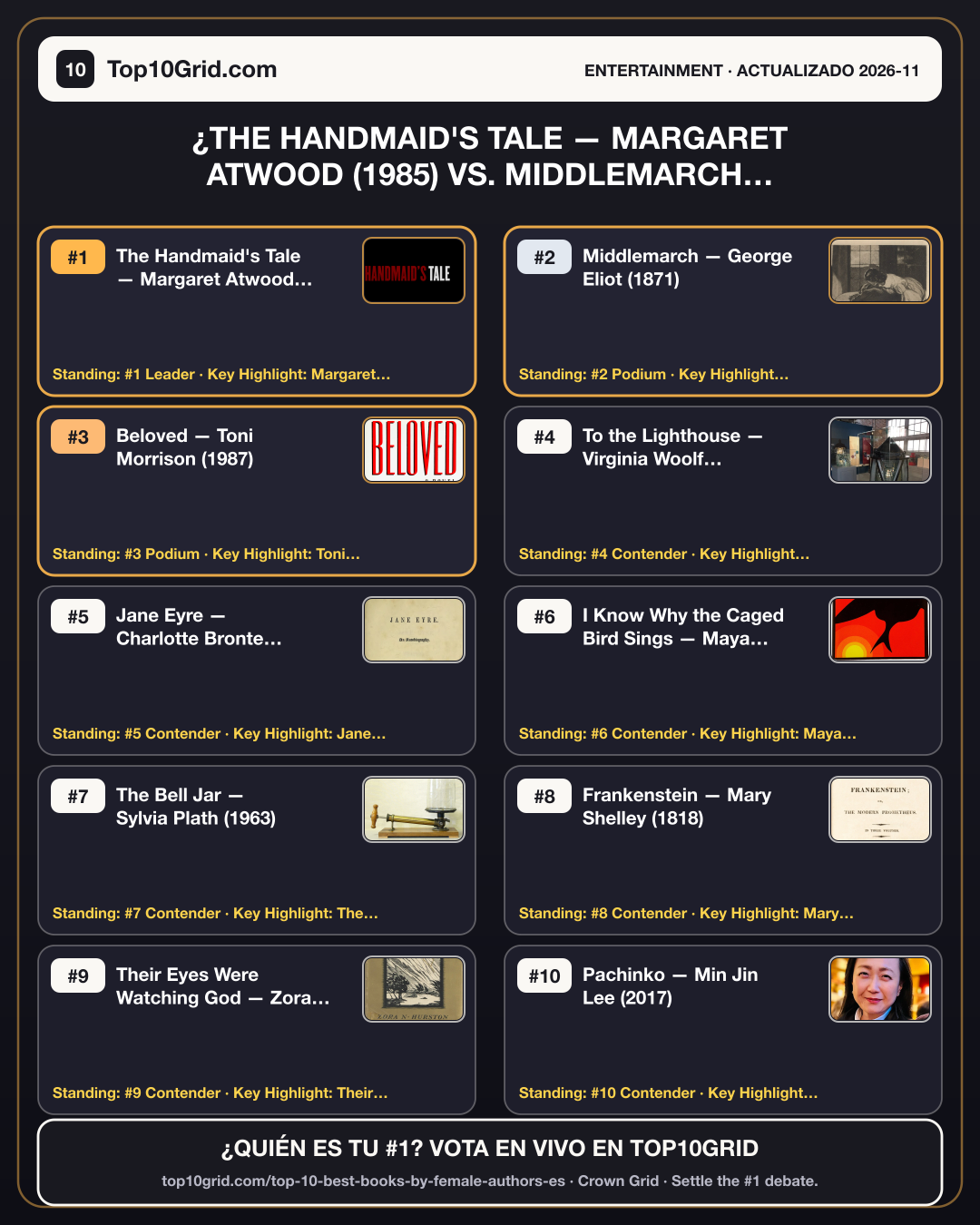
¿The Handmaid's Tale — Margaret Atwood (1985) vs. Middlemarch — George Eliot (1871)? Top 10: Books by Female Authors
| Rank | Contender | Key Fact |
|---|---|---|
| #1 | The Handmaid's Tale — Margaret Atwood (1985) | Margaret Atwood's The Handmaid's Tale is the most prescient dystopian novel written by a woman |
| #2 | Middlemarch — George Eliot (1871) | Middlemarch, frequently hailed as the greatest novel in the English language by wide critical |
| #3 | Beloved — Toni Morrison (1987) | Toni Morrison's Beloved, winner of the Pulitzer Prize in 1988 and the Nobel Prize in 1993, stands |
| #4 | To the Lighthouse — Virginia Woolf (1927) | Virginia Woolf's To the Lighthouse reinvented the novel through stream-of-consciousness narration |
| #5 | Jane Eyre — Charlotte Bronte (1847) | Jane Eyre by Charlotte Brontë created the modern literary heroine by pioneering first-person |
| #6 | I Know Why the Caged Bird Sings — Maya Angelou (1969) | Maya Angelou's I Know Why the Caged Bird Sings stands as a landmark of American autobiography |
| #7 | The Bell Jar — Sylvia Plath (1963) | The Bell Jar by Sylvia Plath offers the definitive fictional account of depression, tracing a young |
| #8 | Frankenstein — Mary Shelley (1818) | Mary Shelley's Frankenstein, written at age 18, invented science fiction and the modern myth |
| #9 | Their Eyes Were Watching God — Zora Neale Hurston (1937) | Their Eyes Were Watching God stands as Zora Neale Hurston's crowning achievement, tracing Janie |
| #10 | Pachinko — Min Jin Lee (2017) | Pachinko is Min Jin Lee's most ambitious work, chronicling four generations of a Korean family |
Think something was robbed of a spot?
Nominate a missing contender — once approved, the community votes it up or down into the rankings.
Metodología del Ranking y Criterios de Evaluación
Esta clasificación evalúa a los diez principales contendientes de ¿The Handmaid's Tale — Margaret Atwood (1985) vs. Middlemarch — George Eliot (1871)? Top 10: Books by Female Authors —encabezados por The Handmaid's Tale — Margaret Atwood (1985) (#1) y Middlemarch — George Eliot (1871) (#2)— combinando métricas verificables, impacto sostenido y reputación comprobada. Los votos en directo de la comunidad actualizan continuamente el consenso frente al análisis editorial.
Image credits
- The Handmaid's Tale — Margaret Atwood (1985): Official Literary Edition (294D7002)
- Middlemarch — George Eliot (1871): Official Literary Edition (B63A84D0)
- Beloved — Toni Morrison (1987): Official Literary Edition (BB7887C1)
- To the Lighthouse — Virginia Woolf (1927): To the Lighthouse / Wikipedia
- Jane Eyre — Charlotte Bronte (1847): Official Literary Edition (F3D3EDAF)
- I Know Why the Caged Bird Sings — Maya Angelou (1969): Official Literary Edition (F8374665)
- The Bell Jar — Sylvia Plath (1963): Official Literary Edition (F2D8FE73)
- Frankenstein — Mary Shelley (1818): Official Literary Edition (387DE13C)
- Their Eyes Were Watching God — Zora Neale Hurston (1937): Official Literary Edition (54DF8E54)
- Pachinko — Min Jin Lee (2017): OpenLibrary (OL17762217W)
Visual Ranking Infographic
Verified Infographic · Updated 2026-11-24¿The Handmaid's Tale — Margaret Atwood (1985) vs. Middlemarch — George Eliot (1871)? Top 10: Books by Female Authors — Visual Infographic
Interactive Ranking Mind Map
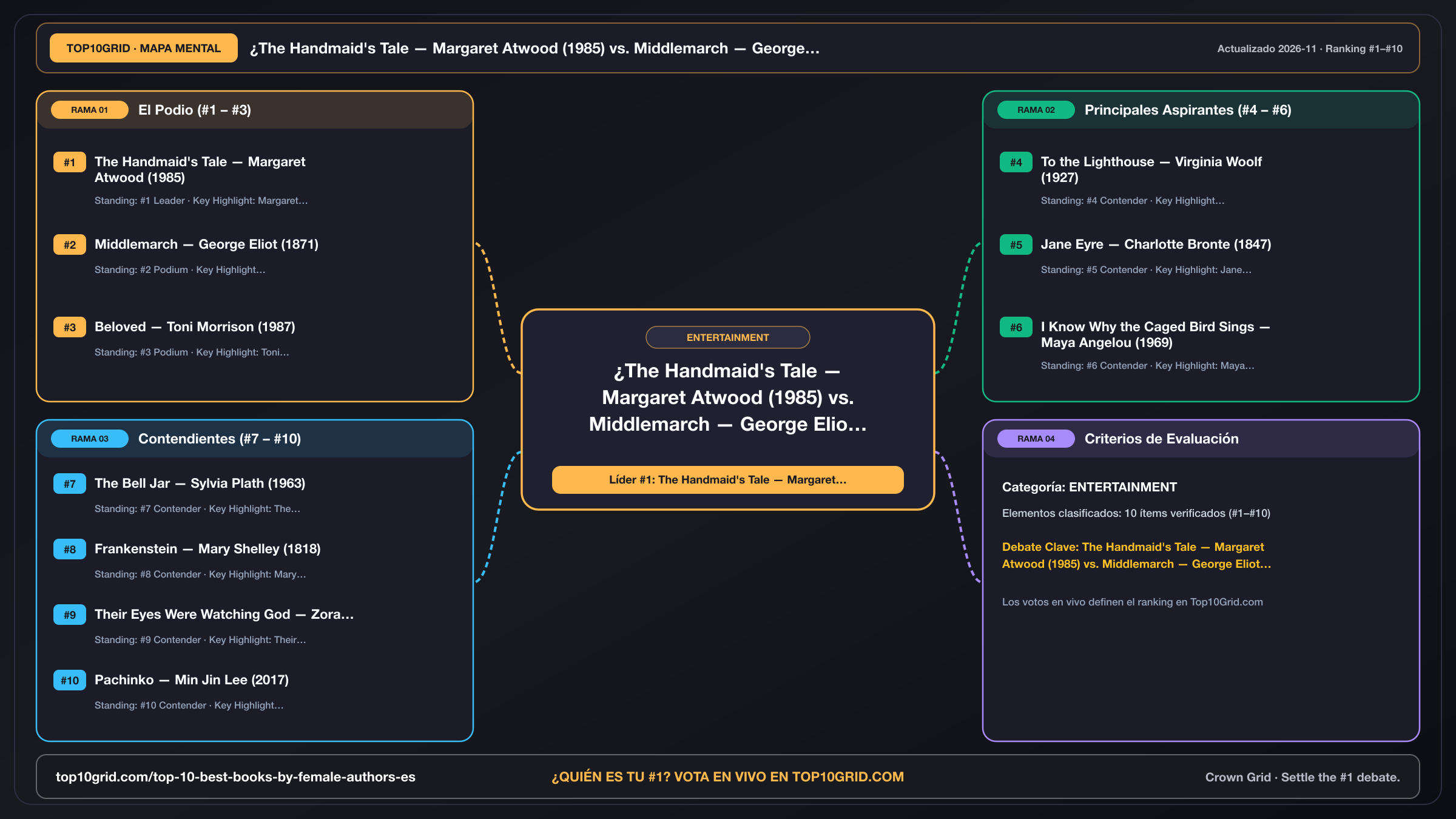
Core Identity: Foundational methodology, primary institutional citations, and scope rules behind ¿The Handmaid's Tale — Margaret Atwood (1985) vs. Middlemarch — George Eliot (1871)? Top 10: Books by Female Authors.
Inspect Primary Sources ↓¿The Handmaid's Tale — Margaret Atwood (1985) vs. Middlemarch — George Eliot (1871)? Top 10: Books by Female Authors — Ranking Mind Map
Rank it your way
Fork and customize this ranking with your own picks, or open the interactive play hub for Rank Scramble, Time Capsule predictions, and live game modes enabled for this list.