
yaabot.com
Cast the first vote in 1 tap — pick #1 Claude Code (Anthropic) or #2 Cursor to reveal the live split:
Benchmarked on multi-file architecture refactors, terminal test loops, Next-Edit tab speed, MCP integration, and real monthly token bills.
yaabot.com

Starting order. Vote up or down to reorder this list.
Think something was robbed of a spot?
Nominate a missing contender — once approved, the community votes it up or down into the rankings.

Claude Code works directly inside your terminal, VS Code, or JetBrains without forcing an editor migration: point it at a failing test or cross-package feature and it inspects git history, edits files, runs linters, and verifies builds end-to-end.
Pros
Cons

Cursor remains the gold standard for interactive IDE flow: its custom Tab model predicts your next multi-line edit across files before you finish typing, while Composer lets you swap between Claude, Gemini, and GPT per task with zero-retention Privacy Mode.
Pros
Cons

GitHub Copilot closed much of the capability gap by adding Agent Mode, MCP support, multi-model selection (Claude, Gemini, OpenAI), and async GitHub PR review/coding agents—while keeping entry paid plans at $10–$15/mo and supporting JetBrains and Xcode natively.
Pros
Cons
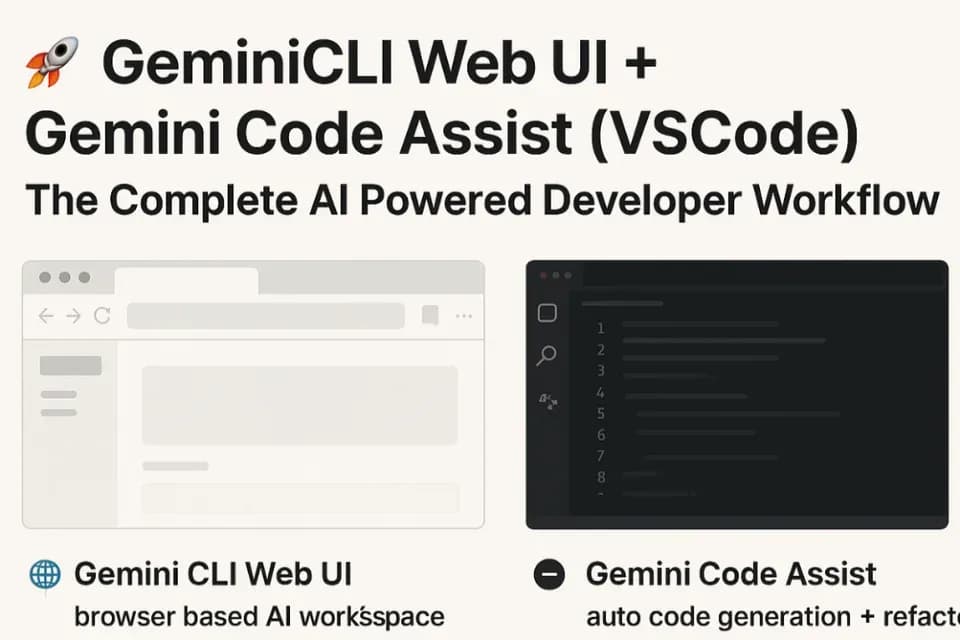
Google gives individual builders an extraordinary deal: up to 180,000 monthly code completions in VS Code/JetBrains plus the open-source Apache-2.0 Gemini CLI with massive 1M-token context, Google Search grounding, and native MCP server extensibility.
Pros
Cons
After Cognition rebranded Windsurf into Devin Desktop in June 2026, developers kept Cascade's clean automatic context retrieval and live DOM-to-code browser preview while gaining seamless handoffs to parallel cloud Devin sessions.
Pros
Cons

Cline gives developers total transparency inside standard VS Code: separate Plan and Act modes let you inspect architectural plans with a reasoning model, execute edits with a fast coding model, launch headless Chrome to inspect console errors, and pay raw API rates.
Pros
Cons

Lovable goes beyond static UI mockups: describe a SaaS workflow and it scaffolds a clean React + Vite/Tailwind frontend, provisions Supabase Postgres tables and row-level security, wires Stripe checkout, and syncs clean commits two-way with GitHub.
Pros
Cons
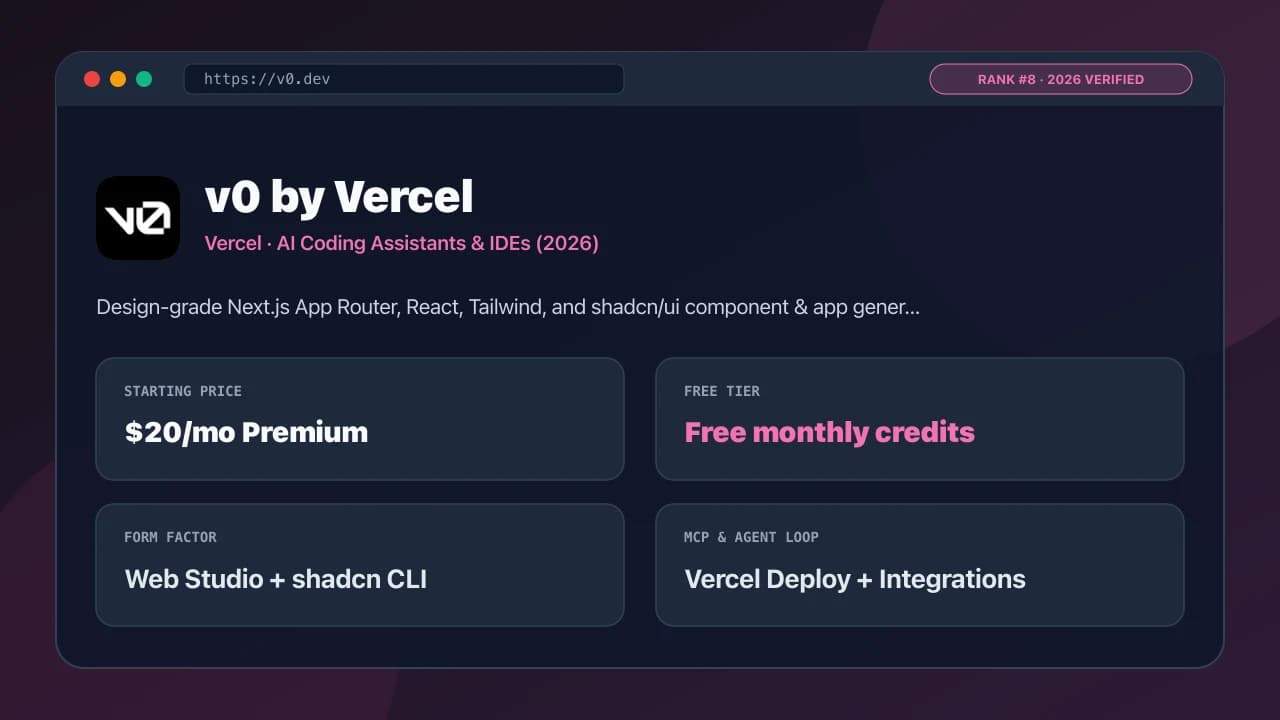
Built by the creators of Next.js and shadcn/ui, v0 generates accessible, tasteful React interfaces that drop straight into production repositories via a single `npx shadcn add` command—avoiding generic purple-gradient AI slop.
Pros
Cons
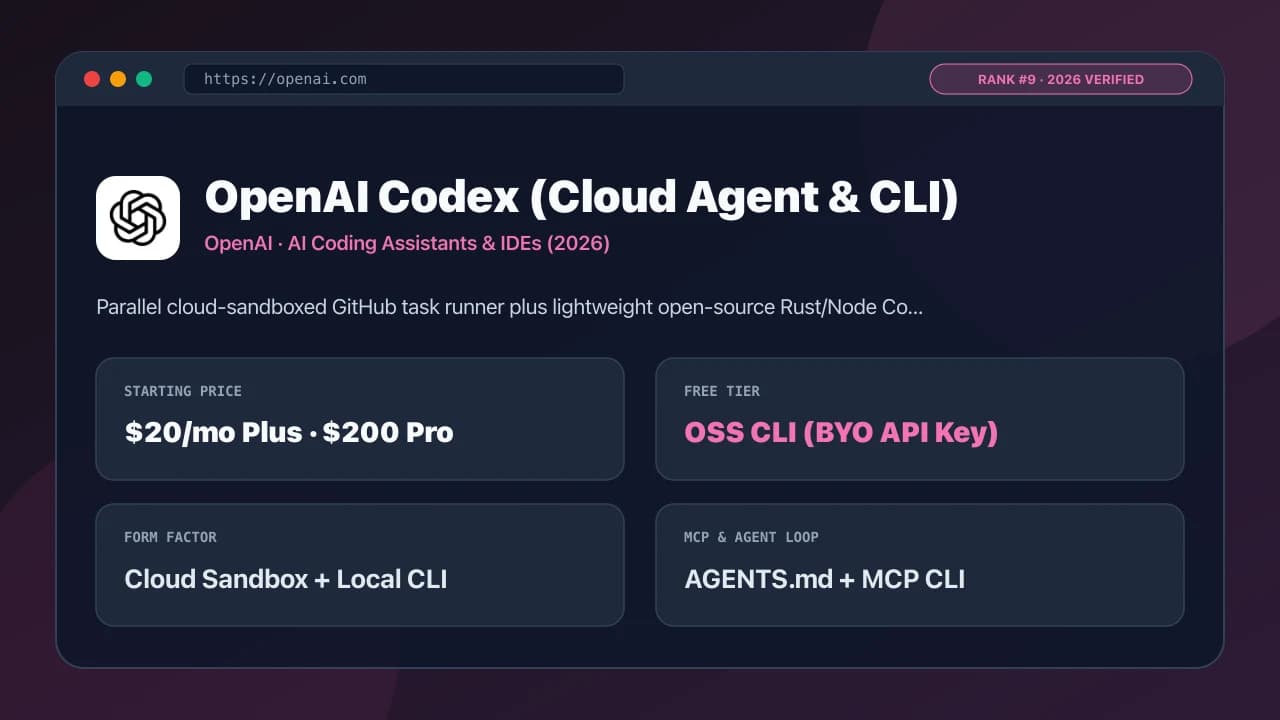
OpenAI pairs an open-source local Codex CLI with an isolated cloud container agent inside ChatGPT: assign five bugfixes, unit-test backfills, or dependency upgrades simultaneously from your browser or phone and review the resulting GitHub PRs.
Pros
Cons
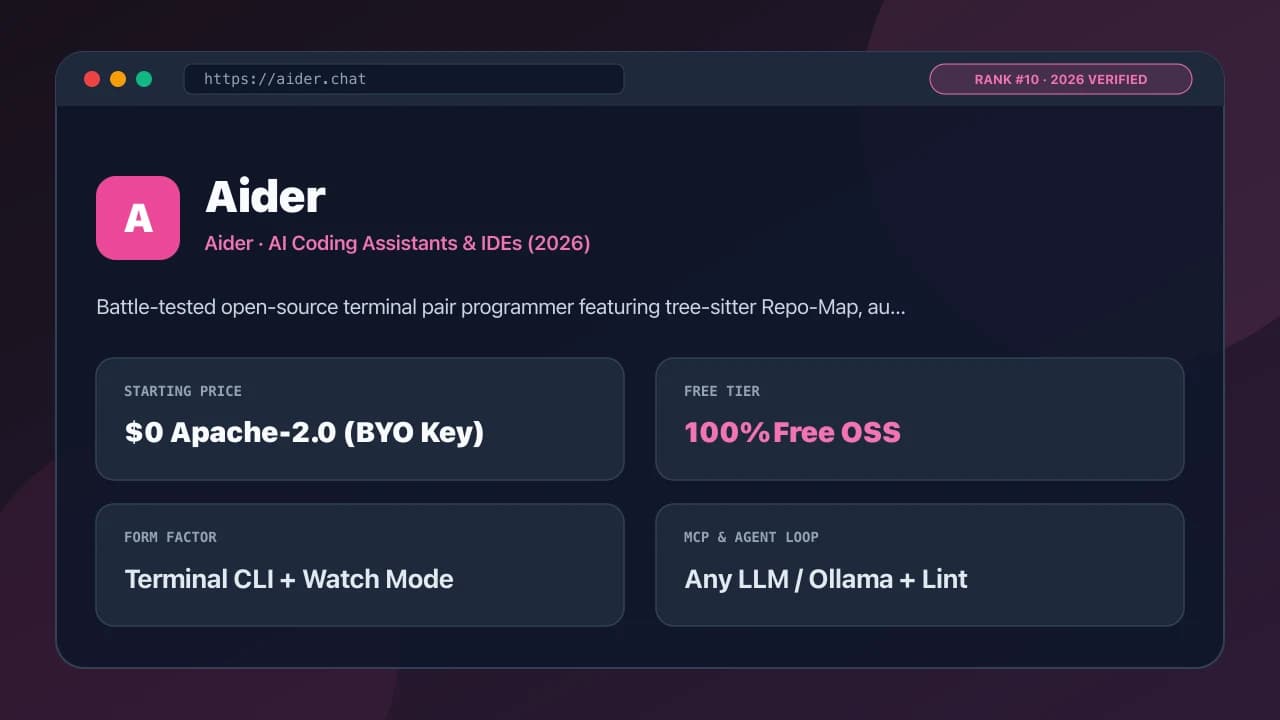
Aider pioneered terminal pair programming with its tree-sitter AST Repo-Map, giving LLMs a surgical map of giant repositories while spending minimal tokens. Every edit creates a descriptive git commit automatically so `git undo` is always one keystroke away.
Pros
Cons
Have a list idea?
Start your own list and get help drafting entries with AI. A free account is required.
Create a list with AI →Debating whether #1 Claude Code (Anthropic) holds the top spot against #2 Cursor.
The published order is the starting point; item votes can help reshape it.
Rank Scramble: Can You Order Today's Top 10?
Drag ten shuffled picks into their live community order in under 60 seconds.
Rank it your way
Remix this list into your own ranking, or head to the play hub for every game mode and community breakdown — blind mode, challenges, tier lists, and more.

#1 VS Code · #2 Blender · #3 Linux (Ubuntu)
Explore this ranking →
#1 First Solar · #2 NextEra Energy · #3 Enphase Energy
Explore this ranking →
#1 Actively exploited sandbox RCE in all Chromium versions · #2 Discovery of a new OpenAI agent message board · #3 Formalizing Fermat's Last Theorem
Explore this ranking →