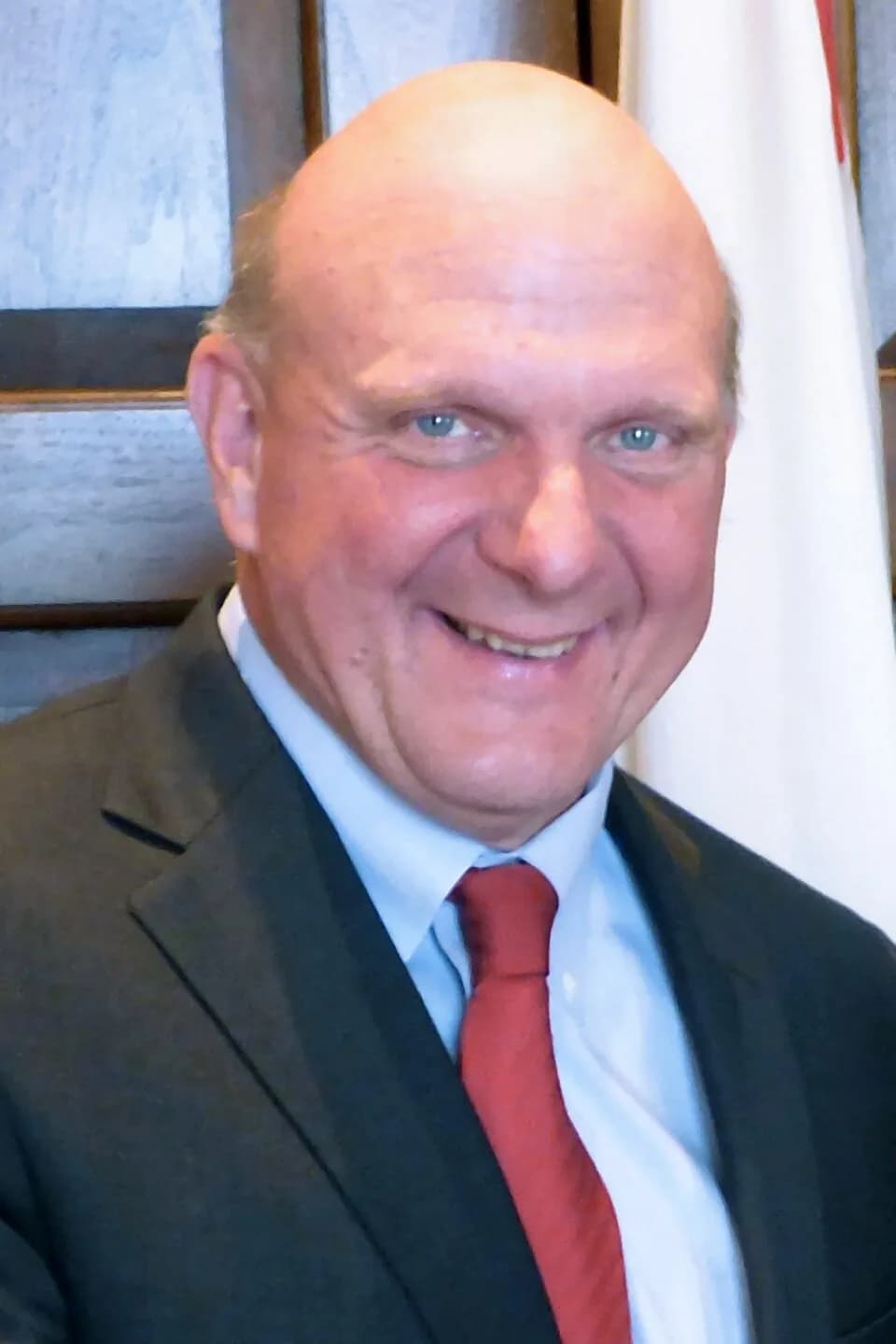
Steve Ballmer
Business Leader1 list appearance
Over a 34-year corporate career, Ballmer built Microsoft's foundational business infrastructure—establishing the operating-system licensing model, leading sales, systems, and support, and steering the company through the enterprise software boom, the dot-com crash, and the successful launches of Windows XP, Windows 7, Microsoft Office, SQL Server, and Xbox. He succeeded Gates as CEO in January 2000, navigating antitrust battles and tripling Microsoft's annual revenue to nearly $78 billion before announcing his retirement in August 2013 (succeeded by Satya Nadella in February 2014). Upon stepping down, Ballmer retained his massive Microsoft shareholdings (roughly 4% of the company), making him Microsoft's largest individual shareholder. In August 2014, he completed a record-breaking $2 billion acquisition of the NBA's Los Angeles Clippers. As one of the world's richest sports owners and centibillionaires, Ballmer divides his post-Microsoft life between sports management, civic data transparency via USAFacts, and aggressive multi-billion-dollar philanthropy focused on economic mobility.
1-Tap Primary Ranking Ballot
Overview#10 Full List
Does Steve Ballmer deserve the #10 spot on “Top 10 Most Powerful Billionaires in the World 2025”?
#10 Steve Ballmer?
Verified Entity DossierRanked #10 in Top 10 Most Powerful Billionaires in the World 2025
Community Weigh-In & Debate
Should Steve Ballmer rank higher than #10 in Most Powerful Billionaires in the World 2025?
Ranked #10 on "Top 10 Most Powerful Billionaires in the World 2025". Cast your vote to back or challenge this spot.
Be the first to vote on this ranking.
Structured Facts & Specifications
Verified highlightsParents
Morris Henry Ballmer (manager at Ford Motor Company) and Beatrice Dworkin
Education
Detroit Country Day School; Harvard University (AB in Applied Mathematics and Economics, magna cum laude, 1977); Stanford Graduate School of Business (attended 1 year, dropped out)
Full Name
Steven Anthony Ballmer
Citizenship
United States
Date Of Birth
1956-03-24
Known Children
3 sons: Sam, Aaron, and Peter Ballmer
Marital Status
Married to Connie Snyder (since 1990)
Place Of Birth
Detroit, Michigan, United States
Sports Ownership
Owner, Los Angeles Clippers (NBA) (acquired August 2014 for $2.0 billion via Murphy's Bowl LLC)
Net Worth (draft)
~$126.6B–$161.6B USD (Forbes Real-Time $161.6B as of Nov 11–12, 2026; June 2026 Forbes baseline $126.6B)
Primary Residence
Hunts Point, Washington, United States
Global Wealth Rank
#9 to #15 worldwide (Forbes Real-Time #9 as of Nov 11–12, 2026; #15 on March 2026 annual Forbes list)