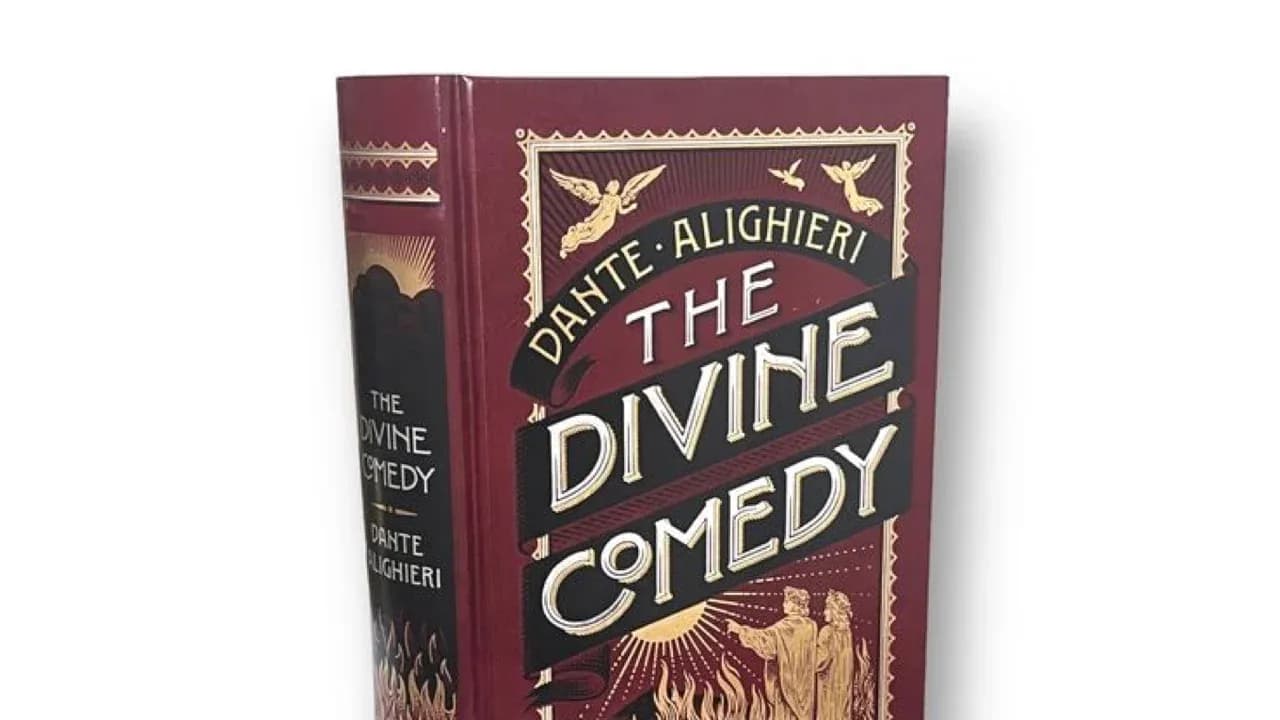
The Divine Comedy
Book0 list appearances
Primary Identity: The Divine Comedy (La Divina Commedia, originally titled Comedìa by Dante) is a monumental medieval narrative poem tracing Dante's allegorical journey through Hell (Inferno), Purgatory (Purgatorio), and Heaven (Paradiso), guided by Virgil, Beatrice, and Bernard of Clairvaux Core Thesis: Combining medieval Christian theology, classical philosophy, Ptolemaic astronomy, and fierce Florentine political commentary in vernacular Tuscan verse, The Divine Comedy codified the Western literary imagination of the afterlife and elevated Italian to a premier literary language Trinitarian Mathematical Architecture: Comprises 3 cantiche of 33 cantos each plus 1 introductory canto in Inferno (totaling 100 cantos); its terza rima tercets follow an interlocking ABA BCB CDC rhyme scheme with 11-syllable lines (33 syllables per tercet) Nine-Plus-One Cosmology & Contrapasso: Each realm follows a 9+1 symmetry (nine circles of Hell + Lucifer; nine rings of Mount Purgatory + Eden; nine celestial spheres + the Empyrean), while punishments operate by contrapasso (poetic justice mirroring each sin)
Verified Entity Dossier
Community Weigh-In & Debate
Should The Divine Comedy rank in the Top 10 for Book?
Cast your vote to weigh in on The Divine Comedy.
Be the first to vote on this ranking.
Structured Facts & Specifications
Verified highlightsOriginal Language
Tuscan Italian (instrumental in forming standard Italian)
the-epoch-institute.orgOfficial the-epoch-institute.org ↗
First Printed Edition
1472 in Foligno by Johann Numeister and Evangelista Angelini da Trevi (300 copies printed; 14 survive)
the-epoch-institute.orgOfficial the-epoch-institute.org ↗
Form Scale
14,233 hendecasyllabic lines in terza rima across 100 cantos divided into 3 cantiche (Inferno, Purgatorio, Paradiso)
the-epoch-institute.orgOfficial the-epoch-institute.org ↗
Author
Dante Alighieri (1265–1321), composed during his exile from Florence circa 1308–1321
britannica.comOfficial britannica.com ↗
Official Archival Url
britannica.comOfficial britannica.com ↗
Category
Epic Narrative Poem
Form & Scale
14,233 hendecasyllabic lines in terza rima across 100 cantos divided into 3 cantiche (Inferno, Purgatorio, Paradiso)
Official Website
Appears in 0 lists
No published list appearances yet.