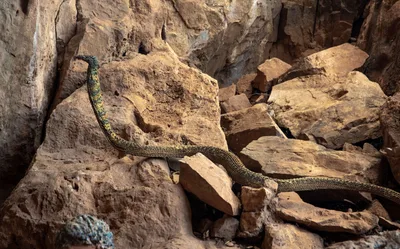
Yurlunggur camfieldensis
Named in 1992 by Australian paleontologist John D. Scanlon, Yurlunggur camfieldensis was discovered in the Camfield Beds at Bullock Creek in the Northern Territory of Australia. Dating to approximately 15 Ma during the Middle Miocene epoch, Yurlunggur takes its generic name from the Rainbow Serpent of Australian Aboriginal mythology. The fossil material includes exceptionally preserved partial skulls and extensive vertebral series. Mature specimens attained body lengths between 4.5 m and 6.0 m, with an estimated adult mass of 200 kg. Detailed cranial scans revealed an archaic braincase morphology that retained primitive squamate sensory features, such as enclosed inner ear canals adapted for low-frequency ground vibrations. Yurlunggur lived in tropical riparian riverbeds and lacustrine systems, hunting fish, frogs, turtles, and juvenile diprotodontids. Its well-preserved cranium provided vital insights into the evolutionary anatomy of basal snakes, demonstrating how madtsoiids maintained ecological dominance across Australasia throughout the Neogene.