Wonambi naracoortensis
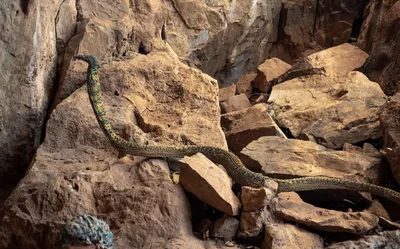
Wonambi naracoortensis was discovered in 1976 by Meredith J. Smith within the fossil-rich deposits of Naracoorte Caves in South Australia. Living from the Pliocene through the Late Pleistocene until approximately 0.05 Ma, Wonambi represents the last known surviving genus of the ancient Madtsoiidae lineage. Skeletal reconstructions reveal a heavily built constrictor measuring between 5.0 m and 6.0 m in total length, with an estimated mass of 250 kg. Unlike modern pythons, Wonambi possessed a small, non-kinetic skull with firmly fused braincase elements, indicating it could not swallow prey larger than its head. Instead, it preyed upon small to medium-sized Australian marsupials, including juvenile diprotodonts, kangaroos, and wallabies, which it ambushed at natural waterholes. Wonambi coexisted with indigenous Australian megafauna and early human populations for thousands of years. Its eventual extinction around 50,000 years ago aligned with widespread megafaunal collapses triggered by aridification and human ecosystem modifications.