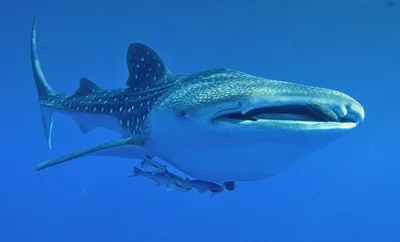
Whale Shark (Rhincodon typus)
Inhabiting tropical and warm-temperate pelagic waters across the globe, Rhincodon typus is the sole extant member of the family Rhincodontidae and the largest non-cetacean animal alive today. Verified scientific surveys record maximum body masses of 21.5 tonnes (47,000 lb) and total lengths of 18.8 m (61.7 ft), with asymptotic growth models predicting theoretical lengths up to 21.9 m. Mature adult females typically measure 12.1 to 14.5 m (40 to 48 ft) and weigh between 9 and 15 tonnes, while males average 8 to 9 m. As an active filter feeder, the whale shark processes over 6,000 liters of seawater per hour through 20 specialized spongy gill pads, consuming plankton, krill, fish eggs, and small schooling teleosts like sardines. Possessing skin up to 15 cm thick covered with protective dermal denticles, whale sharks migrate thousands of kilometers between seasonal feeding aggregations at Ningaloo Reef, the Yucatan Peninsula, and the Arabian Sea.